

Gold Record High Signals Shift as Bitcoin Falls Behind
Gold Record High prices have drawn global attention as gold surged past the $5,000 mark while Bitcoin moved in the opposite direction. The sharp contrast between these two assets highlights a shift in investor behavior as economic uncertainty and geopolitical tensions push markets toward traditional safe havens rather than high-risk alternatives.
In recent weeks, gold reached an all-time high, reflecting strong demand from investors seeking stability. At the same time, Bitcoin failed to keep pace, trading well below its previous peak. This divergence suggests that, despite comparisons between Bitcoin and gold, markets still treat them very differently during periods of stress.
Gold Record High Driven by Global Uncertainty
Gold Record High levels were achieved amid growing concerns about the global economy. Trade tensions between major economies, ongoing geopolitical conflicts, and fears surrounding government stability all contributed to rising demand for gold. These factors created an environment where investors favored assets with a long history of preserving value.
Uncertainty surrounding fiscal policy also played a major role. Discussions around potential government shutdowns and rising public debt increased anxiety in financial markets. When confidence in political and economic leadership weakens, gold often benefits as a neutral and tangible asset.
Central banks and institutional investors further supported gold’s rally. Many have continued increasing gold reserves as a hedge against currency volatility and inflation risks. This steady institutional demand added momentum to gold’s climb toward record levels.
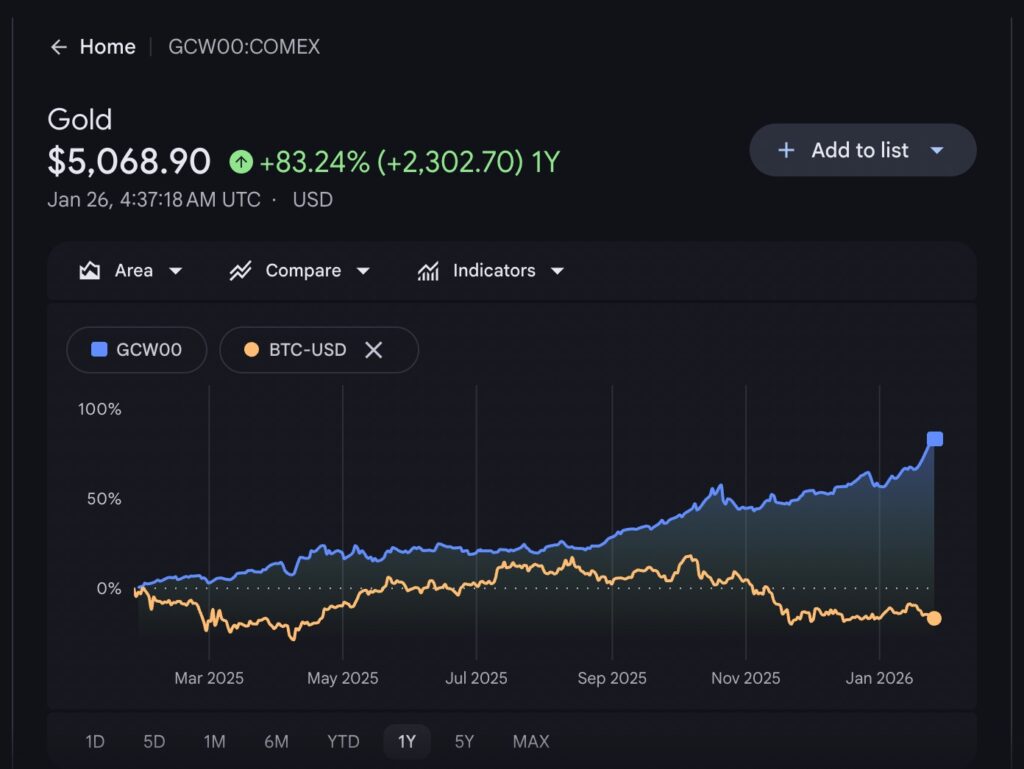
Viewed over a full year, the chart shows that gold’s move higher was not driven by a single spike but by steady persistence. Periods of consolidation were repeatedly followed by renewed buying, suggesting conviction rather than short-term speculation. What stands out is how little urgency there appears to be on pullbacks, with prices stabilizing instead of sharply reversing. That kind of behavior often reflects investors treating gold less as a trade and more as a place to park capital while waiting for clearer signals elsewhere.
Bitcoin Lags as Risk Appetite Declines
While gold surged, Bitcoin struggled to maintain upward momentum. The cryptocurrency dropped significantly from its previous highs, reflecting a broader decline in investor appetite for risk. As uncertainty increased, capital moved away from volatile assets and into safer alternatives.
Bitcoin has often been described as digital gold, but its recent performance tells a different story. Unlike gold, Bitcoin remains highly sensitive to market sentiment. When investors become cautious, cryptocurrencies tend to experience sharper pullbacks than traditional assets.
The decline in Bitcoin also mirrored weakness across the wider crypto market. Reduced trading activity and lower speculative interest contributed to slower price action. This reinforced the perception that Bitcoin behaves more like a risk asset than a safe haven during turbulent periods.
Gold Record High Highlights Asset Divergence
The Gold Record High emphasizes how differently markets treat gold and Bitcoin in times of uncertainty. Gold’s appeal lies in its long-standing reputation as a store of value, while Bitcoin’s role is still evolving. When fear dominates financial markets, investors often rely on what they know best.
Gold has centuries of history as a hedge against inflation, political instability, and currency devaluation. Bitcoin, by contrast, is still relatively young and subject to rapid price swings. This difference becomes especially visible when economic confidence weakens.
The divergence also reflects differences in investor profiles. Conservative investors and institutions tend to favor gold during uncertain times, while Bitcoin attracts those willing to tolerate higher risk. As caution spreads, funds typically rotate toward stability rather than growth.
Market Psychology Behind the Shift
Investor psychology plays a crucial role in explaining the recent divergence. Fear and uncertainty encourage defensive positioning, which benefits assets like gold. When markets expect slower growth or potential crises, preserving capital becomes a higher priority than chasing returns.
Bitcoin’s volatility can amplify losses during downturns, making it less attractive when risk tolerance drops. Even investors who believe in Bitcoin’s long-term potential may reduce exposure temporarily in favor of safer holdings.
This behavior does not necessarily signal a loss of confidence in Bitcoin as a technology or asset class. Instead, it reflects short-term reactions to macroeconomic stress and shifting priorities within portfolios.
What the Gold Record High Means for Investors
The Gold Record High serves as a signal that markets are prioritizing safety. Investors are responding to uncertainty by reallocating funds toward assets with proven resilience. This trend suggests caution rather than optimism dominates current market sentiment.
For Bitcoin, the underperformance highlights the challenges of being positioned as both an alternative investment and a safe haven. While Bitcoin may perform well during periods of expansion and liquidity growth, it can struggle when fear takes hold.
Investors are closely watching whether Bitcoin can stabilize or regain momentum if economic conditions improve. A reduction in geopolitical tension or clearer fiscal policy could help restore confidence in risk assets.
Looking Ahead
The contrast between gold and Bitcoin may continue as long as uncertainty remains high. Gold’s performance reflects ongoing demand for security, while Bitcoin’s struggles show that digital assets are still influenced heavily by broader market conditions.
Future price movements will likely depend on developments in global politics, economic policy, and investor sentiment. If stability returns, Bitcoin could benefit from renewed risk appetite. Until then, gold’s dominance highlights its enduring role in financial markets.
Editor’s View: Why Investors Still Reach for Gold First
What this divergence really shows is habit as much as strategy. In moments of stress, investors tend to fall back on assets they have already seen work in past crises, even if newer alternatives promise similar protection. Gold benefits from familiarity, institutional acceptance, and decades of collective memory, while Bitcoin still requires a leap of conviction at the exact moment when conviction is usually in short supply. Charts show performance, but behavior often explains why capital moves before performance confirms it.
Conclusion
The gold record high above $5,000 marks a significant moment for global markets. It underscores how investors respond to uncertainty by favoring traditional safe havens over newer, more volatile assets. Bitcoin’s divergence during this period highlights the difference between perceived and actual behavior under stress.
As markets continue to navigate economic and political challenges, the relationship between gold and Bitcoin will remain a key indicator of investor confidence. For now, gold’s rise reflects caution, while Bitcoin’s pullback reveals the limits of its safe-haven narrative during times of widespread uncertainty.
Disclaimer: This content is for informational purposes only and does not constitute financial advice.
Keep yourself updated with the latest crypto news with FYI Gazette
Read more about Memecoins with FYI Gazette
Keep yourself updated with the latest Altcoin News with FYI Gazette
 Bitcoin
  Ethereum
  Tether
  BNB
BNB  XRP
XRP  Solana
  TRON
TRON  Dogecoin
  Litecoin
  Pepe
Pepe