

Bitcoin Fire Sale Shows Deep Market Discount
Bitcoin Fire Sale conditions are now clearly visible across the crypto market as Bitcoin trades at deeply discounted levels amid heavy capital outflows and intense bearish sentiment. Recent market data shows that investors are pulling funds at a pace rarely seen before, pushing key valuation metrics to historic lows. This combination of falling prices, negative capital flows, and extreme fear has led analysts to describe the current environment as a true fire sale for Bitcoin.
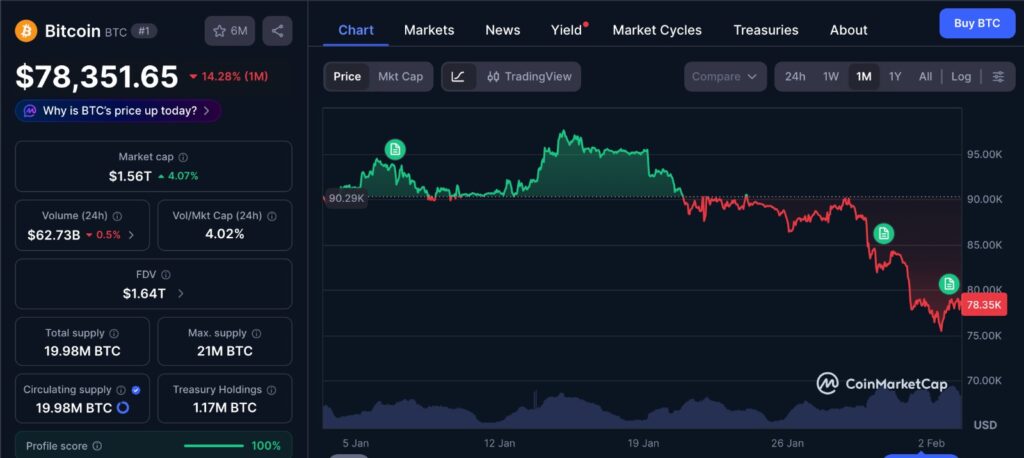
Viewed over the past month, Bitcoin’s price action shows how quickly sentiment has shifted from expectation to caution. The chart reflects a steady loss of momentum rather than a single shock, with lower highs and weak recovery attempts becoming more frequent. This type of structure often signals uncertainty rather than panic, as buyers hesitate to step in with conviction. It also highlights how selling pressure can persist even without dramatic news, driven more by positioning and risk management than by fundamentals alone.
Bitcoin Fire Sale and Market Capitulation
Bitcoin’s price has fallen sharply from its all time high, dropping roughly forty percent to levels near seventy four thousand dollars. This decline marks one of the steepest drawdowns of the current cycle and has triggered widespread concern among both retail and institutional investors. The sell off has not been limited to spot markets but has also affected investment products tied directly to Bitcoin.
One of the strongest signals confirming Bitcoin Fire Sale conditions is the scale of capital exiting Bitcoin exchange traded products. Global Bitcoin ETPs have recorded more than one billion dollars in net outflows over a short period. U.S. spot Bitcoin ETFs accounted for the majority of these withdrawals, showing that large investors are stepping back from exposure.
These outflows suggest a capitulation phase where investors choose to exit positions rather than endure further downside. Historically, such moments often coincide with periods of extreme pessimism and compressed valuations.
Bitcoin Fire Sale Reflected in Valuation Metrics
Record Low MVRV Signals Undervaluation
A key indicator supporting the Bitcoin Fire Sale narrative is the two year rolling Market Value to Realized Value z score. This metric compares Bitcoin’s market price to the average cost basis of coins on the network. It has now dropped to its lowest level on record, signaling that Bitcoin is trading far below its historical norm.
Such readings imply that most market participants are holding Bitcoin at a loss relative to recent years. This level of undervaluation has only appeared during major market stress events in the past, reinforcing the idea that prices are deeply discounted.
Sentiment Indicators Show Extreme Fear
Broader sentiment data also paints a bleak picture. The Cryptoasset Sentiment Index has fallen into deeply negative territory, with only a small number of indicators remaining above short term trend levels. This shows that bearish expectations dominate the market, and confidence has eroded significantly.
Extreme fear often causes investors to act emotionally, accelerating sell pressure. At the same time, these conditions have historically preceded periods of stabilization or short term recovery.
Technical Signals During the Bitcoin Fire Sale
Oversold Conditions Increase Bounce Potential
From a technical perspective, Bitcoin’s daily relative strength index has dropped into the low twenties. This RSI range is considered heavily oversold and has previously been associated with short term rebounds of around ten percent.
While oversold signals alone do not guarantee a recovery, they do suggest that selling pressure may be nearing exhaustion. Traders often watch these levels closely for signs of relief rallies, especially during capitulation phases.
Spot Demand Versus Leverage
Another important development during the Bitcoin Fire Sale is the shift in market structure. Spot cumulative volume data has turned positive, meaning buyers are stepping in at lower prices on major exchanges. At the same time, derivative market indicators such as funding rates and open interest suggest that the recent move is driven more by spot demand than by excessive leverage.
This distinction matters because spot driven buying tends to be more stable than leverage fueled speculation. It reduces the risk of sudden liquidation cascades that can push prices sharply lower in short timeframes.
Liquidations and Market Pressure
Despite signs of emerging spot demand, the market has already experienced significant liquidations. More than one point eight billion dollars in long positions have been wiped out as prices fell. This wave of forced selling added to downside momentum and intensified the fire sale environment.
At the same time, billions of dollars in short positions remain open near key resistance levels. If prices were to rebound even modestly, these positions could come under pressure, potentially contributing to a short term bounce.
Institutional Behavior and Capital Flows
Institutional investors play a major role in shaping Bitcoin price trends, especially through ETF and ETP flows. During the current Bitcoin Fire Sale, large funds have reduced exposure, adding to negative sentiment and reinforcing the downtrend.
Major Bitcoin investment vehicles have reported notable outflows, confirming that the selling pressure is not limited to smaller traders. When institutions retreat, liquidity conditions often worsen, making price declines sharper and more volatile.
What the Bitcoin Fire Sale Could Mean Next
Short Term Outlook
In the near term, Bitcoin remains vulnerable to further volatility. However, the combination of oversold technical indicators, improving spot demand, and extreme pessimism suggests that a relief rally is possible. Historically, similar setups have produced short term rebounds even within broader bearish trends.
Such a move would not necessarily mark the end of the downturn but could provide temporary stabilization and reduce immediate selling pressure.
Longer Term Perspective
From a longer term viewpoint, Bitcoin Fire Sale conditions may attract investors with a high risk tolerance and extended time horizons. Deep discounts relative to historical valuation metrics have previously offered accumulation opportunities, although timing remains uncertain.
Future price direction will depend on broader market confidence, macroeconomic conditions, and whether capital flows eventually reverse. Until sentiment improves, Bitcoin is likely to remain in a fragile state.
Editor’s View: Why Capitulation Rarely Looks Rational
Periods like this rarely feel orderly from inside the market. When prices fall alongside heavy outflows, most decisions are not driven by valuation models but by fatigue, risk limits, and the need to reduce exposure quickly. Investors are often reacting to pressure elsewhere in their portfolios rather than making a deliberate judgment on Bitcoin itself. This is why capitulation phases tend to overshoot on the downside, even when long term metrics suggest deep discounts. Charts can show where stress appears, but they cannot capture the psychological relief many participants seek simply by exiting.
Conclusion
Bitcoin Fire Sale conditions reflect one of the most extreme periods of fear and undervaluation in the current market cycle. Heavy capital outflows, record low valuation metrics, and widespread pessimism define the current landscape. While risks remain elevated, technical signals and spot market behavior suggest the possibility of a short term rebound. Whether this fire sale evolves into a sustained recovery or deeper consolidation will depend on how investors respond to these historic levels.
Disclaimer: This content is for informational purposes only and does not constitute financial advice.
Keep yourself updated with the latest crypto news with FYI Gazette
Read more about Memecoins with FYI Gazette
Keep yourself updated with the latest Altcoin News with FYI Gazette
 Bitcoin
  Ethereum
  Tether
  BNB
BNB  XRP
XRP  Solana
  TRON
TRON  Dogecoin
  Litecoin
  Pepe
Pepe