
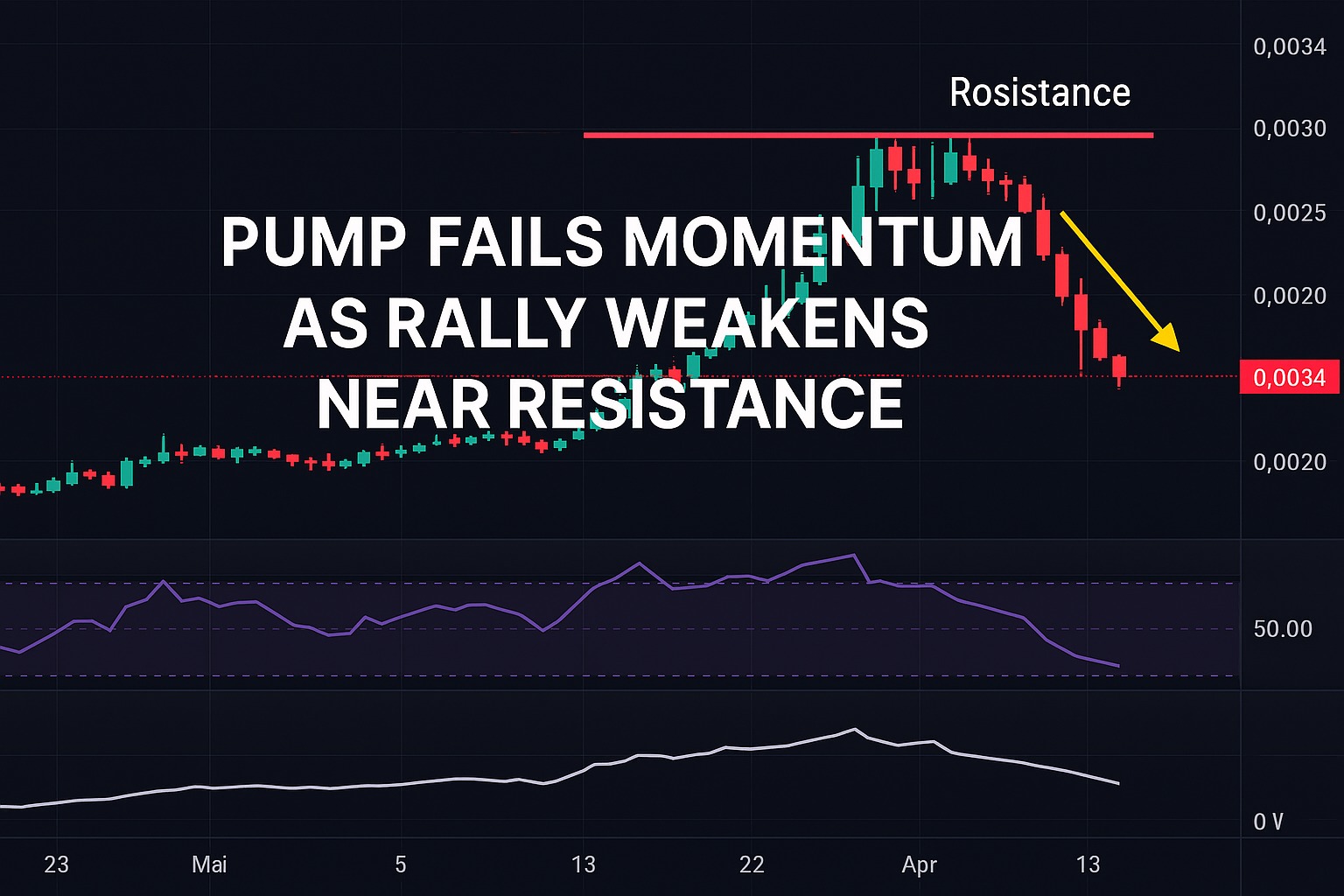
PUMP Fails Momentum as Rally Weakens Near Resistance
PUMP fails momentum as price action struggles to maintain strength near a key resistance level, signaling fading bullish pressure in the short term. After showing signs of recovery earlier in the month, the token was unable to push past the 0.0034 zone, a level that has repeatedly acted as a barrier for upward movement. This slowdown in momentum has raised concerns among traders, especially as broader market conditions remain uncertain and risk appetite continues to weaken.
The recent rally was supported by improved on chain performance and higher trading activity, which initially helped PUMP move away from its local lows. However, price behavior near resistance revealed hesitation from buyers, suggesting that demand was not strong enough to sustain a breakout. When momentum fades at such critical levels, it often increases the likelihood of consolidation or a pullback.
Understanding why PUMP fails momentum is essential for evaluating what may come next.
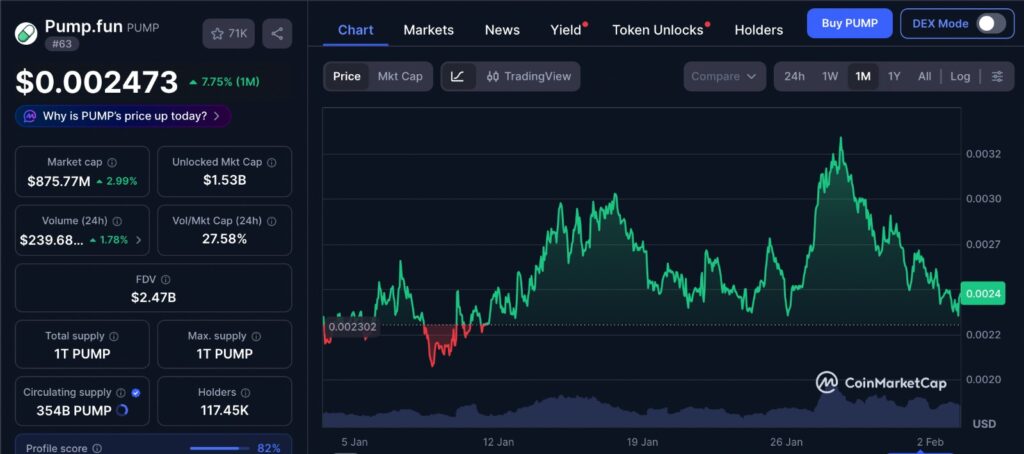
The one month price chart provides useful context for the recent loss of momentum, showing that PUMP’s advance was gradual rather than impulsive. Price spent extended time moving within a narrow range before testing resistance, suggesting accumulation but without strong follow through from new buyers. When momentum slowed near the upper end of the range, the lack of sharp volatility hinted at hesitation rather than aggressive selling. This type of price behavior often reflects a market waiting for confirmation, where participants observe closely but delay decisions until direction becomes clearer.
Why PUMP Fails Momentum at the 0.0034 Level
The 0.0034 level has proven to be a major obstacle for PUMP. In the past, this zone acted as support, but once price fell below it, the level flipped into resistance. When price revisits former support zones, sellers often step in, leading to rejection if buying pressure is insufficient.
In this case, PUMP approached the resistance with declining momentum rather than strong acceleration. This made it easier for sellers to defend the level. As a result, price stalled and failed to close decisively above resistance, confirming that bullish strength was weakening rather than expanding.
Market structure also played a role. While the token attempted higher lows earlier, the inability to form a higher high near resistance kept the structure neutral rather than bullish. Without a clear breakout, traders became cautious, reducing follow through buying.
Technical Indicators Confirm PUMP Fails Momentum
Technical indicators further support the idea that PUMP fails momentum rather than preparing for another rally. The Relative Strength Index moved below the neutral 50 level, indicating a shift away from bullish control. When RSI fails to hold above this midpoint during a rally attempt, it often suggests weakening demand.
On Balance Volume also showed signs of decline. This indicator tracks volume flow to determine whether buyers or sellers are dominant. A falling OBV while price remains near resistance suggests that volume is not supporting further upside. In simple terms, fewer buyers are stepping in at higher prices.
Momentum based indicators collectively point toward exhaustion rather than expansion. This does not automatically mean a strong bearish move will follow, but it does imply that upside potential is limited unless market conditions change.
How the Broader Market Affects PUMP Fails Momentum
Another important reason PUMP fails momentum lies outside its own chart. Broader market weakness has played a significant role in limiting upside. Bitcoin’s recent decline reduced confidence across the altcoin market, leading traders to scale back exposure to higher risk assets.
Altcoins often rely on strong sentiment and liquidity to sustain rallies. When the market leader struggles, capital tends to move defensively, making it harder for tokens like PUMP to attract sustained buying interest. Even positive internal metrics can be overshadowed by unfavorable market conditions.
This correlation explains why PUMP’s rally lost steam despite increased activity earlier. Without broader support from the market, breakouts become harder to maintain.
Key Support Levels to Watch Next
With PUMP fails momentum near resistance, attention shifts to support levels. The most important area lies near 0.00225, which previously acted as a base for the recent rally. This level represents a key demand zone where buyers have historically stepped in.
If price holds above this area, the token may enter a consolidation phase rather than an immediate downtrend. However, a decisive breakdown below this support could confirm a bearish shift in structure, increasing downside risk.
Support levels are crucial because they define where market participants reassess value. Losing them often triggers further selling, while holding them can restore confidence.
Can PUMP Recover Momentum Again
For momentum to return, PUMP would need to reclaim the 0.0034 level and hold above it on strong volume. This would signal renewed demand and invalidate the current bearish pressure. Without this confirmation, any bounce remains vulnerable to rejection.
A recovery is possible, but it depends on improved market sentiment and stronger participation from buyers. Until then, caution remains warranted.
What Traders Should Take Away
When PUMP fails momentum, it sends a message about market balance. Buyers are no longer in full control, and sellers are defending key levels effectively. For short term traders, this means tighter risk management and awareness of support breakdowns.
For longer term participants, fundamentals may still matter, but technical weakness can dominate price behavior in the near term. Understanding momentum shifts helps avoid chasing rallies that lack confirmation.
Editor’s View: When Momentum Quietly Dries Up
Markets often reveal more through hesitation than through sharp moves. The failure to sustain momentum near resistance usually reflects uncertainty rather than outright fear, where participants are unwilling to commit fresh capital without clearer signals from the broader market. In these phases, traders who bought earlier tend to reduce exposure into strength, while new buyers stay on the sidelines. This creates a slow fade in momentum that does not immediately appear bearish but gradually shifts control away from buyers. Such conditions often persist longer than expected because neither side has enough conviction to force resolution.
Final Thoughts on PUMP Fails Momentum
PUMP fails momentum near a critical resistance zone, highlighting the challenges of sustaining rallies in a weak market environment. Despite earlier signs of strength, technical indicators and price action now point toward exhaustion rather than continuation. As long as resistance holds and support remains under pressure, the risk of further downside cannot be ignored.
Monitoring key levels and broader market conditions will be essential for determining whether this pause turns into consolidation or a deeper correction.
Disclaimer: This content is for informational purposes only and does not constitute financial advice.
Keep yourself updated with the latest crypto news with FYI Gazette
Read more about Memecoins with FYI Gazette
Keep yourself updated with the latest Altcoin News with FYI Gazette
 Bitcoin
  Ethereum
  Tether
  BNB
BNB  XRP
XRP  Solana
  TRON
TRON  Dogecoin
  Litecoin
  Pepe
Pepe