
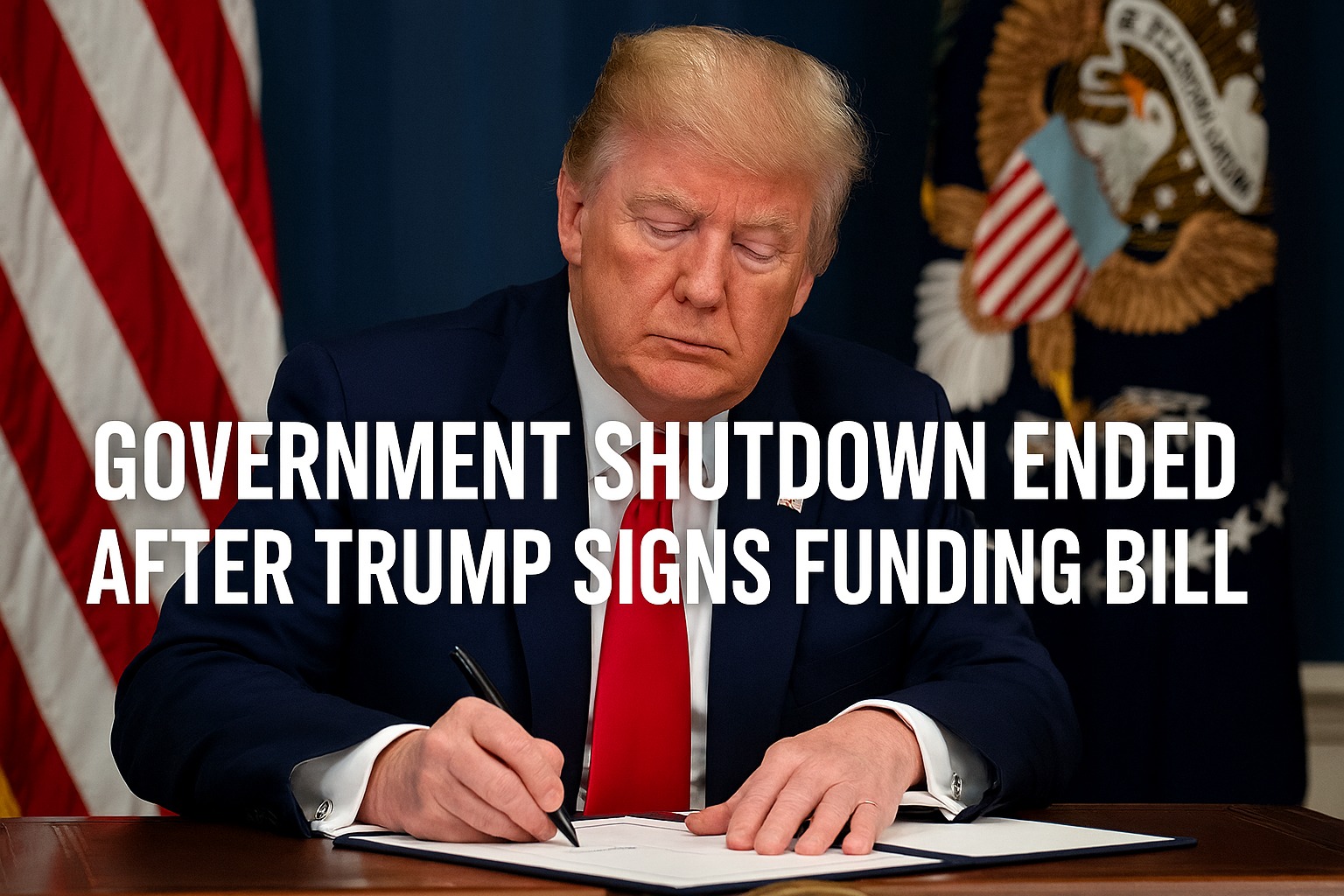
Government Shutdown Ended After Trump Signs Funding Bill
Government Shutdown Ended as U.S. lawmakers passed a major funding bill designed to restore federal operations following a short partial shutdown. The closure, which lasted several days, disrupted government services after Congress failed to agree on spending legislation before the deadline. With the House approving the bill and President Donald Trump expected to sign it, most federal agencies are now funded through the end of the fiscal year.
The shutdown occurred amid intense political disagreement, particularly around immigration enforcement and funding for the Department of Homeland Security. As negotiations stalled, parts of the federal government were forced to halt nonessential operations, affecting workers and delaying services. Lawmakers from both parties ultimately moved to end the disruption by advancing a compromise spending package.
Government Shutdown Ended Following Narrow House Vote
The House of Representatives passed the funding bill by a narrow margin, reflecting deep divisions within Congress. While the Senate had already approved the measure, the House vote was closely contested, with members of both parties split on whether the deal went far enough or conceded too much.
The legislation includes approximately $1.2 trillion in government funding, covering departments such as defense, education, health, labor, transportation, and housing. By approving the bill, lawmakers ensured that most federal agencies can continue operating without interruption until the end of the current fiscal year.
Despite the bill’s passage, the close vote highlighted ongoing disagreements over government spending priorities. Some lawmakers argued that the deal was necessary to prevent further economic uncertainty, while others criticized it for failing to address long-term policy concerns.
Government Shutdown Ended With Temporary DHS Funding
One of the most controversial elements of the agreement was the decision to provide only short-term funding for the Department of Homeland Security. Instead of receiving full-year funding like other agencies, DHS was granted a temporary extension lasting just a few weeks.
This compromise reflects ongoing disputes over immigration policy and enforcement practices. Some lawmakers pushed for reforms related to border security operations, oversight, and accountability measures. Others argued that such changes could weaken enforcement efforts or interfere with national security responsibilities.
By limiting DHS funding to a short-term extension, Congress left the door open for further negotiations. Lawmakers are expected to revisit the issue before the temporary funding expires, raising the possibility of renewed debate or another funding deadline.
Bipartisan Support to Avoid Further Disruption
Although the funding deal faced criticism from both sides, a number of lawmakers crossed party lines to support it. Their backing was driven largely by a desire to prevent a longer shutdown that could have more severe consequences for federal workers and the broader economy.
Several members who opposed the bill argued that it failed to resolve core policy disputes and relied too heavily on temporary measures. Still, enough votes were secured to pass the legislation, signaling a shared understanding that continued shutdowns are politically and economically costly.
Government Shutdown Ended but Political Tensions Remain
While federal operations have resumed, the issues that caused the shutdown remain unresolved. Immigration enforcement, border security, and agency oversight continue to divide lawmakers, particularly as the temporary DHS funding deadline approaches.
Democrats have emphasized the need for stronger accountability measures and reforms, while Republicans have focused on maintaining enforcement authority and operational flexibility. These competing priorities suggest that future negotiations could be just as contentious.
The funding deal also underscores broader challenges in passing long-term budget agreements. In recent years, Congress has increasingly relied on short-term extensions and last-minute deals, increasing the risk of repeated shutdowns.
The full House floor session and debate surrounding the funding vote can be viewed through the official live stream at https://live.house.gov/
Impact on Broader Legislative Agenda
The shutdown temporarily slowed progress on other legislative efforts, including financial regulation, technology policy, and market oversight initiatives. Lawmakers now face pressure to make up for lost time while also addressing upcoming funding deadlines.
Although the shutdown was relatively brief, it served as a reminder of how quickly government operations can be disrupted by political gridlock. Even short closures can delay services, disrupt federal workers’ pay schedules, and reduce public confidence in government institutions.
Compared to previous shutdowns that lasted weeks, the impact this time was limited. However, analysts note that repeated funding crises can still create long-term uncertainty for agencies and businesses that rely on consistent federal operations.
Editor’s View: Why Short Shutdowns Still Matter
Even brief shutdowns reveal how fragile confidence in government continuity can be. For federal workers, uncertainty about pay and operations tends to linger longer than the closure itself, shaping morale and decision-making in subtle ways. Markets and institutions may appear resilient on the surface, but repeated reliance on last-minute deals reinforces the perception that budgeting is reactive rather than planned. That perception, more than any single shutdown, is what quietly erodes trust over time.
What the Government Shutdown Ended Means Going Forward
For most Americans, the immediate effects of the shutdown ending may be minimal. Federal employees have returned to work, and government services are operating normally again. However, the political consequences of the dispute may continue to shape budget negotiations in the months ahead.
The restoration of funding helps stabilize markets and reassures investors who often react negatively to prolonged government closures. Avoiding a longer shutdown also prevents further economic strain and administrative backlogs.
In summary, the Government Shutdown Ended after Congress passed a broad funding bill and moved to temporarily resolve disputes over homeland security funding. While the agreement restored federal operations, it left key policy debates unresolved. As lawmakers prepare for the next round of negotiations, the risk of future funding conflicts remains, highlighting ongoing challenges in achieving lasting budget solutions.
Disclaimer: This content is for informational purposes only and does not constitute financial advice.
Keep yourself updated with the latest crypto news with FYI Gazette
Read more about Memecoins with FYI Gazette
Keep yourself updated with the latest Altcoin News with FYI Gazette
 Bitcoin
  Ethereum
  Tether
  BNB
BNB  XRP
XRP  Solana
  TRON
TRON  Dogecoin
  Litecoin
  Pepe
Pepe