

Bitcoin Bear Market May Not Be Over as Traders Eye 50K
Bitcoin Bear Market conditions continue to dominate market sentiment as traders warn that the recent price rebound may not signal the true end of the downturn. Although Bitcoin has shown short-term strength after bouncing from recent lows, several analysts argue that the broader trend still points to additional downside before a lasting bottom is formed.
Bitcoin recently recovered more than 20 percent from its local low, briefly pushing prices back above the 71,000 level. While this move provided temporary relief, many traders remain cautious. They believe the bounce resembles previous bear market rallies that ultimately failed, rather than the start of a sustainable recovery. Comparisons are increasingly being made to Bitcoin’s 2022 decline, where multiple sharp rallies occurred before the final bottom was reached.
Market participants emphasize that bear markets rarely end with a single drop. Instead, they often involve prolonged periods of volatility, false recoveries, and renewed selling pressure. The current environment appears to reflect that pattern, keeping confidence fragile.
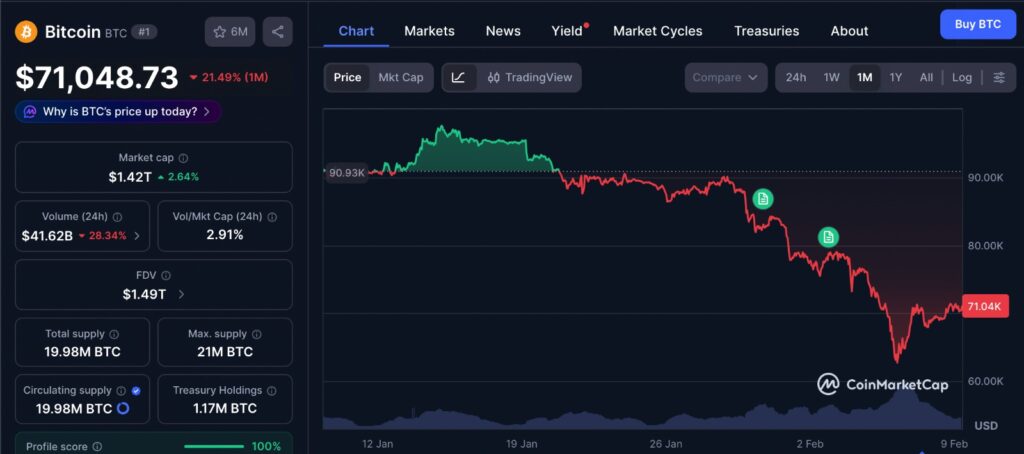
Viewed over the past month, Bitcoin’s price action highlights how compressed the market has become, with sharp moves in both directions failing to establish follow-through. The chart shows periods of quick recovery being met with equally fast pullbacks, suggesting short-term positioning rather than sustained conviction. This type of movement is typical when participants are reacting to price levels instead of broader trends. In such conditions, volatility reflects uncertainty more than momentum, and direction often remains unresolved.
Bitcoin Bear Market Signals From Technical Analysis
Technical indicators are playing a key role in shaping bearish expectations. Several analysts note that Bitcoin’s recent price action mirrors earlier stages of the 2022 bear market, when temporary recoveries ultimately led to deeper losses. These similarities suggest that the current rebound may not be enough to reverse the broader trend.
One area of concern is Bitcoin’s interaction with long-term moving averages. Historically, the 200-week moving averages have acted as critical support during extended downturns. In past cycles, when Bitcoin lost these levels, price weakness often continued until stronger demand emerged. Current projections place these support zones significantly lower than present prices, increasing the risk of another downward leg.
Momentum indicators also show limited confirmation of a trend reversal. While short-term buying pressure has increased, longer-term signals still point to structural weakness. For many traders, this reinforces the belief that the Bitcoin Bear Market has not fully played out.
Why Capitulation Matters in a Bitcoin Bear Market
Another major theme in the current discussion is capitulation. Capitulation occurs when sellers finally give up after prolonged losses, leading to a sharp sell-off followed by stabilization. Many analysts argue that Bitcoin has not yet experienced this type of decisive event in the current cycle.
Without capitulation, bearish pressure may continue to build beneath the surface. Investors who entered the market at higher prices may still be holding positions, hoping for a recovery. If prices fall further, these holders could be forced to sell, adding to downward momentum.
Traders watching previous cycles point out that true bear market bottoms often coincide with extreme fear, widespread pessimism, and heavy volume sell-offs. While sentiment has weakened, some believe it has not yet reached levels typically associated with final bottoms.
ETF Cost Basis Adds Pressure to Bitcoin Bear Market
The introduction of US spot Bitcoin exchange-traded funds has added a new layer to the Bitcoin Bear Market narrative. These ETFs attracted substantial inflows during higher price levels, resulting in an average cost basis near 82,000.
If Bitcoin trades well below that level for an extended period, ETF investors could face significant unrealized losses. This situation may create additional selling pressure, as some investors may choose to exit positions during rallies to limit downside risk.
This dynamic can cap upside momentum, making it harder for Bitcoin to sustain recoveries. Instead of long-term accumulation, rallies may be met with distribution from investors seeking to reduce exposure.
Historical Patterns Still Favor Caution
Historical price behavior continues to influence trader expectations. In previous bear markets, Bitcoin often revisited lower support zones multiple times before establishing a durable base. The current cycle appears consistent with that behavior.
Some analysts estimate that a final bottom could occur near the 50,000 region, where stronger technical and psychological support may exist. While this level is not guaranteed, it aligns with historical retracement zones seen in earlier market cycles.
At the same time, traders acknowledge that history does not repeat perfectly. Market structure has evolved, institutional participation has increased, and liquidity conditions differ from previous years. These factors introduce uncertainty and make precise predictions difficult.
Editor’s View: Market Behavior Beyond the Charts
One detail that charts do not capture well is how investor confidence erodes unevenly during prolonged drawdowns. Many participants do not exit at obvious breakdowns, but slowly disengage as repeated rallies fail to hold. This creates a market where price can appear stable while conviction quietly weakens underneath. In that environment, even modest declines can trigger outsized reactions, not because of panic, but because trust in recovery narratives has already faded.
What the Bitcoin Bear Market Means for Investors
For investors, the ongoing Bitcoin Bear Market highlights the importance of risk management and patience. Short-term traders may continue to face choppy conditions, with sudden rallies followed by renewed weakness. Long-term investors, however, may view deeper pullbacks as potential accumulation opportunities.
Caution remains a common theme across market commentary. Rather than assuming the worst is over, many traders prefer to wait for clearer confirmation of a trend reversal. Signs such as sustained higher lows, increased volume, and improved macro conditions could help validate a stronger recovery.
Until those signals appear, the prevailing view is that Bitcoin remains in a fragile phase. While rebounds are possible, the broader structure suggests that the market may still need more time to fully reset.
In conclusion, the Bitcoin Bear Market narrative remains intact despite recent gains. Technical signals, historical comparisons, ETF dynamics, and the absence of capitulation all point toward continued caution. Whether the final bottom forms near 50,000 or elsewhere, traders agree that the journey is likely not over yet.
Disclaimer: This content is for informational purposes only and does not constitute financial advice.
Keep yourself updated with the latest crypto news with FYI Gazette
Read more about Memecoins with FYI Gazette
Keep yourself updated with the latest Altcoin News with FYI Gazette
 Bitcoin
  Ethereum
  Tether
  BNB
BNB  XRP
XRP  Solana
  TRON
TRON  Dogecoin
  Litecoin
  Pepe
Pepe