
Bitcoin Bottom Signals Await $50K Test
Bitcoin Bottom expectations are growing as traders enter a new week with caution following Bitcoin’s recent price pullback. After failing to hold higher levels, market participants are increasingly focused on whether the current decline is part of a broader reset before a sustainable recovery. With macroeconomic pressure, currency shifts, and on-chain signals all aligning, many believe Bitcoin may need to test lower support before a clear bottom is confirmed.
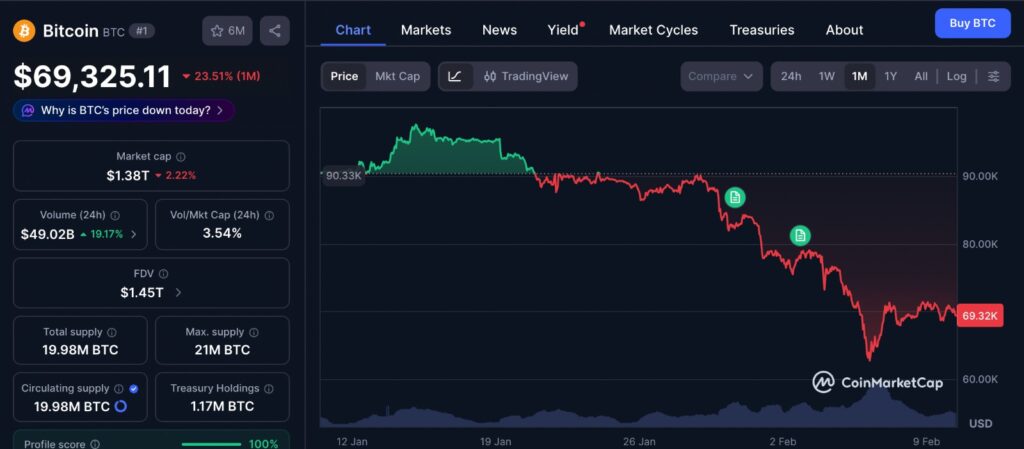
The one-month price chart highlights how Bitcoin has spent much of the recent period moving within a broad but defined range rather than trending decisively. Sharp moves in either direction have been followed by quick retracements, suggesting hesitation rather than strong conviction from either buyers or sellers. This kind of price behavior often reflects a market that is still processing uncertainty, where participants are reacting to short-term signals without committing to longer-term positions. In that context, the chart reinforces the idea that the market is still searching for balance rather than confirming a clear directional shift.
Bitcoin Bottom Outlook This Week
Bitcoin Bottom sentiment has strengthened due to uncertainty surrounding recent price action. Bitcoin continues to trade in a wide range, but repeated failures to reclaim key resistance zones have weakened bullish confidence. Traders are now questioning whether the market has truly found support or if another leg down is still ahead.
While Bitcoin remains well above prior cycle lows, several analysts argue that current conditions resemble earlier phases where price consolidation preceded deeper corrections. This has led to increased discussion around potential downside targets, particularly near the $60,000 and $50,000 zones, which are viewed as critical psychological and technical levels.
Market Structure and Bitcoin Bottom Expectations
From a structural standpoint, Bitcoin has struggled to establish a strong upward trend. Short term price rallies have often been met with selling pressure, suggesting that demand may not yet be strong enough to absorb available supply. This has reinforced the idea that recent gains could be temporary rather than the start of a sustained move higher.
Some traders believe the market is still in a distribution phase, where price fluctuates within a range before making a more decisive move. If this view holds, Bitcoin could revisit lower levels as part of a process to flush out remaining leverage and reset sentiment.
Bitcoin Bottom and Inflation Data Impact
Bitcoin Bottom discussions this week are closely tied to upcoming US inflation data. The release of the Consumer Price Index is expected to influence broader market sentiment, especially as expectations for interest rate cuts have shifted. With inflation remaining a key concern, risk assets like Bitcoin are sensitive to any data that suggests tighter financial conditions may persist.
Reduced optimism around near term rate cuts has already weighed on equities and cryptocurrencies alike. If inflation data comes in stronger than expected, it could reinforce a risk off environment, adding pressure to Bitcoin and increasing the likelihood of further downside.
Macro Uncertainty and Market Reaction
Macroeconomic uncertainty continues to shape trader behavior. Beyond inflation, earnings reports and central bank guidance are contributing to cautious positioning across financial markets. Bitcoin, often viewed as a high risk asset during periods of tightening liquidity, tends to feel these effects quickly.
As a result, many traders are opting to stay defensive, waiting for clearer confirmation of a Bitcoin Bottom before increasing exposure. This wait and see approach reflects broader hesitation rather than outright panic, but it still limits upside momentum.
Bitcoin Bottom Signals from the US Dollar
The Bitcoin Bottom narrative is also being influenced by movements in the US dollar. Recent attempts by the dollar to regain strength have introduced headwinds for Bitcoin. Historically, a stronger dollar has often coincided with weaker performance in risk assets, including cryptocurrencies.
If the dollar continues to push higher, it could reduce demand for Bitcoin in the short term. Traders are watching these correlations closely, as shifts in currency markets can act as early indicators for changes in crypto price trends.
Global Currency Trends and Bitcoin Bottom Risks
Beyond the US dollar, developments in other major economies are also affecting sentiment. In Japan, political stability combined with strong equity performance has raised expectations of continued yen weakness. A softer yen can influence global capital flows and impact risk appetite across markets.
These cross market dynamics add complexity to the Bitcoin Bottom outlook. With multiple currencies in play, traders must consider how shifts outside the crypto space could amplify or reduce pressure on Bitcoin price action.
Miner Activity and Bitcoin Bottom Formation
On-chain data has added another layer to the Bitcoin Bottom discussion, particularly through miner behavior. Recently, miners have been transferring larger amounts of Bitcoin to exchanges than usual. This activity is often interpreted as preparation to sell, which can increase short term supply.
While miner selling does not automatically signal a long term bearish trend, it can contribute to temporary downside pressure. In past cycles, periods of elevated miner distribution have sometimes occurred near local or macro bottoms, as weaker participants exit and stronger hands accumulate.
Supply Dynamics and Market Reset
These miner movements suggest that the market may still be in a rebalancing phase. Bitcoin changing hands between different groups of participants can be a necessary step before a new uptrend begins. If selling pressure is absorbed effectively, it could help establish a more durable base.
However, until that absorption is clearly visible, traders remain cautious. Many prefer to wait for signs of reduced selling and stronger demand before declaring that a Bitcoin Bottom is firmly in place.
Editor’s View: Bitcoin Bottom Is Also a Test of Patience
One element charts do not fully capture is trader fatigue. After extended periods of volatility and false starts, many participants become less reactive, not because risk disappears, but because conviction erodes. This often leads to quieter markets where price drifts rather than moves decisively, even when headlines suggest urgency. In those moments, the absence of aggressive buying or selling can matter as much as any technical level, as markets tend to reset only after participants disengage emotionally as well as financially.
Conclusion: Bitcoin Bottom Still Unclear
The search for a Bitcoin Bottom continues as traders navigate a complex mix of technical, macroeconomic, and on-chain factors. While recent price action has sparked hope for stabilization, skepticism remains high. Key support levels around $60,000 and $50,000 are firmly on the radar, and a test of these zones would not surprise many market participants.
With inflation data, currency movements, and miner behavior all influencing sentiment, the coming days may provide important clues. Until then, the Bitcoin Bottom debate remains unresolved, with traders closely watching for confirmation that the market has truly found its footing.
Disclaimer: This content is for informational purposes only and does not constitute financial advice.
Keep yourself updated with the latest crypto news with FYI Gazette
Read more about Memecoins with FYI Gazette
Keep yourself updated with the latest Altcoin News with FYI Gazette
 Bitcoin
  Ethereum
  Tether
  BNB
BNB  XRP
XRP  Solana
  TRON
TRON  Dogecoin
  Litecoin
  Pepe
Pepe