Aave Liquidations Spike After 2.85% Price Error
Aave Liquidations are often viewed as purely mechanical outcomes, but events like this suggest they are also shaped by how participants collectively interpret stability. When an asset behaves predictably over time, confidence quietly shifts toward tighter positioning and reduced buffers, especially in systems that feel mathematically reliable. This creates an environment where risk is not removed, but compressed into rare moments when assumptions break. The pricing error did not introduce new risk as much as it revealed how much had already accumulated beneath the surface.
Aave Liquidations surged after a 2.85% pricing error triggered a wave of forced liquidations across the protocol, resulting in nearly $27 million in losses within a short period. The incident revealed how even small deviations in price data can have outsized consequences in automated DeFi systems.
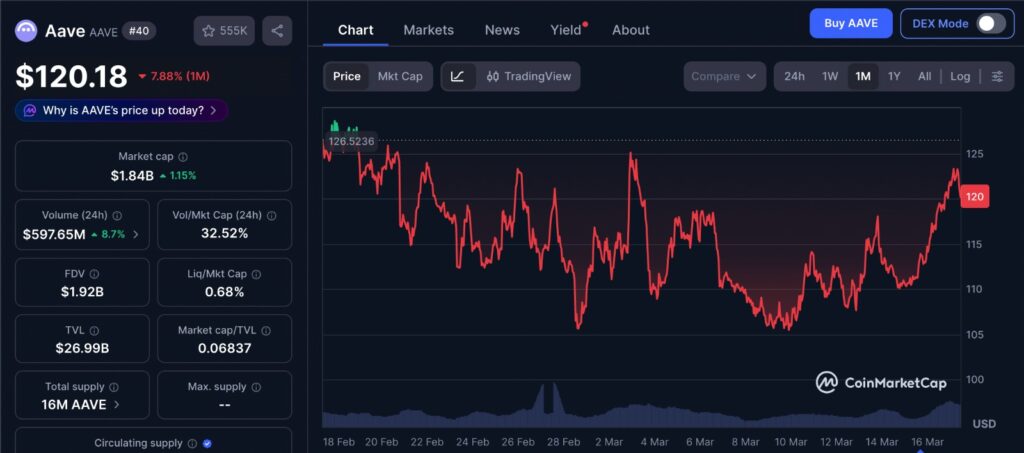
The one-month price chart for AAVE shows a gradual recovery after a period of weakness earlier in the month, with price action stabilizing and trending higher into recent sessions. This kind of structure often reflects a shift from reactive selling toward more measured positioning, where participants begin to re-enter after volatility subsides. Notably, the move higher appears steady rather than aggressive, suggesting that confidence is rebuilding slowly rather than being driven by sudden speculative demand. In the context of the recent liquidation event, this reinforces how price stability can return even after sharp disruptions, but often with a more cautious market structure.
What Triggered the Aave Liquidations Event
The event was caused by a mispricing of wstETH relative to ETH, where the price briefly deviated by around 2.85%. This discrepancy originated from a configuration issue in the CAPO risk oracle, which is used to provide price data to the Aave protocol.
Because Aave relies on external price feeds to determine the value of collateral, the incorrect data was treated as valid. This caused many positions to appear undercollateralized, even though market conditions had not materially changed.
As a result, the protocol began liquidating positions automatically, as it is designed to do when collateral falls below required thresholds.
How Aave Liquidations Reached $27 Million
The liquidation cascade happened quickly. Once the incorrect price was registered, multiple positions were flagged at the same time. Liquidation bots, which constantly monitor the protocol, executed trades almost instantly.
Users who had borrowed against wstETH suddenly saw their positions fall below safety levels. Their collateral was partially or fully liquidated, often at a discount, as liquidators stepped in to repay debt and claim assets.
In total, the liquidations amounted to approximately $27 million. While the protocol itself remained solvent, individual users absorbed significant losses.
The Role of Oracles in Aave Liquidations
Why Price Feeds Are Critical
Aave depends on oracle systems to supply real-time price data for assets. These oracles aggregate information from multiple sources and deliver a single price that the protocol uses for all calculations.
In this case, the CAPO oracle introduced incorrect parameters, leading to a temporary mismatch between the reported price and the actual market value. Since smart contracts cannot verify the accuracy of data beyond what they receive, the system acted on this faulty input.
Dependency on External Data
This incident highlights a key risk in DeFi. Even if a protocol’s internal logic is sound, its reliance on external data introduces vulnerabilities. A small error in pricing can cascade into large financial consequences when leveraged positions are involved.
The automation that makes DeFi efficient also means that these errors are executed instantly, without human intervention or delay.
Understanding Liquidation Mechanics
On Aave, users deposit collateral to borrow assets. Each position has a health factor that reflects its safety. If the value of collateral drops relative to the borrowed amount, the health factor decreases.
When the health factor falls below a certain threshold, the position becomes eligible for liquidation. Liquidators repay part of the debt and receive collateral in return, often with a bonus.
During the 2.85% pricing error, many positions experienced a sudden drop in health factor. What were previously safe positions became liquidatable within seconds.
This rapid shift is what caused the large-scale liquidation event.
Why the Losses Were So Significant
Several factors contributed to the scale of the losses. First, the error affected a widely used collateral asset, meaning many positions were exposed at the same time.
Second, the level of leverage in the system amplified the impact. Even a small price deviation can trigger liquidations when positions are highly leveraged.
Third, the speed of liquidation bots ensured that positions were closed almost immediately, leaving users with no time to react or add collateral.
Additionally, liquidation penalties and discounts meant that users lost more than just the temporary price deviation.
Protocol Stability and Aftermath
Despite the scale of liquidations, Aave itself remained stable and did not incur bad debt. The system functioned as designed, executing liquidations to maintain solvency.
Liquidators reportedly earned significant profits from the event, as they were able to acquire collateral at discounted rates during the liquidation process.
The issue was traced back to oracle configuration rather than a flaw in Aave’s smart contracts. This distinction is important, as it shows that the protocol’s core mechanics were not compromised.
Editor’s View: Automation vs Reality
What stands out in this event is how closely DeFi users tend to operate near liquidation thresholds during stable market conditions. When prices move gradually, this behavior can appear rational, as the system feels predictable and efficient. However, moments like this reveal that even small, temporary deviations can expose how little margin many participants actually maintain. The reliance on automated systems creates a false sense of control, where risk feels manageable until the inputs themselves become unreliable. In that sense, the losses were not just a result of the pricing error, but also of how participants position themselves within these systems.
Lessons From the Aave Liquidations Event
The Aave liquidations incident highlights the importance of reliable oracle systems in DeFi. It shows that risks do not only come from smart contract bugs but also from external dependencies.
For users, the event reinforces the need to maintain a margin of safety in collateralized positions. Relying on minimum thresholds can leave positions vulnerable to sudden changes, even if those changes are temporary.
For the broader ecosystem, the incident raises questions about whether additional safeguards should be implemented. Mechanisms such as circuit breakers or validation layers could help reduce the impact of sudden pricing anomalies.
Ultimately, while Aave functioned as intended, the event exposed a critical layer of risk that extends across decentralized finance.
Disclaimer: This content is for informational purposes only and does not constitute financial advice.
Keep yourself updated with the latest crypto news with FYI Gazette
Read more about Memecoins with FYI Gazette
Keep yourself updated with the latest Altcoin News with FYI Gazette
 Bitcoin
  Ethereum
  Tether
  XRP
XRP  BNB
BNB  Solana
  TRON
TRON  Dogecoin
  Litecoin
  Pepe
Pepe