
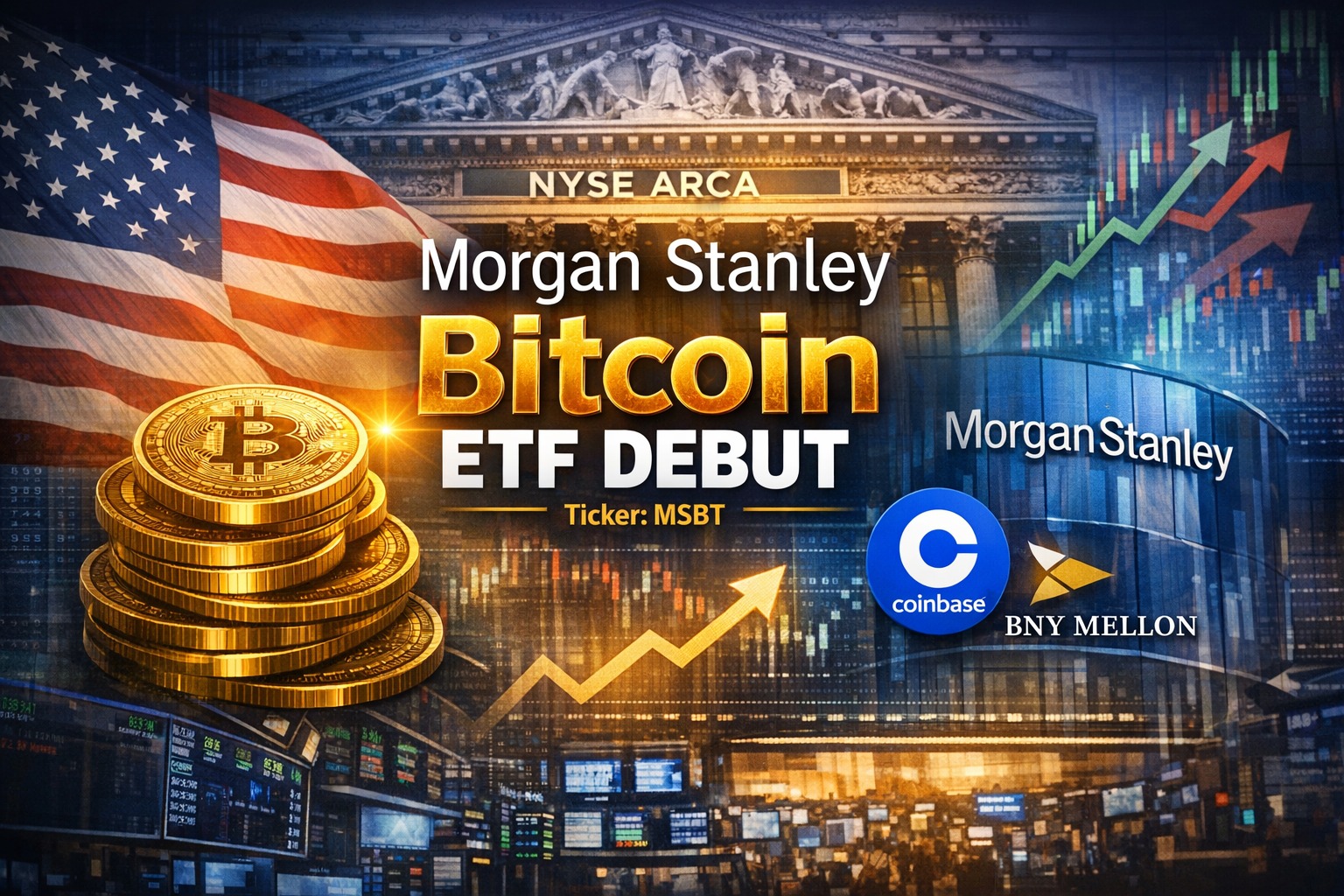
Bitcoin ETF debut: Morgan Stanley launches MSBT
Bitcoin ETF debut changes more than access, it changes how participation is paced. When exposure is introduced through advisory networks rather than direct buying, capital does not move impulsively, it moves according to structure. This creates a gap between interest and execution, where demand exists but is deployed gradually. What matters here is not just that investors can access Bitcoin, but that their entry is now shaped by allocation frameworks rather than market urgency.
This is a straightforward development: a major bank is now directly offering Bitcoin exposure through a regulated investment product.
What Happened
Morgan Stanley’s Bitcoin ETF debut will go live under the ticker MSBT. The launch comes nearly two years after the last similar product entered the market, when Grayscale Investments introduced its Bitcoin Mini Trust ETF in July 2024.
The ETF will trade on NYSE Arca, one of the main platforms for exchange-traded products in the US.
Morgan Stanley has also confirmed that Coinbase and BNY Mellon will serve as custodians, handling the storage and operational side of the Bitcoin held by the fund.
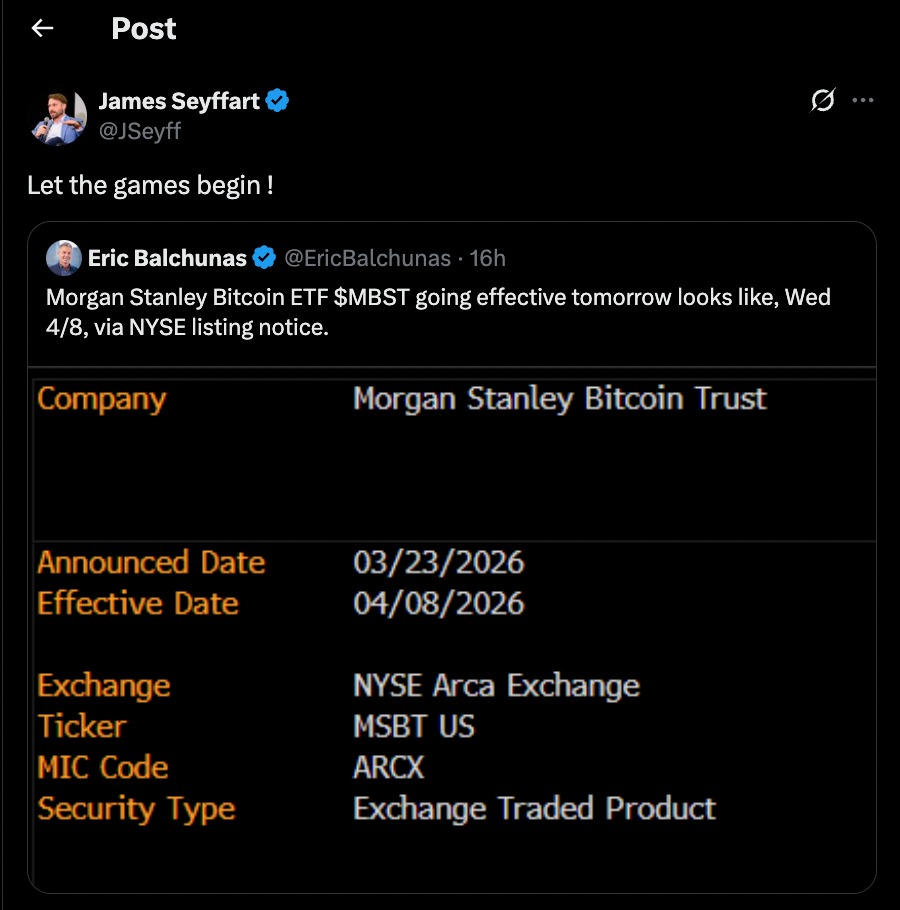
The listing confirmation shared by analysts highlights how closely institutional developments are tracked in real time. Updates like this tend to circulate quickly among market participants, not because they change fundamentals instantly, but because they signal when access is about to shift. In recent sessions, similar confirmations have often marked the point where attention begins to turn into positioning, even if price does not react immediately.
Why the Market Moved
The Bitcoin ETF debut matters because it expands access rather than creating new demand. When a firm like Morgan Stanley enters the space, it opens the door for clients who were not previously active in crypto markets.
Over the past day, similar developments have shown that markets react not just to demand, but to who is able to participate.
This is why the market can respond even if nothing has fundamentally changed about Bitcoin itself.
A key detail is pricing. Morgan Stanley has set the MSBT fee at 0.14 percent, which is lower than many competing products. Lower fees make it easier for investors to hold exposure over time, especially at larger portfolio sizes.
What’s Driving the Reaction
The current Bitcoin ETF market is already competitive. BlackRock and Fidelity Investments lead the space, with their ETFs bringing in a combined $74.3 billion in net inflows since January 2024.
Morgan Stanley is entering later, but it has a different advantage. Its network of around 16,000 advisors manages about $6 trillion in client assets. These advisors play a direct role in how capital is allocated.
As Eric Balchunas noted, these advisors act as gatekeepers to large pools of capital. Their involvement means that investment decisions are often guided rather than self-directed.
The key idea is simple: access shapes participation.
Broader Market Context
In recent sessions, the crypto market has shown that new institutional products tend to change how money flows before they change price trends. Capital often moves gradually as portfolios are adjusted rather than all at once.
Morgan Stanley’s ETF also fits into a wider push into crypto. The bank has applied for a national trust banking charter, which would allow it to custody crypto, execute trades, and offer services like staking.
It has also filed for additional ETFs tied to Ether and Solana, showing that its strategy is not limited to Bitcoin.
The infrastructure behind the ETF reflects a mix of traditional and crypto firms. While Morgan Stanley provides distribution, companies like Coinbase handle custody, showing how both sides of the market are still connected.
What This Means
The Bitcoin ETF debut signals that crypto exposure is becoming part of standard financial products rather than a separate category. It makes access simpler for traditional investors who prefer regulated structures.
One important takeaway is that price does not move just because access improves — it moves when that access begins to compete for available liquidity.
In practical terms, this launch is less about immediate price impact and more about how capital will be introduced into the market over time.
Editor’s View: Bitcoin ETF debut and controlled participation
What stands out is not the product itself, but how exposure is being filtered. When access is routed through advisors, decisions are no longer driven by urgency or market noise, but by portfolio rules and timing discipline. This changes the pace of participation. Investors are not reacting to price moves in real time, they are entering through structured recommendations. Over time, that tends to smooth out behavior, even if the underlying asset remains volatile.
Conclusion
Morgan Stanley’s Bitcoin ETF debut adds another major player to an already competitive space. The launch expands access, introduces pricing pressure, and strengthens the link between traditional finance and crypto markets.
While the immediate effects may be limited, the long term impact lies in how participation evolves as more institutional channels open.
Disclaimer: This content is for informational purposes only and does not constitute financial advice.
Keep yourself updated with the latest crypto news with FYI Gazette
Read more about Memecoins with FYI Gazette
Keep yourself updated with the latest Altcoin News with FYI Gazette
 Bitcoin
  Ethereum
  Tether
  XRP
XRP  BNB
BNB  Solana
  TRON
TRON  Dogecoin
  Litecoin
  Pepe
Pepe