
Bitcoin ETF resilience explains holder confidence
Bitcoin ETF resilience is clearly visible as long-term holders remain unfazed despite $1.3 billion in outflows from U.S. spot Bitcoin ETFs within a single week. Normally, such heavy exits would spark fear and strong downside price action. However, Bitcoin’s price has remained relatively stable, showing that deeper on-chain dynamics and holder behavior are absorbing the pressure. This stability suggests that the market structure remains healthy even as traditional investors reduce exposure.
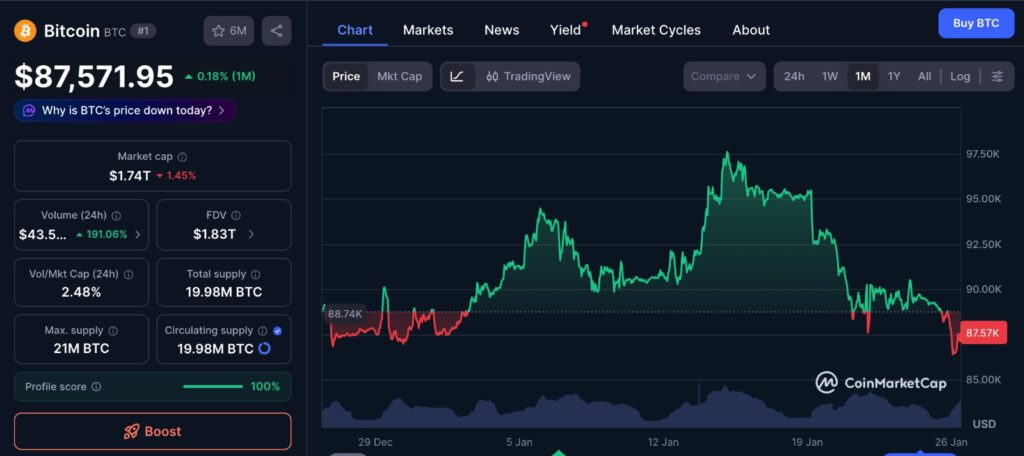
Viewed over the past month, Bitcoin’s price action reflects compression rather than direction. The chart shows repeated attempts to move higher and lower being met with relatively quick absorption, suggesting neither buyers nor sellers have full control. This kind of sideways behavior often aligns with uncertainty rather than fear, where participants wait for confirmation instead of forcing positions. In this context, muted price movement alongside heavy ETF outflows reinforces the idea that selling pressure is being offset quietly, rather than resolved through sharp moves.
Understanding Bitcoin ETF Resilience During ETF Outflows
Bitcoin ETF resilience goes beyond headline numbers. While ETF outflows reflect reduced participation from institutional and traditional investors, they do not automatically translate into panic selling across the broader market. In this case, the scale of the outflows was significant, marking one of the largest weekly exits in months. Yet, Bitcoin avoided a sharp breakdown, pointing toward strong underlying demand and disciplined holder behavior.
ETF products represent only a portion of Bitcoin’s investor base. When outflows occur, the impact depends on whether long-term holders step in to sell or continue holding. Current data suggests that most long-term holders have chosen patience over fear, helping stabilize price action during a period of uncertainty.
Short-Term Holder Behavior Supports Bitcoin ETF Resilience
Short-term holders play a crucial role in shaping Bitcoin ETF resilience. One key indicator used to assess their behavior is the Short-Term Holder Spent Output Profit Ratio, commonly referred to as STH SOPR. This metric shows whether short-term holders are selling their coins at a profit or a loss. A value near 1 indicates break-even behavior rather than panic-driven selling.
At present, STH SOPR is hovering just below the neutral level, indicating that short-term holders are not aggressively exiting their positions. Instead of rushing to sell, many appear to be holding and even accumulating. This behavior limits sell pressure and helps explain why ETF outflows have not triggered a steep price decline.
Coin age data also supports this observation. Coins held for shorter durations are increasingly remaining dormant rather than moving onto exchanges. This shift suggests growing confidence among short-term participants, which strengthens overall market resilience.
Market Structure Points to Potential Upside
Bitcoin ETF resilience is further reinforced by the relationship between long-term and short-term holder profitability. The ratio between Long-Term Holder SOPR and Short-Term Holder SOPR remains relatively low compared to historical peaks. This indicates that the market is not overheated and has not reached conditions typically associated with major tops.
Historically, when this ratio begins to rise from lower levels while short-term holders move into profit, Bitcoin often experiences renewed upward momentum. Current conditions suggest that the market may still have room to grow, provided selling pressure remains controlled and accumulation continues.
These dynamics highlight how resilience is built gradually through holder behavior rather than sudden shifts in sentiment.
Long-Term Holder Confidence Remains Strong
A key reason Bitcoin ETF resilience remains intact is the behavior of long-term holders. These participants tend to hold their assets through periods of volatility and only sell during strong bullish phases. If long-term holders were actively distributing their coins, the impact of ETF outflows would likely be much more severe.
On-chain indicators show that long-term holders are not significantly increasing their selling activity. Metrics that track the movement of older coins remain low, signaling that long-held Bitcoin is staying put. This lack of distribution suggests confidence in future price appreciation and reduces the available supply on the market.
By maintaining their positions, long-term holders effectively counterbalance selling pressure from ETF redemptions and short-term traders.
Bitcoin ETF Resilience and Investor Psychology
Bitcoin ETF resilience also reflects broader investor psychology. While ETF outflows can be interpreted as a loss of confidence, they may also represent short-term portfolio adjustments rather than a fundamental shift in belief about Bitcoin’s value. Meanwhile, on-chain investors appear to view current conditions as an opportunity rather than a threat.
The muted market reaction shows that fear has not taken hold. Instead, both short-term and long-term holders are behaving rationally, waiting for clearer signals rather than reacting emotionally. This balanced sentiment plays a major role in preventing sharp drawdowns.
Why ETF Outflows Have Not Crashed the Market
Several factors explain why Bitcoin ETF resilience remains strong despite large outflows. First, selling from ETFs is being absorbed by other market participants who are willing to accumulate at current prices. Second, short-term holders are not capitulating, which helps limit volatility. Third, long-term holders continue to restrict supply by holding onto their coins.
Together, these forces create a buffer against downside pressure. ETF flows alone no longer dictate price action as strongly as they once did, especially when on-chain metrics point toward stability and accumulation.
Editor’s View: Bitcoin ETF resilience is also about patience, not conviction
What stands out in this phase is not aggressive confidence, but patience. Many long-term holders are not necessarily bullish in the short term; they are simply not compelled to act. After years of volatility, these participants are familiar with periods where narratives shift faster than fundamentals. ETF outflows may reflect portfolio rebalancing or short-term frustration, while long-term holders appear comfortable waiting through uncertainty rather than reacting to every institutional signal. This kind of inertia often reflects experience more than optimism.
What Bitcoin ETF Resilience Means Going Forward
Bitcoin ETF resilience suggests that the market is currently in a consolidation phase rather than the start of a major downturn. As long as long-term holders remain inactive sellers and short-term holders avoid panic, Bitcoin can continue to absorb institutional outflows without major damage.
Future price movement will likely depend on whether short-term holders move decisively into profit and whether broader sentiment improves. If these conditions align, Bitcoin could regain upward momentum even if ETF flows remain volatile.
Ultimately, resilience is built on conviction, and current data shows that many holders still believe in Bitcoin’s long-term value. This steady foundation may prove more important than temporary ETF movements as the market navigates its next phase.
Disclaimer: This content is for informational purposes only and does not constitute financial advice.
Keep yourself updated with the latest crypto news with FYI Gazette
Read more about Memecoins with FYI Gazette
Keep yourself updated with the latest Altcoin News with FYI Gazette
 Bitcoin
  Ethereum
  Tether
  XRP
XRP  BNB
BNB  Solana
  TRON
TRON  Dogecoin
  Litecoin
  Pepe
Pepe