
Bitcoin Market Bottom Signals After Massive Holder Sell-Off
Bitcoin Market Bottom discussions have intensified after long-term Bitcoin holders sold a large amount of BTC during a period of strict macroeconomic conditions. The sudden sell-off raised concerns across the crypto market, but it also sparked debate about whether this event may signal a market bottom. By examining on-chain data, holder behavior, and broader economic pressures, investors are trying to determine whether Bitcoin is entering a stabilization phase or facing further downside.
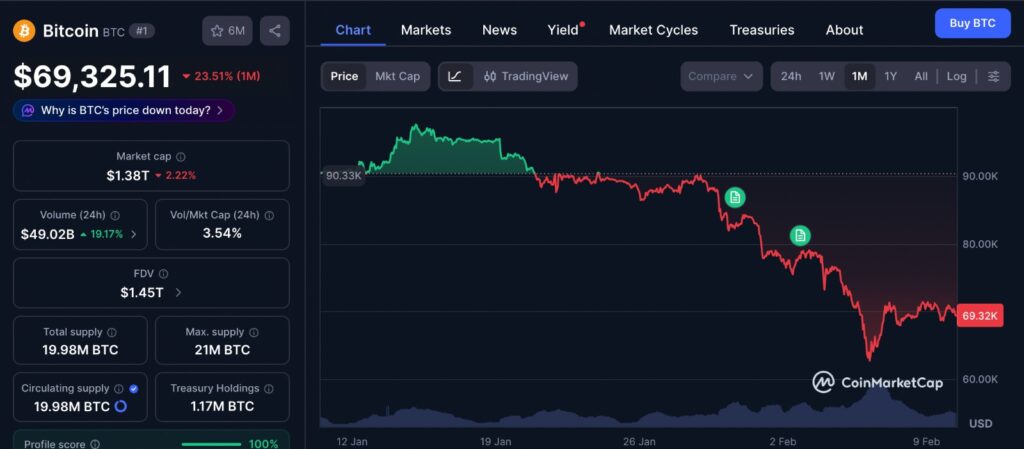
The one-month price chart adds useful context to the recent on-chain signals. Rather than showing a clean trend in either direction, Bitcoin’s movement over this period reflects hesitation, with sharp reactions followed by quick stabilization. This kind of price behavior often appears when the market is processing new information rather than committing to a strong directional move. In this phase, price action tends to mirror uncertainty more than conviction, reinforcing the idea that the market is still evaluating recent selling pressure rather than responding emotionally to it.
Bitcoin Market Bottom and Recent Price Volatility
The concept of a Bitcoin Market Bottom refers to a price level where selling pressure weakens and prices begin to stabilize before a potential recovery. Recently, Bitcoin experienced a sharp drop that pushed prices briefly below the $60,000 level. This decline happened quickly and was accompanied by heavy selling activity, especially from long-term holders who typically remain inactive during short-term volatility.
Following the drop, Bitcoin rebounded and traded back above $70,000, suggesting that buyers were willing to step in at lower prices. This bounce fueled speculation that the market may have already absorbed the worst of the selling pressure. However, price recoveries alone do not confirm a bottom, which is why analysts continue to rely on on-chain data and macroeconomic trends for confirmation.
Long-Term Holder Selling and Bitcoin Market Bottom Signals
One of the most important developments in the Bitcoin Market Bottom discussion is the behavior of long-term holders. On-chain data showed that long-term holders reduced their Bitcoin holdings by approximately 245,000 BTC in a short period. This marked the largest net outflow from this group since late 2024.
Long-term holders are often considered the most patient participants in the market. When they begin selling at scale, it can signal either fear or strategic profit-taking. In past market cycles, similar spikes in long-term holder selling often occurred near major price corrections rather than at the beginning of prolonged bear markets.
Despite this selling activity, the total amount of Bitcoin classified as long-term held has continued to rise over time. This happens because Bitcoin that remains unmoved for a specific period is automatically reclassified as long-term supply. As a result, total long-term supply can grow even while some holders are actively selling.
Supply Aging and Accumulation Behavior
Supply aging plays a key role in identifying a potential Bitcoin Market Bottom. Supply aging measures how long Bitcoin remains unmoved on the blockchain. Older coins are typically associated with strong conviction holders who are less likely to sell during periods of uncertainty.
Recent data shows that aged Bitcoin supply continues to increase despite recent volatility. This suggests that many investors are holding onto their coins rather than exiting the market. Historically, this behavior has often been observed during bottom-building phases when weaker hands exit and stronger hands accumulate.
Another important indicator is the long-term holder spent output profit ratio, which measures whether coins being sold are in profit or loss. After the recent sell-off, this metric moved back above one, meaning that coins were being sold at a profit on average. This shift suggests that panic selling may be easing and that sellers are becoming more selective.
Macro Conditions Shaping the Bitcoin Market Bottom
While on-chain metrics provide valuable insight, macroeconomic conditions remain a major factor influencing whether a Bitcoin Market Bottom can hold. Tight monetary policy, inflation concerns, and uncertainty around interest rate decisions continue to affect risk assets, including Bitcoin.
Markets are currently pricing in limited chances of near-term interest rate cuts, reflecting persistent inflationary pressure. Higher interest rates reduce liquidity in financial markets and make non-yielding assets like Bitcoin less attractive to some investors. This environment can slow down recoveries even if on-chain data suggests reduced selling pressure.
U.S. Treasury yields remain elevated, which has also contributed to volatility across global markets. When yields rise, investors often move capital toward safer assets, reducing exposure to speculative investments. This dynamic can limit Bitcoin’s upside in the short term, even if selling pressure weakens.
Currency strength also plays a role. Movements in the U.S. dollar can influence Bitcoin demand, as a stronger dollar often places pressure on alternative assets. These macro forces mean that even if Bitcoin has found a temporary bottom, price action may remain choppy.
Is the Bitcoin Market Bottom Confirmed?
Determining whether a Bitcoin Market Bottom is confirmed is difficult because market bottoms are usually only clear in hindsight. However, several factors suggest that the market may be transitioning into a stabilization phase. Heavy long-term holder selling has already occurred, aged supply continues to grow, and some technical indicators show signs of recovery.
At the same time, macroeconomic headwinds remain strong. Tight financial conditions and global uncertainty could trigger additional volatility. This means that while downside risk may be reduced, sharp price movements are still possible.
Rather than signaling a clear reversal, current data suggests that Bitcoin may be entering a period of consolidation. During such phases, price tends to move sideways as buyers and sellers reach temporary balance.
Editor’s View: Reading Between the Selling
Large sell-offs by long-term holders are often treated as purely technical signals, but they usually reflect a shift in mindset rather than panic. When investors who have held through volatility choose to reduce exposure, it often suggests fatigue with uncertainty instead of fear of collapse. Many of these participants are not abandoning Bitcoin, but rebalancing risk after extended periods of macro pressure. This kind of behavior tends to appear when conviction remains intact, yet patience is being tested by factors outside the crypto market itself.
Bitcoin Market Bottom Outlook
In summary, the Bitcoin Market Bottom narrative is supported by several on-chain signals, including long-term holder distribution, rising aged supply, and improving profit metrics. These indicators suggest that a significant portion of selling pressure has already been absorbed by the market.
However, macroeconomic uncertainty continues to influence investor sentiment and could delay a sustained recovery. Instead of a sudden rebound, Bitcoin may continue building a base while the market waits for clearer economic signals.
For investors, this period highlights the importance of monitoring both on-chain behavior and broader economic trends. While a definitive bottom may not yet be confirmed, current conditions suggest that Bitcoin is closer to stabilization than to the early stages of another major decline.
Disclaimer: This content is for informational purposes only and does not constitute financial advice.
Keep yourself updated with the latest crypto news with FYI Gazette
Read more about Memecoins with FYI Gazette
Keep yourself updated with the latest Altcoin News with FYI Gazette
 Bitcoin
  Ethereum
  Tether
  XRP
XRP  BNB
BNB  Solana
  TRON
TRON  Dogecoin
  Litecoin
  Pepe
Pepe