

Bitcoin Price Compression Signals Possible 80K Move
Bitcoin Price Compression tends to surface when the market is no longer reacting to new information but instead processing existing positions that have not yet been resolved. In this phase, price moves less because participants are waiting, not because interest has disappeared. Liquidity quietly builds at predictable levels as traders cluster around the same structural assumptions, creating a fragile balance. What follows is often less about direction being discovered and more about which side is forced to adjust first.
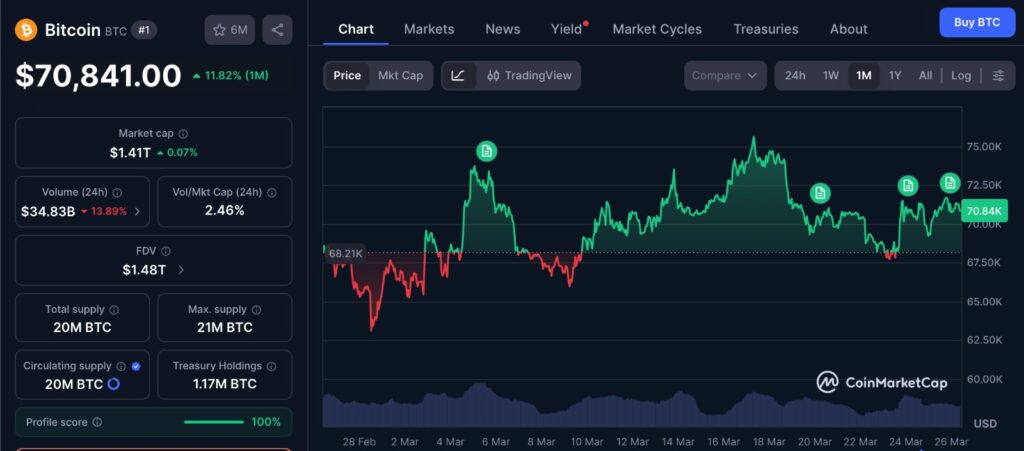
The past month of Bitcoin price action reflects a gradual tightening of range rather than a clear directional trend, with price repeatedly moving between similar high and low zones without sustained follow-through. This type of behavior often indicates that the market is absorbing volatility, with both buyers and sellers becoming more selective rather than aggressive. The repeated rejections and recoveries within this range suggest that positioning is building, even as momentum appears muted. In this context, the chart highlights not weakness, but a phase where the market is stabilizing before a larger move resolves the current balance.
Bitcoin Price Compression Signals Tightening Range
Bitcoin’s recent structure shows a clear sequence of lower highs and higher lows, creating a narrowing range that reflects compression. This pattern indicates that volatility is being absorbed rather than expressed, with price movements becoming smaller as equilibrium forms.
In practical terms, this means liquidity is stacking above resistance and below support. Traders place breakout orders at the edges of the range, while stop losses accumulate just beyond those levels. The longer price remains compressed, the more concentrated this liquidity becomes. When price eventually breaks, it tends to move quickly because it is triggering orders rather than discovering new value.
Bitcoin Price Compression and Key Pivot Levels
The 71500 region is acting as a structural pivot where both directional biases are being tested. Holding above this level suggests that buyers are still willing to defend higher ground, while repeated rejections from this area indicate that sellers are not fully exhausted.
Markets tend to react sharply around such pivots because they represent areas where positions are heavily concentrated. For institutional participants, these levels are not just technical markers but zones where liquidity can be accessed efficiently. A move away from this pivot often reflects positioning being forced to unwind, rather than a gradual shift in sentiment.
Bitcoin Price Compression and the 80K Scenario
The current structure resembles a potential inverse head and shoulders formation, which is often associated with continuation after consolidation. In this case, the neckline aligns with resistance near the upper boundary of the compression range.
If price breaks above this level with sustained momentum, the move toward the 80000 region becomes structurally valid. This is not because the level itself holds intrinsic significance, but because it represents the measured extension of the pattern. More importantly, a breakout would likely force short positions to close, adding mechanical buying pressure to the move.
However, without a decisive break and follow-through, the pattern remains incomplete. Compression structures often produce false starts before resolving, particularly when liquidity is heavily concentrated on both sides.
Bitcoin Price Compression and Market Structure Imbalance
A notable feature of the current setup is the imbalance between derivatives activity and spot demand. Open interest has increased, indicating that more positions are being built in futures markets. This suggests that recent price action is being influenced more by leveraged positioning than by underlying demand.
This dynamic matters because leveraged moves behave differently from spot-driven trends. When price is pushed by derivatives, it can extend quickly but lacks stability. If the move begins to reverse, liquidations can accelerate the downside just as quickly as they supported the upside.
For a breakout to sustain, it needs participation from the spot market. This reflects actual capital entering the asset rather than positions being rotated within leveraged environments. Without that support, breakouts tend to fade rather than develop into sustained trends.
Bitcoin Price Compression and Declining Sell Pressure
On-chain data indicates that sell-side pressure has been decreasing, meaning fewer participants are actively distributing their holdings. This reduces the amount of supply that the market needs to absorb for price to move higher.
In previous cycles, similar conditions have allowed price to expand more easily once demand returned. The absence of aggressive selling creates a more responsive environment, where even moderate buying can have a noticeable impact on price.
That said, reduced selling does not automatically create upward movement. It simply removes one side of the equation, making it easier for demand to take control if it emerges.
Editor’s View: Compression Rewards Patience More Than Conviction
Bitcoin Price Compression often creates the illusion that the market is preparing for a clear directional move, but in reality it tends to expose how uncertain participants actually are. Traders begin to rely on structure rather than confirmation, placing positions based on expectation instead of evidence. This shift in behavior reduces conviction, even as exposure increases, which is why breakouts from these phases often feel sudden and unstable. What looks like a technical pattern is often just a reflection of how participants manage risk when clarity is missing.
What Comes Next for Bitcoin Price Compression
As Bitcoin continues to trade within this tightening range, the focus remains on how price interacts with the boundaries of the structure. A break above resistance with sustained participation would indicate that buyers have absorbed available supply and are willing to push higher.
On the other hand, a loss of support would suggest that the current structure has failed, shifting control toward sellers. In both cases, the reaction following the breakout is more important than the breakout itself. Strong follow-through confirms that the move is supported, while hesitation often signals a lack of commitment.
For now, Bitcoin price compression defines the market environment. It reflects a phase where volatility is being stored rather than released, with positioning building beneath the surface. The resolution of this structure will not introduce new information, but it will reveal which side of the market is overextended.
Disclaimer: This content is for informational purposes only and does not constitute financial advice.
Keep yourself updated with the latest crypto news with FYI Gazette
Read more about Memecoins with FYI Gazette
Keep yourself updated with the latest Altcoin News with FYI Gazette
 Bitcoin
  Ethereum
  Tether
  BNB
BNB  XRP
XRP  Solana
  TRON
TRON  Dogecoin
  Litecoin
  Pepe
Pepe