
Crypto Market Structure Bill Faces Pressure as Trump Blames Banks
Crypto Market Structure debates in the United States have intensified after President Donald Trump criticized banks for allegedly slowing progress on a major crypto bill in the Senate. The disagreement centers on how stablecoins should be regulated and whether platforms should be allowed to offer yield payments to stablecoin holders. As lawmakers continue negotiating the legislation, the dispute has created a standoff between traditional financial institutions and the cryptocurrency industry.
Trump’s comments came as lawmakers attempt to finalize broader crypto regulations that would define how digital assets are treated under US financial law. Supporters of the legislation say it would provide long needed regulatory clarity for the crypto sector, while critics argue certain provisions could create risks for the traditional banking system.
Crypto Market Structure Dispute Draws Trump’s Attention
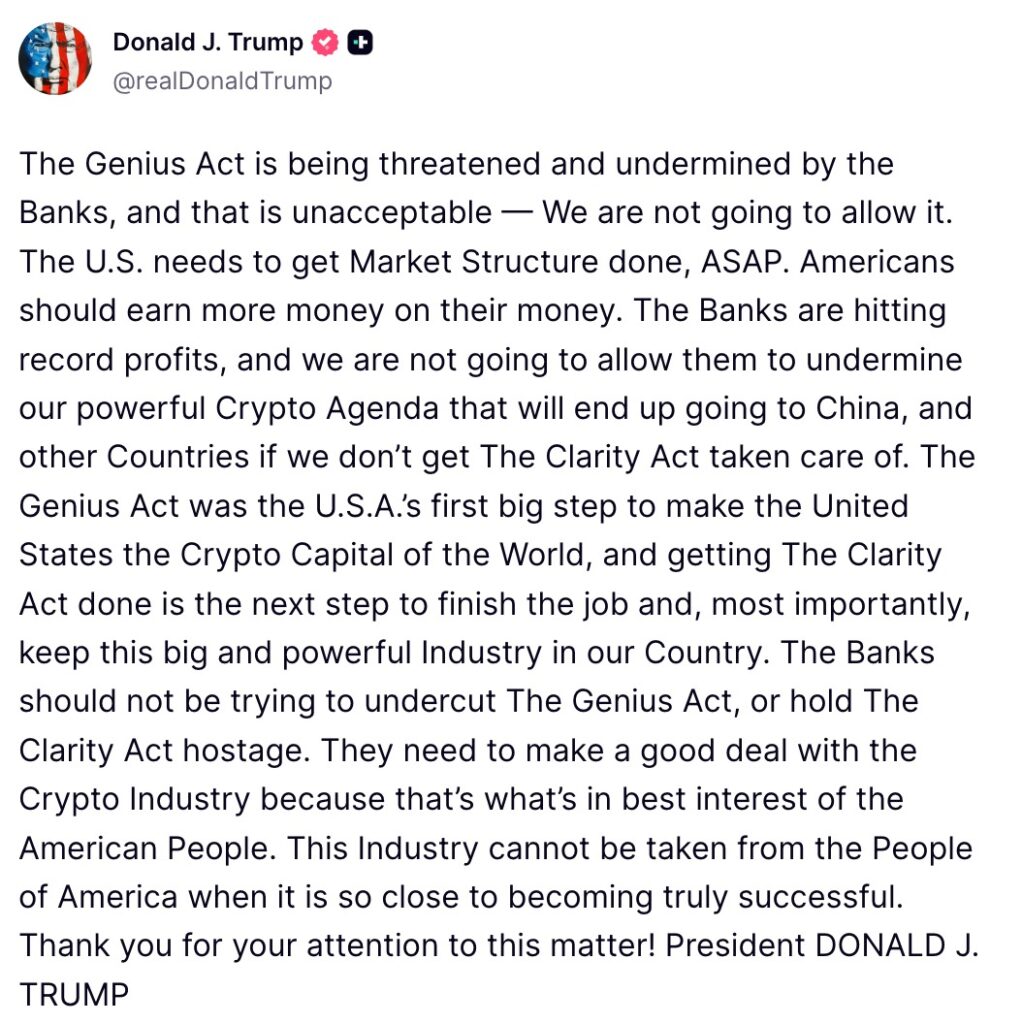
Trump’s statement highlights how the debate over crypto regulation is increasingly intersecting with broader financial and political interests. By directly calling out banks, the president framed the stalled legislation as a conflict between traditional financial institutions and the emerging digital asset industry. His comments also underline the administration’s push to position the United States as a global center for crypto innovation, particularly as lawmakers continue negotiating the broader market structure framework.
Trump publicly criticized banking institutions in a post on his Truth Social platform. He argued that banks were attempting to weaken crypto related legislation that his administration has supported.
“The Genius Act is being threatened and undermined by the Banks, and that is unacceptable. We are not going to allow it,” Trump wrote.
The GENIUS Act, which Congress passed in July, created a regulatory pathway for stablecoin issuers operating in the United States. The law is designed to bring more structure and oversight to stablecoins while allowing the industry to continue growing.
Trump has frequently described the GENIUS Act as one of the most significant steps toward bringing crypto innovation into the US financial system. However, he warned that banks are now attempting to slow the next phase of crypto legislation.
“The US needs to get Market Structure done, ASAP,” Trump said in the same post. He also warned that delays could push crypto innovation toward other countries if lawmakers fail to move forward quickly.
Stablecoin Yield Payments Become Key Issue
At the center of the dispute is the question of whether stablecoin holders should be able to earn yield on their assets.
Under the GENIUS Act, stablecoin issuers are not allowed to directly offer interest or yield payments to users who hold their tokens. Lawmakers included this rule to prevent stablecoins from functioning like interest bearing financial products similar to bank deposits.
However, the law does not prevent third party platforms from offering yield. Crypto exchanges and other platforms can still provide reward programs to users who hold stablecoins on their services.
Banking groups say this creates a loophole that could allow stablecoins to compete directly with traditional bank deposits. They argue that if stablecoin yield programs expand, people may move funds from bank accounts into digital assets.
Because of this concern, banking organizations are pushing lawmakers to include stronger restrictions in the Senate’s crypto market structure legislation. Their proposal would extend the ban so that stablecoin yield payments cannot be offered by any platform.
Crypto Industry Opposes Banking Lobby Efforts
The cryptocurrency industry has strongly pushed back against the banking sector’s proposal.
Crypto companies and industry lobbyists argue that banning yield programs would reduce innovation and make US crypto platforms less competitive compared with companies operating in other regions.
Many executives also say stablecoins are primarily used as payment tools rather than investment products. From their perspective, yield programs are simply one feature that exchanges offer to attract users.
The disagreement has already affected political support for the legislation. In January, major crypto exchange Coinbase withdrew its support for the bill because of concerns about potential restrictions on stablecoin yields.
Coinbase is one of the largest and most influential companies in the US crypto industry. Its withdrawal removed an important source of support for the legislation and contributed to the current stalemate in Congress.
Senate Banking Committee Delays Bill Review
Following Coinbase’s withdrawal, the Senate Banking Committee postponed a scheduled markup session for the crypto market structure bill.
A markup session is a key stage in the legislative process where lawmakers review and finalize the language of a bill before it moves forward. The committee has not yet announced a new date for the session.
Banking groups continue to warn that stablecoin yield programs could weaken the traditional financial system by pulling money away from bank deposits. They argue that large shifts of funds into stablecoins could create stability risks.
Crypto companies disagree with that assessment and say digital assets should not be treated as a threat to banks. Instead, they argue that clear regulation would allow both industries to coexist while expanding financial innovation.
White House Meetings Attempt to Reach Compromise
Efforts have been made to resolve the dispute between banks and the crypto industry.
Representatives from both sectors have participated in three meetings at the White House this year to discuss possible compromises that could allow the bill to move forward.
The discussions have focused on finding language that addresses banking concerns while still allowing crypto companies to operate competitively.
Despite these meetings, no agreement has been reached so far.
Editor’s View: Why Stablecoin Yield Has Become a Political Flashpoint
The debate around stablecoin yield reveals a deeper tension between traditional banking models and emerging digital payment systems. Banks rely heavily on deposits as a stable source of funding, so the idea of funds gradually moving into stablecoins raises understandable concern within the sector. At the same time, crypto platforms view yield programs as a natural extension of how digital finance products compete for users. The current dispute suggests that the real issue may not only be regulation, but how quickly financial power shifts when new technology begins offering similar services outside the traditional banking framework.
Political Stakes Grow Ahead of Midterm Elections
The timing of the legislation has also become politically important. Trump has pushed lawmakers to pass the crypto market structure bill before the upcoming midterm elections in November.
The administration views the legislation as a major policy achievement that could demonstrate support for financial innovation and digital asset companies.
Crypto lobbying groups have also increased their political spending. These organizations have reportedly raised more than 200 million dollars to support candidates who favor policies friendly to the crypto industry.
French Hill Suggests Senate Use House Version
Representative French Hill, chair of the House Financial Services Committee, has suggested another path forward if the Senate remains deadlocked.
Hill said the Senate could consider adopting the House version of the legislation, known as the CLARITY Act.
According to Hill, the CLARITY Act reaffirmed the principle established in the GENIUS Act that stablecoins should function as payment tools on blockchain networks rather than investment products.
Under this approach, stablecoins would not directly pay interest to users.
Hill suggested that if the Senate cannot reach agreement on its own version of the bill, lawmakers should consider using the House language to move the legislation forward.
For now, negotiations over the crypto market structure bill remain unresolved, leaving the future of the legislation uncertain.
Disclaimer: This content is for informational purposes only and does not constitute financial advice.
Keep yourself updated with the latest crypto news with FYI Gazette
Read more about Memecoins with FYI Gazette
Keep yourself updated with the latest Altcoin News with FYI Gazette
 Bitcoin
  Ethereum
  Tether
  BNB
BNB  XRP
XRP  Solana
  TRON
TRON  Dogecoin
  Litecoin
  Pepe
Pepe