

Crypto Bear Market Began in November, Data Shows
Crypto Bear Market conditions appear to have started in November, according to on-chain data analysis, signaling a meaningful shift in the overall cryptocurrency cycle. While many investors expected the market to remain strong following Bitcoin’s earlier highs, multiple indicators suggest momentum has weakened. Long-term metrics, demand trends, and historical comparisons all point toward a broader downtrend that could continue for some time.
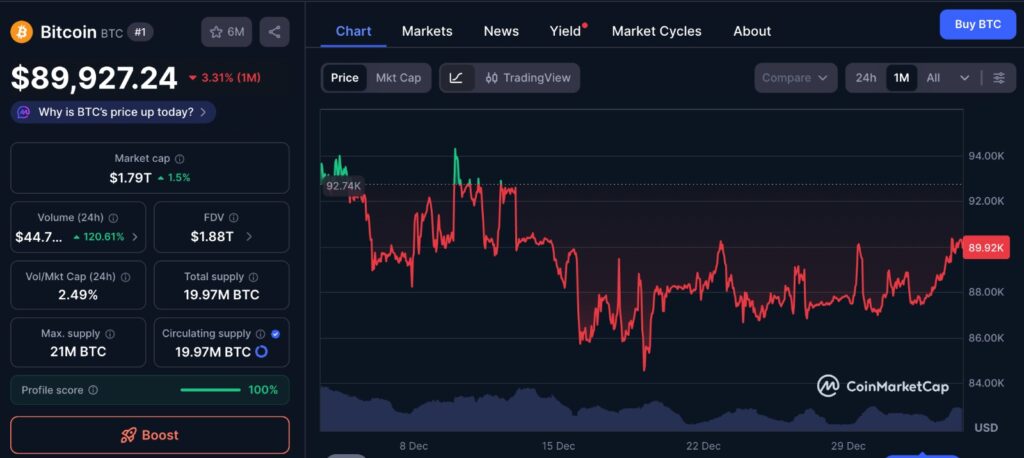
Viewed alongside the past month of price action, the chart highlights how Bitcoin has struggled to regain momentum after recent pullbacks. Rather than sharp sell-offs, the movement reflects hesitation, with rebounds failing to hold and downward moves occurring on relatively steady volume. This kind of sideways-to-lower behavior often suggests uncertainty rather than panic, as market participants wait for clearer confirmation before committing capital. The lack of decisive follow-through in either direction reinforces the broader theme of a market searching for balance rather than trending with conviction.
Crypto Bear Market Signals Emerging in November
One of the clearest signals of a Crypto Bear Market came when Bitcoin dropped below its one-year moving average in early November. This level is commonly used to assess long-term market direction. Historically, when Bitcoin trades below this average for a sustained period, the market often transitions from a bullish phase into a bearish one. Since breaking below this level, Bitcoin has struggled to regain it, reinforcing the idea that market sentiment has shifted.
In addition to price behavior, multiple on-chain indicators began flashing warning signs around the same time. Metrics that track network activity, investor profitability, and demand growth showed broad weakness. When several independent indicators align in this way, it often reflects more than a short-term correction. Instead, it suggests that the market may be entering a longer period of reduced optimism and slower growth.
Price Performance Supports the Crypto Bear Market View
Bitcoin’s price action over recent months adds further support to the Crypto Bear Market narrative. After reaching a cycle high in October, Bitcoin failed to maintain upward momentum and began trending lower. By the end of the year, its price had fallen below where it started, a pattern that contrasts with typical bullish cycle behavior.
This reversal has been especially notable because it followed a period of strong expectations around continued gains. When prices fail to hold after reaching new highs, it often signals that buying pressure is weakening. Without consistent new demand, even strong assets like Bitcoin can enter extended downturns.
Crypto Bear Market Bottom Expectations
Looking ahead, analysts estimate that Bitcoin could eventually find a bottom between the mid fifty-thousand and low sixty-thousand dollar range. This projection is based on historical behavior during previous bear markets, where price often moves closer to the realized price. The realized price reflects the average cost at which current holders acquired their Bitcoin and has historically acted as a support zone during major downturns.
If Bitcoin were to fall to this range, the total decline from its peak would be significant but still smaller than losses seen in earlier cycles. Previous Crypto Bear Market phases often involved drawdowns exceeding seventy percent. A more moderate decline this time may reflect changes in market structure, including more experienced investors and stronger long-term holding behavior.
Editor’s View: Reading the Mood Behind the Metrics
What often gets lost in bear market discussions is how slowly sentiment actually shifts. Many participants do not react to a single price break or indicator change, but to a gradual erosion of confidence that builds over weeks. Traders stop buying dips as aggressively, long-term holders become quieter rather than panicked, and optimism fades without a dramatic trigger. This kind of environment rarely shows up clearly on charts, but it is usually present when markets drift lower despite the absence of major negative news.
How This Crypto Bear Market Differs From the Past
While the current downturn shares similarities with earlier bear markets, there are also notable differences. Previous cycles were often marked by large-scale collapses of major platforms or projects, which amplified fear and accelerated selling. So far, the current market has not experienced comparable systemic failures.
Another difference is the presence of more institutional participation. Larger investors tend to operate on longer time horizons and are often less reactive to short-term price fluctuations. Their gradual accumulation strategies may help reduce extreme volatility, even during a Crypto Bear Market. This could explain why the projected downside appears less severe compared to past cycles.
Impact of the Crypto Bear Market on Investors
A confirmed Crypto Bear Market has important implications for investor behavior. Traders who relied on strong momentum may reduce risk exposure, while long-term investors may shift focus toward capital preservation rather than aggressive growth. Lower enthusiasm often leads to reduced trading volume, slower project funding, and more selective investment decisions.
Demand indicators also show signs of cooling. Reduced inflows from new market participants and slower accumulation suggest that confidence has weakened. Without strong demand growth, price recovery becomes more difficult, especially in the short to medium term.
Broader Effects of a Crypto Bear Market
The effects of a Crypto Bear Market extend beyond Bitcoin alone. Alternative cryptocurrencies often experience larger percentage losses during downturns. This can result in reduced liquidity across the market and increased pressure on smaller projects that rely on sustained interest and funding.
Market participants may also become more cautious in how they evaluate risk. Strategies shift toward defensive positioning, and speculative activity typically declines. These conditions can persist until clearer signs of recovery emerge, such as renewed demand growth or a sustained move above key technical levels.
What to Watch Going Forward
As the market continues to evolve, several factors will determine whether the Crypto Bear Market remains in place. Key areas to monitor include Bitcoin’s ability to reclaim long-term moving averages, changes in on-chain demand metrics, and overall investor sentiment.
A return to bullish conditions would likely require consistent buying pressure and confirmation across multiple indicators. Until that happens, the data suggests that the market remains in a corrective phase that began in November.
In summary, on-chain analysis provides strong evidence that the crypto market has entered a bearish period. While the long-term outlook for digital assets may remain intact, the current environment reflects caution, reduced momentum, and the possibility of further downside before stability returns.
Disclaimer: This content is for informational purposes only and does not constitute financial advice.
Keep yourself updated with the latest crypto news with FYI Gazette
Read more about Memecoins with FYI Gazette
Keep yourself updated with the latest Altcoin News with FYI Gazette
 Bitcoin
  Ethereum
  Tether
  BNB
BNB  XRP
XRP  Solana
  TRON
TRON  Dogecoin
  Litecoin
  Pepe
Pepe