

Bitcoin April Gain Shows Relief, But the Market Still Needs Confirmation
Bitcoin April gain has given the crypto market something it had been missing for months: visible relief.
According to Cointelegraph, Bitcoin posted an 11.87% return in April, making it the asset’s strongest monthly performance in the past 12 months. That explains why traders are paying closer attention heading into May. After several months of pressure, one strong monthly candle can shift market mood, reset positioning, and bring sidelined attention back into Bitcoin.
But the bigger question is not whether April was strong.
The real question is whether April changed the structure of the market, or simply gave traders a recovery after a long stretch of weakness.
That distinction matters because Bitcoin rallies can look powerful on the surface while still depending on short covering, thin liquidity, or traders chasing price after being underexposed. A strong monthly close improves sentiment, but it does not automatically confirm that long-term demand has returned with enough strength to absorb sellers at higher levels.
Markets do not move higher when traders feel better. They move higher when buyers keep absorbing supply.
Why Bitcoin’s April Gain Matters
April was important because it interrupted a weaker phase for Bitcoin.
Bitcoin just closed two monthly candles in green after five straight red monthly candles. That shift matters because monthly candles often shape how larger market participants view trend stability. Daily moves can be noisy, but monthly closes tend to influence broader sentiment, risk appetite, and allocation decisions.
A single green month does not erase the previous decline, but it can reduce panic. It gives traders a reason to reassess whether selling pressure is weakening. It also forces short sellers to become more careful, especially if price begins holding above areas that previously acted as resistance.
This is where April becomes more than just a return figure.
If traders were underexposed after months of weakness, April’s move may have pulled some of them back into the market. If bearish traders were positioned for continuation lower, the recovery may have forced them to reduce exposure. If long-term holders stayed firm during the decline, the rebound may have strengthened confidence that deeper demand still exists.
That does not mean a new Bitcoin breakout is confirmed. It means the market has moved from clean weakness into a more contested phase, where both buyers and sellers now have something to prove.
The Rally Still Came With Limits
Even though April was Bitcoin’s strongest month in a year, the move was not extreme by historical standards.
It is reported that April’s 11.87% gain still came in slightly below Bitcoin’s historical April average of 12.98%, based on CoinGlass data. That detail keeps the move in perspective. April was strong relative to the past year, but it was not unusually explosive compared with Bitcoin’s own history.
This is where many traders can misread the signal.
A strong monthly return can create the feeling that momentum has fully returned. But if the market is still far below its previous high, the recovery may be better understood as repair rather than expansion.
Bitcoin was trading around $78,190, roughly 38% below its October all-time high of $125,100. That gap shows why the market may still need more than one strong month before confidence fully returns.
Bitcoin has recovered, but it has not fully reclaimed the structure lost during the previous decline. Bitcoin has recovered, but it has not fully reclaimed the structure lost during the previous decline, which is why Bitcoin demand still needs confirmation before the rally can be viewed as structurally stronger. Until higher levels are accepted by the market, some traders may continue to treat rallies as areas to reduce risk rather than proof of a new trend.
Why May Becomes a Key Test
May now becomes important because the market needs to show whether April created real follow-through.
Historically, Bitcoin has delivered an average May return of about 7.78%. Traders often use these seasonal averages as reference points, especially after a strong monthly close. However, historical averages are not signals by themselves. They are context, not confirmation.
The market still has to prove whether buyers are willing to support price after April’s recovery. The market still has to prove whether buyers are willing to support price after April’s recovery, especially as Bitcoin’s $80K resistance test remains an important area for judging follow-through.
That means May is less about expecting another strong month and more about watching how Bitcoin behaves after the relief rally. If dips are bought quickly, it would suggest that demand is becoming more active. If dips are bought quickly, it would suggest that demand is becoming more active and that Bitcoin support and resistance structure is starting to improve after the earlier decline. If price stalls near resistance and selling pressure returns, April may look more like a corrective bounce than the beginning of a broader recovery.
This matters because rallies often slow when price reaches areas where earlier buyers want to exit and late shorts are already out of the trade. At that point, the market needs fresh demand, not just reduced selling pressure.
Liquidity is not always evenly available. Once nearby orders are absorbed, price has to move toward the next area where enough buyers or sellers are willing to trade.
Recent sessions have shown how quickly sentiment improves when Bitcoin starts holding firm after a weak stretch. But the stronger test is not the first recovery. It is whether buyers continue stepping in after the easier part of the rebound has already happened.
Fear Has Not Fully Left the Market
One of the more interesting details in the Cointelegraph report is that market sentiment remained cautious despite Bitcoin’s strong April performance.
The Crypto Fear & Greed Index showed a “Fear” reading of 39, according to the report. That suggests the market has not fully shifted into aggressive risk-taking mode. In some ways, that makes the current setup more complex.
A strong price recovery with lingering fear can mean two different things.
On one side, it may suggest that the rally still has room to develop if cautious participants begin returning. When sentiment remains fearful after price improves, it can show that many traders are still under-positioned or waiting for confirmation.
On the other side, fear can show that investors do not fully trust the move yet. They may be watching for signs that the rally was driven by futures activity, short covering, or temporary liquidity rather than steady spot demand.
That uncertainty is why Bitcoin’s next move matters more than the April return itself.
The market is no longer in the same weak position it was during the red-month stretch, but it has also not moved into full confidence. It is sitting somewhere in between, where traders are watching price behavior more closely than headlines.
Analysts Are Divided For a Reason
The split among analysts reflects the same tension visible in the market.
CryptoQuant warned Bitcoin could face a multi-month decline if April’s rally was mainly driven by futures traders. That concern is reasonable because futures-led rallies can become fragile when leverage builds faster than real demand.
When futures traders push price higher, the market can rise quickly. But if price stops moving upward, those same leveraged positions can become vulnerable. Crowded longs and sudden liquidations can turn a strong-looking move into a sharp reversal. Crowded longs and sudden liquidations can turn a strong-looking move into a sharp reversal, especially after periods of recent Bitcoin liquidations that show how quickly leverage can unwind.
That is why the source of a rally matters.
A move supported by patient demand is usually more stable than one driven mainly by traders chasing momentum. Both can lift price in the short term, but they do not carry the same strength underneath the surface.
The reason this happens is simple: leveraged traders often need the move to continue. If price pauses for too long, their positions become harder to hold, and what looked like buying pressure can quickly turn into forced selling.
At the same time, other analysts remain more optimistic. Michael van de Poppe’s view that Bitcoin may not need a new narrative to move back toward $100,000.
That view also has logic behind it. Sometimes markets do not need a fresh headline. They only need sellers to weaken, liquidity to return, and buyers to regain confidence. If Bitcoin begins holding higher levels, the narrative can follow the price rather than lead it.
This is why May should not be viewed through a single bullish or bearish lens.
Bitcoin is sitting in a confirmation zone.
Editor’s View: The Market Is Stronger, But Not Yet Settled
Editor’s View: Bitcoin’s April gain matters because it changed the mood without fully resolving the structure. That is usually where markets become most interesting. Traders who were too bearish now have to reconsider, but buyers still need to prove they can defend price after the initial relief move.
This is not a market that looks ignored anymore. It is a market being tested.
The key point is simple: April gave Bitcoin breathing room, but May will show whether that breathing room turns into stronger participation.
How This Affects the Global Crypto Market
Bitcoin’s April gain matters beyond Bitcoin itself because BTC still sets the tone for the broader crypto market.
When Bitcoin stabilizes after a weak stretch, it can reduce pressure across altcoins. Traders usually become more willing to rotate into higher-risk assets when Bitcoin stops falling and begins holding key levels. That does not mean altcoins automatically rally, but it can improve the conditions for selective strength.
However, if Bitcoin’s recovery is not supported by durable demand, the broader market remains exposed. Altcoins are often more sensitive to liquidity changes, and a failed Bitcoin follow-through can quickly pull risk appetite away from smaller assets.
This is why April’s Bitcoin move should be seen as a market-wide relief signal, not a full confirmation signal.
The crypto market has more breathing room than it did during the red-month stretch. But breathing room is not the same as a new trend.
For altcoins, Bitcoin’s behavior in May may be especially important. If BTC holds firm, traders may become more comfortable looking for opportunities outside the largest asset. If BTC loses momentum, capital may stay defensive, and weaker altcoins could struggle to attract meaningful demand.
What Traders Should Watch Next
The main thing to watch now is whether Bitcoin can turn April’s strength into May stability.
That means watching whether price holds firm during pullbacks, whether volume supports upward moves, and whether futures activity becomes too crowded. A healthy continuation would likely need more than excitement. It would need steady demand, controlled leverage, and less dependence on short-term speculation.
Bitcoin’s April gain gave the market a reason to pay attention again.
But May will decide whether that attention becomes conviction.
For now, the cleanest reading is simple: Bitcoin has improved, but the market has not fully confirmed a new expansion phase yet. April repaired sentiment. May has to prove whether buyers can defend that repair.
The next move will not be decided by the April candle alone. It will be decided by whether the market can keep absorbing supply when price is tested again.
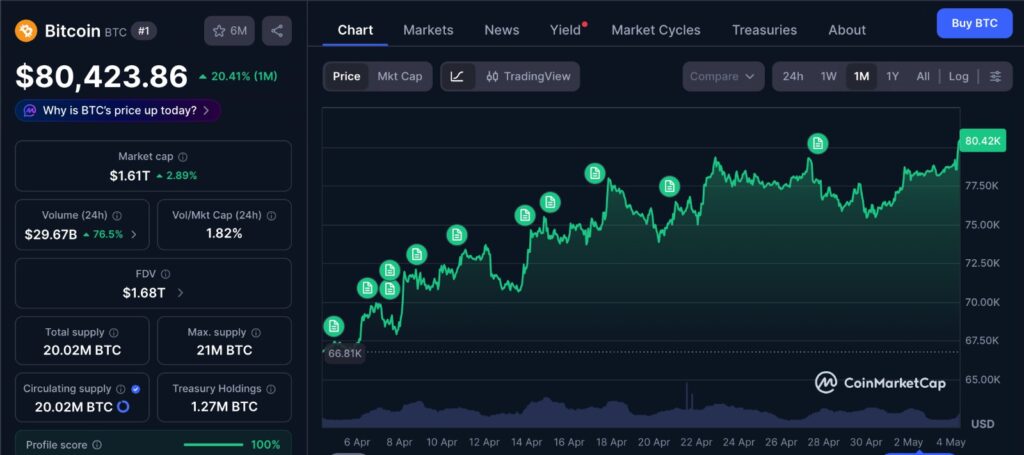
Bitcoin’s one-month CoinMarketCap chart helps show why April’s move changed short-term sentiment. The chart reflects a stronger recovery phase after months of pressure, but it also shows that the market is still working through a larger structure rather than moving in a straight line. This makes the recent Bitcoin April gain important, not because it guarantees continuation, but because it gives traders a clearer area to judge whether demand is returning with enough strength.
Disclaimer: This content is for informational purposes only and does not constitute financial advice.
Keep yourself updated with the latest crypto news with FYI Gazette
 Bitcoin
  Ethereum
  Tether
  BNB
BNB  XRP
XRP  Solana
  TRON
TRON  Dogecoin
  Litecoin
  Pepe
Pepe