

Bitcoin Bull Run May Be Premature as Demand Lags Behind Price Stability
Bitcoin bull run expectations often build around price resilience, but recent conditions suggest that stability alone is not enough to confirm a sustained upward phase. When price holds without a corresponding expansion in demand, the underlying structure begins to reflect imbalance rather than strength.
Recent sessions have shown that while Bitcoin has avoided deeper pullbacks, the intensity of buying pressure has not increased alongside price. This creates a situation where price appears stable on the surface, but the participation supporting it remains narrow. Markets do not weaken when price slows, they weaken when participation fails to broaden.
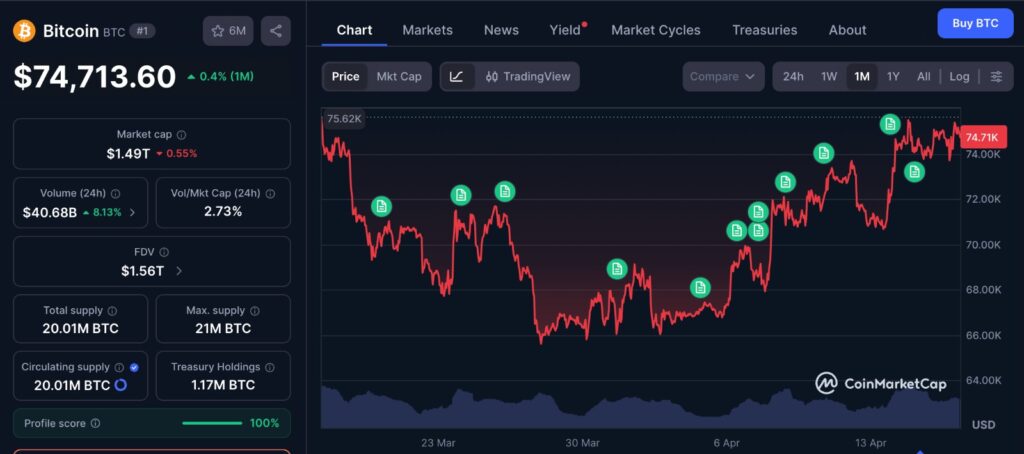
The 1-month Bitcoin price chart reflects a period of controlled movement rather than strong directional expansion. While BTC has managed to hold key levels without significant breakdowns, the absence of sustained upward momentum suggests that buying pressure has remained measured rather than aggressive. This type of price behavior often indicates a market that is being supported by existing positions rather than fresh inflows, reinforcing the idea that stability is present, but broad participation has yet to fully expand.
Price Stability Does Not Always Reflect Strong Demand
Under typical bull market conditions, rising prices are supported by expanding participation. New capital enters, spot demand absorbs supply, and momentum builds through consistent follow through.
However, current market behavior suggests a different dynamic. Price has remained steady, but without clear signs of aggressive accumulation. This indicates that:
- Demand is not accelerating in line with price
- Capital inflows may be uneven or limited
- Participation is becoming more concentrated rather than widespread
Structurally, this matters because markets rely on fresh capital to sustain upward movement. When that flow slows, price stability often reflects reduced selling pressure rather than strong buying. Markets do not move because buyers are present, they move because there is not enough opposing supply to stop them.
When Demand Slows, Leverage Often Fills the Gap
In environments where spot demand does not fully support price, exposure tends to shift toward derivatives. Traders rely more on leverage to maintain or expand positions instead of committing new capital.
This shift changes the nature of the market:
- Exposure grows faster than actual demand
- Price becomes more sensitive to positioning changes
- Stability becomes conditional rather than structural
This pattern becomes clearer when looking at how traders are increasing exposure through derivatives, as seen in rising Ethereum open interest trends. But that support depends on positions staying intact. When leverage drives participation, even small shifts in sentiment can force rapid adjustments as positions are reduced or closed.
This dynamic is explored further in our analysis of Ethereum open interest trends, where rising exposure reflects how traders increase participation without equivalent capital backing.
Capital Rotation Appears Selective, Not Expansive
Another important signal is the behavior of capital across the broader market. In strong bull phases, capital tends to expand outward, moving from Bitcoin into altcoins and creating broad based participation.
Current conditions suggest that rotation is happening more selectively. Instead of expansion, capital appears to be moving within a limited set of opportunities without significantly increasing overall participation.
This has two implications:
- Momentum becomes harder to sustain
- Price movements rely more on repositioning than new inflows
Over the past week, similar conditions have shown that markets can maintain an upward bias even while participation remains constrained. This often results in slower, less decisive price action.
Weak Demand Often Leads to Compression Before Resolution
When demand fails to expand, markets rarely break down immediately. This kind of controlled price behavior is visible in assets like XRP, where XRP consolidation reflects hesitation before a breakout.
This behavior is especially relevant when analyzing assets like XRP, where consolidation phases reflect hesitation rather than clear directional conviction.
Compression is not a sign of weakness on its own. It reflects a market where neither buyers nor sellers have enough conviction to force direction. In these conditions, price remains contained until either new capital enters or existing positions begin to unwind.
Why the Current Structure Requires Caution
The idea that a bull run is underway often comes from observing price stability and assuming it reflects strength. However, markets are not driven by price alone. They are shaped by participation, liquidity, and the willingness of capital to expand.
At present, the key signals suggest:
- Demand is not accelerating meaningfully
- Exposure may be increasingly dependent on leverage
- Capital rotation is limited rather than broad
This does not rule out further upward movement. But it does indicate that the structure supporting price is not yet fully developed. Stability without expansion tends to be fragile, even if it appears controlled.
Editor’s View:
What stands out in the current market is not weakness, but restraint. Participants are not exiting aggressively, but they are also not committing new capital with urgency. This creates a controlled environment where price can hold, but conviction remains limited. The absence of selling pressure can be mistaken for strength, when it may simply reflect hesitation. Markets tend to resolve this kind of imbalance gradually, as shifts in participation eventually force a clearer direction.
How This Impacts the Broader Crypto Market
When Bitcoin’s structure shows signs of limited demand expansion, the effects extend across the broader crypto market.
- Altcoins struggle to sustain momentum without strong Bitcoin led inflows
- Volatility becomes more reactive to positioning than trend driven
- Liquidity conditions tighten, making price movements less stable
This environment often favors short term positioning, as participants wait for clearer signs of expansion or contraction before committing more capital.
Conclusion
Bitcoin’s current price stability may appear constructive, but the lack of strong demand growth suggests that calling a full bull run at this stage could be premature. Markets require more than resilience. They require participation that continues to expand.
Until that expansion becomes visible, price is likely to remain influenced by positioning, selective capital rotation, and periods of compression.
The direction may not be unclear, but the strength behind it still is.
Disclaimer: This content is for informational purposes only and does not constitute financial advice.
Keep yourself updated with the latest crypto news with FYI Gazette
 Bitcoin
  Ethereum
  Tether
  BNB
BNB  XRP
XRP  Solana
  TRON
TRON  Dogecoin
  Litecoin
  Pepe
Pepe