

Crypto Liquidations Surge as Bitcoin Hits $78K – What Forced the Market to Move
Crypto liquidations are often misunderstood as isolated trading losses, but they reveal something deeper about how markets move under pressure. When Bitcoin approaches key levels like $78,000, price action shifts from direction to positioning imbalance. What unfolds is not just volatility, but a forced reset of leveraged exposure. Markets do not move because price reaches a level, they move when positioning around that level becomes unsustainable.
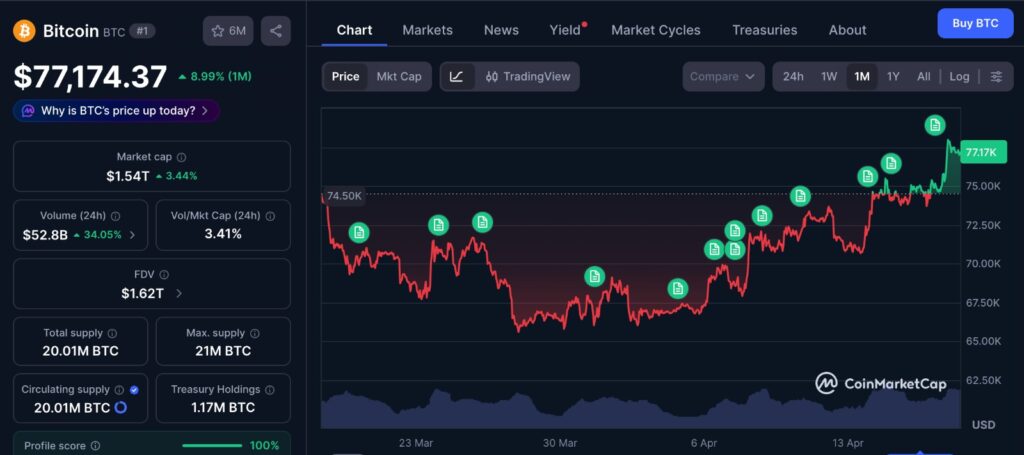
Bitcoin’s recent price movement over the past month shows how the move toward the $78K level developed gradually before triggering a sharp reaction. As price pushed higher, leveraged positioning increased alongside it, leaving the market more sensitive to any slowdown or rejection. Once momentum stalled near this level, the buildup of leveraged exposure began to unwind, leading to the large-scale liquidation event. The chart reflects not just price movement, but the conditions that allowed pressure to build before being released rapidly.
Crypto Liquidations Cross $820M as Leverage Unwinds
The crypto market saw over $820 million in liquidations within 24 hours as Bitcoin tested the $78,000 level.
Liquidations do not begin when price moves, they begin when positions lose flexibility. Leverage allows traders to control larger exposure, but it also removes their ability to hold through uncertainty. Once price moves slightly against these positions, exits are no longer optional. What appears as selling pressure is often forced execution hitting the market all at once.
The key detail is not just the size of the liquidations, but how quickly they occur. This buildup of risk was already visible in the recent surge in Ether open interest, which reflected how aggressively traders were increasing exposure before the unwind began.
When liquidations cluster within a short window:
- Selling becomes mechanical, not discretionary
- Order books are forced to absorb urgent flow
- Price moves faster than organic demand would normally allow
This is why liquidation events rarely stay contained. Once they begin, they tend to accelerate.
Bitcoin at $78K – A Level That Exposed Positioning
Bitcoin reaching the $78K zone did not simply trigger profit-taking. It exposed how aggressively the market was positioned.
Recent sessions have shown traders leaning heavily on leverage, expecting continuation rather than resistance. That expectation created fragility.
Once price failed to extend cleanly higher:
- Long positions began to unwind
- Margin thresholds were breached
- Liquidation engines activated across exchanges
This created a cascade where each forced exit added pressure to the next.
The level itself was not inherently significant. It became significant because positioning was concentrated around it.
Why Liquidations Drive Price, Not Just Reflect It
A common assumption is that price moves first and liquidations follow.
In high-leverage environments, the relationship often reverses.
Liquidations begin to drive price.
Once the first wave starts:
- Positions are force-closed
- Market orders hit the order book
- Price slips further
- More positions get liquidated
This creates a feedback loop where price declines are amplified by forced execution rather than new selling decisions.
Over the past week, similar conditions have shown that liquidation-driven moves tend to occur after periods of tight price compression, where leverage builds quietly before being released all at once.
The Real Issue – Crowded Positioning, Not Direction
The $820M liquidation event highlights a deeper issue: crowding.
Markets can absorb bullish or bearish positioning. What they struggle with is uniform positioning at scale.
When too many traders:
- Enter similar trades
- Use similar leverage
- Place risk around similar levels
The system becomes fragile.
This is not about direction being wrong. It is about positioning becoming too concentrated to remain stable.
Markets don’t break because traders are wrong – they break because too many traders are positioned the same way.
Liquidity Conditions Made the Move Worse
Another key factor behind the liquidation spike is liquidity depth.
In strong liquidity conditions:
- Large orders are absorbed
- Price adjusts gradually
- Volatility remains contained
In thinner conditions:
- Order books lack depth
- Slippage increases
- Forced selling moves price more aggressively
Liquidation events become more severe when liquidity cannot respond fast enough. The issue is not just the presence of sellers, but the absence of sufficient opposing interest.
What This Means for the Broader Crypto Market
This liquidation event reflects how the market is currently structured.
Several signals stand out:
- Leverage remains elevated across major assets
- Positioning is reactive rather than stable
- Liquidity is uneven and selective
At the same time, Bitcoin demand has failed to keep pace with price expansion, which makes leverage-driven moves more fragile when momentum slows.
This creates conditions where:
- Moves are sharper than expected
- Trends are less stable
- Reversals occur quickly
Liquidations are not anomalies in this environment. They are part of how the market resets itself.
Editor’s View: What Most Traders Miss About Liquidations
Liquidation events are often treated as reactions to price, but they are better understood as the release of structural pressure. When too much leverage builds in one direction, the market does not need a strong catalyst to move. It only needs enough imbalance to trigger forced exits. Once that process begins, price moves not because of new conviction, but because existing positions are no longer able to hold.
Conclusion
The $820M liquidation wave tied to Bitcoin’s move toward $78K was not just a volatility spike. It was a positioning reset.
Markets do not move because of price levels alone.
They move when positioning around those levels becomes unstable.
In crypto, price does not lead structure.
Structure forces price.
Disclaimer: This content is for informational purposes only and does not constitute financial advice.
Keep yourself updated with the latest crypto news with FYI Gazette
 Bitcoin
  Ethereum
  Tether
  BNB
BNB  XRP
XRP  Solana
  TRON
TRON  Dogecoin
  Litecoin
  Pepe
Pepe