Ethereum RWA Dominance Exposes ETH Demand Gap
Ethereum RWA dominance is becoming one of the strongest arguments for Ethereum’s long-term relevance, but it is also exposing a problem the market cannot ignore. Recent market data shows Ethereum holding slightly more than half of tokenized asset value on-chain, with roughly $15.7 billion in RWA value hosted on the network.
That is a major signal of infrastructure trust.
Ethereum remains central to tokenized real-world assets, stablecoin liquidity, DeFi settlement, and institutional blockchain activity. For a network often judged by price performance alone, that level of usage is not small.
It means institutions are not abandoning Ethereum.
In fact, the opposite appears true. When traditional finance looks for public blockchain infrastructure to issue, settle, or manage tokenized assets, Ethereum remains one of the first networks considered. That shows Ethereum is still treated as core financial infrastructure.
But ETH price action is telling a more complicated story.
Ethereum is proving infrastructure relevance, but ETH has not yet converted that dominance into sustained market strength. The issue is not whether Ethereum is being used. The issue is whether that usage is creating enough direct demand for ETH itself.
Infrastructure can prove relevance, but price still needs demand.
Recent sessions have shown this gap clearly: Ethereum’s adoption story remains strong, while ETH continues to trade like an asset waiting for stronger demand confirmation.
Ethereum RWA Dominance Shows Infrastructure Trust
Real-world assets, or RWAs, are traditional financial assets represented on-chain. They can include tokenized Treasuries, funds, credit products, commodities, and other instruments issued or tracked using blockchain rails.
This is where Ethereum’s position matters.
Institutions do not usually choose infrastructure casually. For tokenized assets, they need security, liquidity, developer depth, custody support, compliance tooling, and market familiarity. Ethereum has spent years building that foundation. Its network effects remain difficult to replace, especially when large financial players need a blockchain environment that other institutions already understand.
That is why Ethereum’s RWA lead is meaningful. It shows that Ethereum is not just a speculative chain used during bull markets. It is becoming part of the financial plumbing that connects crypto rails with traditional capital markets.
However, investors should be careful with one assumption.
Ethereum as infrastructure and ETH as a tradable asset are connected, but they are not the same thing.
A network can be widely used while its native token underperforms. That happens when activity does not create enough fees, scarcity, staking demand, liquidity, or spot accumulation to force a stronger repricing of the asset.
Ethereum may be winning the infrastructure layer, but ETH still needs clearer value capture.
The market is not asking whether Ethereum has utility. It is asking whether that utility creates enough reason for investors and institutions to buy or hold ETH.
Why ETH Price Is Not Following the RWA Story
The simplest mistake would be to say, “Ethereum dominates RWAs, therefore ETH must rise.”
Markets are not that simple.
RWA growth can strengthen Ethereum’s reputation without immediately creating large ETH buying pressure. Many tokenized assets settle on Ethereum or Ethereum-linked infrastructure, but the value of those assets does not automatically flow into ETH. Institutions may use Ethereum rails without holding meaningful ETH exposure beyond what is needed for operations.
That distinction matters.
If a fund tokenizes assets on Ethereum, the asset value may sit on-chain, but the direct demand is for the tokenized product, not necessarily for ETH as an investment. The network benefits from activity, credibility, and long-term relevance. ETH benefits more directly only when that activity increases fees, burns supply, deepens liquidity, strengthens staking, or makes ETH necessary for settlement, collateral, or treasury exposure.
This is also a participant behavior issue. Many institutions using blockchain infrastructure are constrained by mandates, custody rules, and risk limits. They can use Ethereum for settlement or issuance without becoming active ETH buyers.
This matters because liquidity follows obligation, not attention. If users only need ETH in small operational amounts, demand can remain limited even while Ethereum usage grows.
Right now, the market appears to be separating those two ideas.
Ethereum can be important infrastructure while ETH remains under pressure as a tradable asset. That does not disprove Ethereum’s fundamentals. It shows that the market wants clearer proof that those fundamentals are flowing into token demand. This same gap has appeared before, where Ethereum price rallies faded as network demand failed to confirm the move.
Markets do not reward usage by itself. They reward usage when it changes who needs to buy, hold, or compete for the asset.
The Market Is Asking Where Value Accrues
Earlier in crypto cycles, strong narratives were often enough to move prices. If a network had a major use case, investors quickly priced in future growth. But the market has become more selective.
Now, investors are asking a deeper question: where does the value actually accrue?
For Ethereum, that question is especially important. RWA adoption may prove that Ethereum is useful, but ETH holders need to know whether that usefulness translates into stronger token economics. If more assets are issued on Ethereum while transaction costs stay low, fee burns remain limited, and institutions avoid direct ETH accumulation, then the price reaction may stay muted.
This is not a bearish argument against Ethereum. It is a more realistic one.
Ethereum’s long-term strength may be real, but the market is no longer rewarding infrastructure adoption automatically. It wants evidence that usage is becoming economic demand.
That is the difference between being an important network and being a strongly bid asset.
The strongest crypto assets are not only used. They become difficult to ignore when users, investors, and institutions need exposure at the same time.
Ethereum RWA Dominance Still Matters
Even with ETH price weakness, Ethereum’s RWA position should not be dismissed. Infrastructure adoption often shows up before token repricing. Large financial systems do not move quickly. Institutions test, integrate, issue, settle, and expand gradually.
Ethereum’s advantage is that it already has the trust layer.
If tokenized assets continue growing, Ethereum could benefit from deeper settlement activity, larger liquidity pools, better institutional tooling, and stronger integration with stablecoins and DeFi. Over time, that could create a more direct link between network usage and ETH demand.
But that link has to be proven.
For now, the strongest takeaway is that Ethereum’s fundamentals are not weak. The transmission from those fundamentals into ETH price is weak.
That is a very different issue.
It means Ethereum may be structurally important, but ETH still needs a clearer demand catalyst.
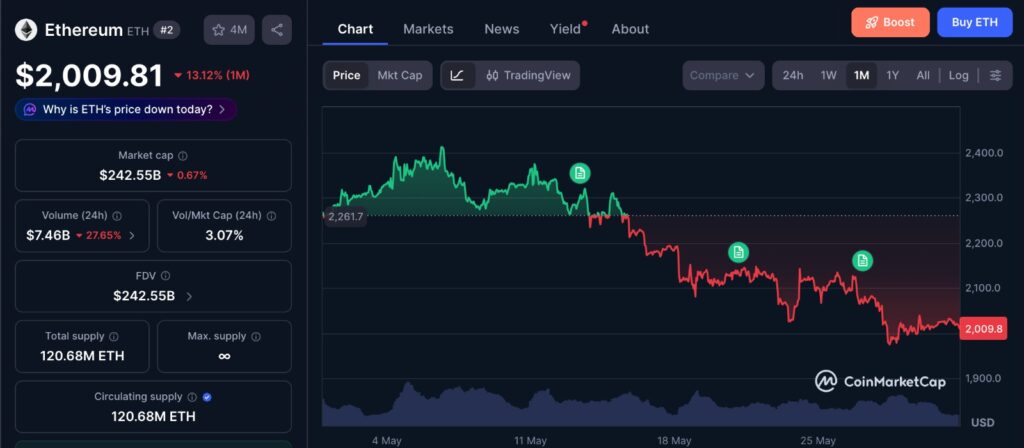
The one-month ETH price chart adds context to the wider Ethereum RWA dominance story. Even as Ethereum continues to hold a leading position in tokenized real-world assets, ETH’s recent price movement shows that the market is still waiting for clearer demand confirmation. The chart helps show the gap between infrastructure adoption and token performance. Ethereum may be gaining trust as a settlement layer for institutional assets, but ETH price strength depends on whether that activity turns into visible demand through fees, liquidity, staking, accumulation, or broader investor confidence.
ETH Price Chart Shows the Value-Accrual Gap
A CoinMarketCap ETH price chart can help readers see the gap between Ethereum’s infrastructure strength and ETH’s market performance. If ETH shows weak or sideways price action despite strong RWA activity, it reinforces the main point: Ethereum usage is not automatically translating into ETH price strength.
A weak ETH chart does not mean Ethereum’s role is broken. It shows that the market is still waiting for stronger demand from fees, liquidity, staking, accumulation, or investor confidence before fully rewarding that usage. This also matters because Ether open interest can show when trader exposure is rising faster than real demand.
The chart should be read as a reminder that markets price demand flow, not just infrastructure quality.
The Real ETH Demand Test
The next major test for Ethereum is not only whether more RWAs come on-chain. It is whether that growth changes ETH’s demand profile.
There are several ways that could happen.
If tokenized assets increase transaction activity on Ethereum, the network could see stronger fee generation. If more institutions hold ETH for settlement, collateral, staking, or balance-sheet exposure, spot demand could improve. If RWA liquidity becomes deeply connected with DeFi, Ethereum could regain a stronger role as the base layer for institutional capital flows. That is why liquidity remains important, especially when Ethereum taker volume shows whether buyers are actually stepping in rather than only reacting to a broader narrative.
But if RWA growth remains mostly product-level adoption, ETH price may continue to lag.
That is the uncomfortable part of the story.
Ethereum can be the road, but ETH still needs to become more than the toll token in the eyes of the market. Investors want to see whether ETH captures value from the traffic moving across that road.
Until then, Ethereum’s RWA lead may support the long-term thesis, but it may not be enough to change weak price action by itself.
Editor’s View: Ethereum’s Problem Is Not Relevance
The market is not questioning whether Ethereum matters. It is questioning how much of Ethereum’s importance belongs to ETH holders.
That is the key difference.
Ethereum RWA dominance proves that institutions still view the network as credible financial infrastructure. But ETH price weakness shows that credibility alone does not create automatic token demand. Too many Ethereum arguments treat network adoption and token appreciation as the same outcome.
They are not.
For ETH to respond more strongly, the market needs to see RWA growth produce measurable economic pressure. That could come through higher fees, deeper liquidity, stronger staking demand, more institutional ETH accumulation, or renewed confidence in Ethereum’s role as the settlement layer for tokenized finance.
Ethereum has earned institutional trust, but ETH has not yet forced institutional urgency.
Until that changes, Ethereum may remain one of crypto’s most important networks while ETH continues trading like a risk asset under pressure.
Ethereum is winning infrastructure trust. ETH still has to win back market demand.
Final Thoughts
Ethereum RWA dominance is a powerful long-term signal, but it should not be treated as a guaranteed ETH price catalyst.
The network remains central to tokenized finance, stablecoin liquidity, and institutional blockchain adoption. That gives Ethereum a serious infrastructure advantage. But ETH price weakness shows that investors are not yet convinced this role is creating enough direct token demand.
For now, the market is drawing a line between Ethereum usage and ETH performance.
That line can close only if RWA growth starts feeding into stronger fees, liquidity, staking demand, accumulation, or investor confidence. Until then, Ethereum’s strongest infrastructure story may continue to coexist with a weaker ETH price chart.
That is not a contradiction.
Price does not move because infrastructure is respected. It moves when that respect becomes demand the market can see.
Disclaimer: This content is for informational purposes only and does not constitute financial advice.
Keep yourself updated with the latest crypto news with FYI Gazette
Keep yourself updated with the latest Altcoin News with FYI Gazette
 Bitcoin
  Ethereum
  Tether
  BNB
BNB  XRP
XRP  Solana
  TRON
TRON  Dogecoin
  Litecoin
  Pepe
Pepe