Zcash Whale Short Tests ZEC Buyers Near Key Resistance
Zcash is facing a fresh positioning test after a major Zcash whale short added pressure to a market still trying to recover from its recent decline.
The trade matters because ZEC is no longer only reacting to its chart breakdown. That shift follows an earlier phase where Zcash price strength was tied to privacy coin demand, making the current short more important as a test of whether that demand can still hold under pressure. It is now being watched as a battle between visible bearish positioning and futures buyers still absorbing pressure. The key question is not just whether ZEC can bounce, but whether buyer demand can become strong enough to challenge the short near key resistance.
The whale reportedly opened a $4.92 million 2x leveraged short near $417.80, according to market data cited in the original report. The position gained attention because the trader had already booked $11.66 million in realized profits from two earlier ZEC trades. That track record gives the latest short more weight among traders who follow large on-chain and derivatives positions.
However, the bearish trade does not confirm market direction on its own.
Zcash Whale Short Adds Pressure To ZEC
Large whale shorts can influence sentiment because they give the market a clear reference point. A similar pattern has appeared before when a Bitcoin whale short created market caution, showing how visible bearish positioning can affect trader behavior even before price confirms direction. When a trader with a profitable record builds new bearish exposure, other participants may become more cautious about chasing upside.
That is now the case with ZEC.
The fresh short suggests that at least one major trader expects weakness to continue or believes the rebound attempt may fail near resistance. For a token already under pressure, this can make buyers more hesitant and encourage short-term sellers to defend key upside levels.
Still, a whale short is not the same as confirmed market direction.
A short position can pressure sentiment, but it also creates risk for the seller if the market moves against it. If ZEC begins to reclaim lost structure while futures buyers remain active, bearish positioning could become more exposed.
That is why the setup matters more than the headline trade.
Markets do not move because one large trader takes a side. They move when positioning becomes heavy enough that the other side is forced to react.
Futures Buyers Are Still Absorbing Pressure
The stronger part of the bullish argument comes from futures taker data.
Despite the whale’s bearish position, 90-day futures taker CVD has remained buyer-dominant in the cited data. In simple terms, aggressive buyers have continued lifting offers instead of allowing sellers to fully control market orders.
That does not make ZEC automatically bullish. It means the market has not fully accepted the bearish trade as the only signal that matters.
This is where the setup becomes more important. If buyers absorb sell pressure while price holds near the same zone, the market may be trying to build a base. But if that absorption fails to lift price, it can also show that demand is present but not strong enough to reverse control.
Absorption only matters if it changes execution. If buyers absorb supply but cannot lift price, sellers remain in control.
Liquidity is not continuous. Once nearby sell orders are absorbed, price needs fresh buying or short covering to move toward the next pocket of available liquidity. Without that follow-through, absorption can slow the decline without changing the structure.
Over the past week, ZEC has shown that same tension in price behavior: sellers have stayed active, but buyers have not fully stepped away.
For now, ZEC is caught between two signals. Sellers have the recent breakdown and the whale short. Buyers have futures taker activity and early signs that downside momentum may be slowing.
The market is not asking whether buyers exist. It is asking whether they can move price after absorbing the supply.
ZEC Still Needs To Reclaim Key Levels
The chart remains the biggest problem for ZEC bulls.
ZEC is still trading below its broken ascending channel, which means the broader structure has not fully recovered. A move back above that broken zone would strengthen the bullish case because it would show that sellers failed to defend the breakdown.
Until then, the rebound remains incomplete.
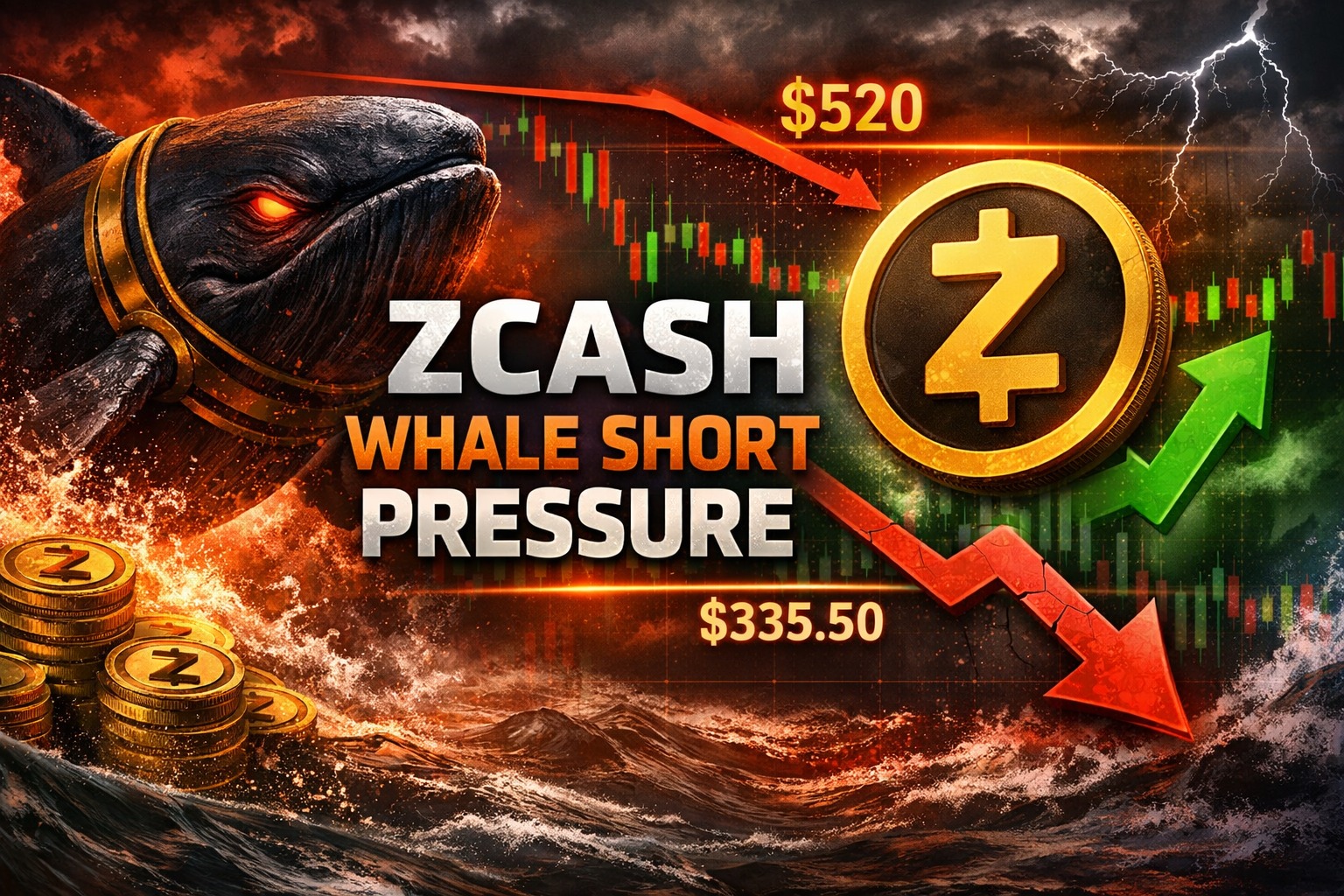
The nearest major resistance sits near $520. That level matters because it is where bearish positioning could face a stronger test. A clean move above it would suggest buyer absorption is turning into price strength, forcing traders to reassess short exposure.
On the downside, $335.50 remains the next important support level if ZEC fails to reclaim higher ground. That keeps the market focused on Zcash price correction support levels if buyers fail to turn absorption into a stronger reclaim. A rejection below resistance could bring that area back into focus, especially if futures buyers lose control of market orders.
Recent sessions have shown that ZEC does not need only buying activity. It needs buying activity strong enough to change structure.
That is the difference between a bounce and a recovery. A bounce can happen when sellers pause. A recovery needs buyers to take control of execution.
ZEC Price Chart Shows the Reclaim Test
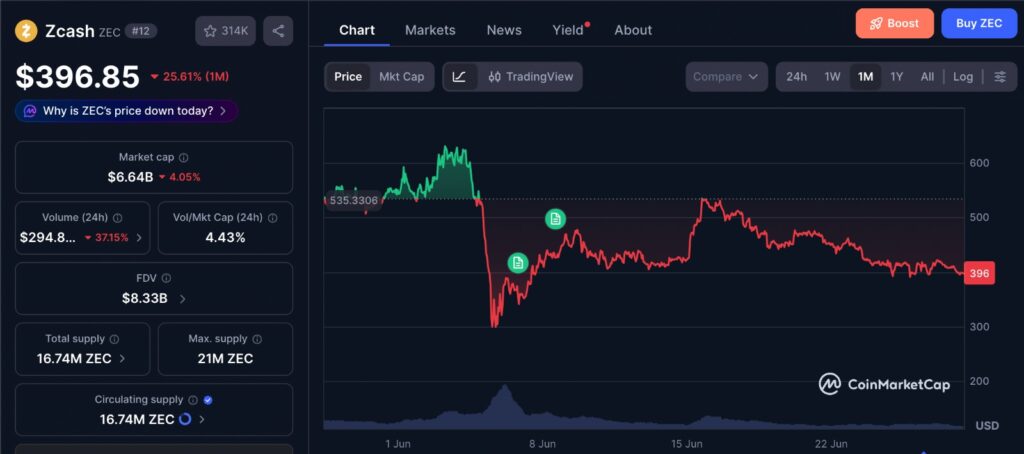
The one-month CoinMarketCap ZEC chart shows why the current setup is more than a simple rebound attempt. ZEC is still trying to stabilize after its recent decline, while buyers attempt to defend price below the key resistance area. The important signal is not only whether ZEC bounces, but whether it can hold higher levels after absorbing sell pressure. If price continues to stall below resistance, the whale short may remain an important sentiment anchor. If buyers push ZEC closer to the $520 zone and hold there, the market will have a stronger test of whether absorption is turning into control.
If ZEC reclaims broken structure and holds above it, the whale short could face a stronger test. If price rejects below resistance and moves back toward $335.50, bearish positioning may continue to shape sentiment.
Oversold Signals Are Not Enough Yet
Momentum indicators show that selling pressure has cooled, but that is not the same as a confirmed reversal.
The Stochastic RSI has dropped into deeply oversold territory, with readings near 4.03 and 6.45 in the cited data. That suggests the selloff may be stretched in the short term. Oversold readings can sometimes support a relief bounce, especially when price stops falling despite negative sentiment.
But oversold does not mean undervalued. It also does not mean buyers have regained control.
This is a key distinction for ZEC. Weak momentum can slow a decline, but only reclaiming lost levels can change market confidence. If price remains below resistance, traders may still treat bounces as temporary rather than structural.
The Parabolic SAR signal also suggested the broader trend had not fully confirmed a bearish flip, but that signal still needs price confirmation. Without a stronger recovery, the market may continue to respect the whale short more than the buyer-dominant taker data.
Editor’s View: ZEC Is Testing Positioning, Not Just Price
ZEC’s next move depends on whether buyer absorption can force bearish positions to react. The whale short matters because it gives traders a visible bearish reference point, but it does not decide the trend by itself.
Futures buyer activity matters for the opposite reason. It suggests sellers are not fully controlling execution, even while the chart remains weak. That balance is what makes this setup worth watching.
Until price reclaims structure, futures buying is support, not confirmation. The market needs proof that buyers can turn absorption into control, not just evidence that they are still present.
Zcash Whale Short Leaves ZEC at a Reclaim Test
The Zcash whale short has raised pressure on ZEC at a sensitive point in the chart. It gives sellers a visible reference point, while futures taker data suggests buyers are still active under the surface.
The $520 area remains the key upside test. A stronger reclaim would challenge bearish positioning, while failure below resistance could keep $335.50 in focus as the next downside support level.
For now, the setup is not cleanly bullish or bearish. The move begins when that balance breaks. ZEC does not need another headline to change sentiment. It needs proof that buyers can turn absorbed supply into control.
Disclaimer: This content is for informational purposes only and does not constitute financial advice.
Keep yourself updated with the latest crypto news with FYI Gazette
Keep yourself updated with the latest Altcoin News with FYI Gazette
 Bitcoin
  Ethereum
  Tether
  BNB
BNB  XRP
XRP  Solana
  TRON
TRON  Dogecoin
  Litecoin
  Pepe
Pepe