

Whale Dumps Bitcoin for $22M Ethereum Long as ETH Rotation Bet Builds
Ethereum is beginning to attract speculative capital away from Bitcoin, but the latest whale trade also shows why the market should be careful about calling it a confirmed rotation.
Wallet data showed that two newly created wallets sold 72 Bitcoin worth around $4.66 million before opening leveraged long positions covering 12,000 ETH. The Ethereum exposure was valued at approximately $22.4 million and reportedly used 20x leverage.
The sequence matters.
This was not simply a trader adding Ethereum to an existing portfolio. Bitcoin was sold first, and the capital was then used to support a much larger directional bet on ETH.
That makes the position a clear expression of relative preference. In the short term, the trader appears to expect Ethereum to outperform Bitcoin.
However, the heavy leverage means the position reflects speculative conviction rather than long-term accumulation.
Whale Converts Bitcoin Into Leveraged ETH Exposure
The wallets entered the trade as Ethereum attempted to hold above $1,800.
ETH had recently rebounded from that area and moved near $1,875, placing the leveraged position close to an important short-term support test.
Selling approximately $4.66 million in BTC did not produce a similarly sized ETH position. Through leverage, the trader expanded that capital into more than $22 million of Ethereum exposure.
This distinction matters because leveraged demand behaves differently from spot buying.
A spot buyer can hold through short-term volatility without facing forced liquidation. A leveraged trader must maintain enough collateral, manage funding costs and avoid price moves that threaten the position.
Even when the wider thesis remains intact, a relatively small decline can force a highly leveraged trader to reduce exposure.
Leverage increases exposure without adding the same amount of underlying capital to the market. It can strengthen an initial move, but it does not create the same depth of support as direct buying.
Leverage can make a rotation appear larger before the underlying capital has fully arrived.
That is the mechanism behind the rotation risk: leverage can create large ETH exposure quickly, but it only becomes durable rotation if spot buyers remove real supply from the market.
The trade reflects confidence, but it also leaves little room for error.
CMC Chart Analysis
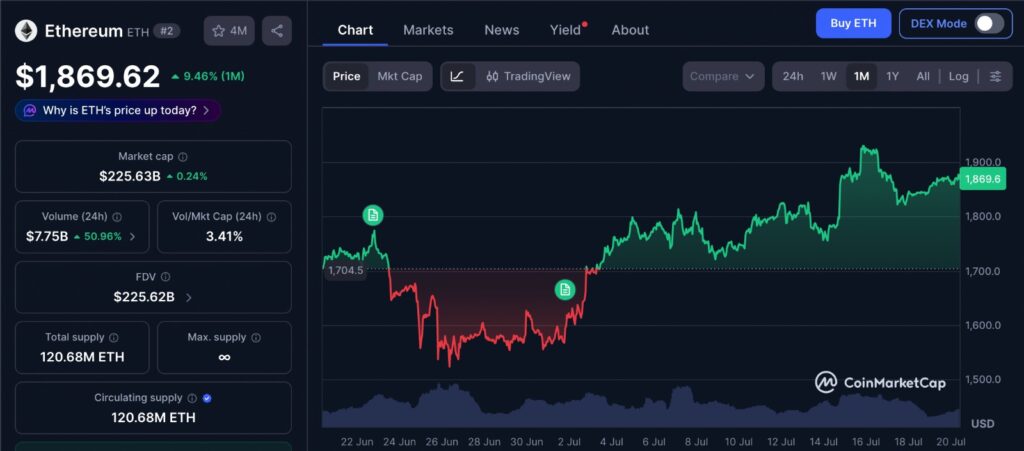
Ethereum’s one-month chart shows ETH trading around the $1,800 region as the whale’s BTC-to-ETH rotation bet gained attention. The important signal is not the rebound alone, but whether Ether can continue holding near this area after leveraged demand enters the market. Sustained support would suggest that wider spot buyers are absorbing available supply, while another weak reaction near $1,875 to $1,900 would indicate that the rotation thesis still lacks broader confirmation.
The key point is not only whether ETH has rebounded, but whether price can hold near support after leveraged demand enters the market.
A stronger hold would suggest buyers are absorbing supply beyond one whale trade, while a weak reaction would show that the rotation thesis still needs broader confirmation.
Ethereum Rotation Is Emerging Through Derivatives
The whale was not operating in isolation.
Ethereum derivatives positioning had also become more optimistic. The taker buy-sell ratio reportedly moved above 1 and reached 1.13, indicating that traders were using more aggressive orders to buy than to sell in the derivatives market.
Market data also pointed to increased futures activity and a long-short ratio above 1 on Binance during the same period. This rise in positioning also fits the broader increase in Ether open interest and trader exposure, which can support short-term momentum while making the market more sensitive to any slowdown in buying. These figures suggest that bullish positioning was building, although they remain a snapshot of derivatives activity rather than proof of a lasting capital shift.
Derivatives buying can increase because of short-term positioning, hedging or traders attempting to capture a limited move. It does not require the same amount of ETH to be purchased in the spot market.
A trader can create millions of dollars in ETH exposure through futures without removing a similar amount of ETH from available supply. That is why Ethereum taker volume and buyer absorption matter: aggressive orders can lift price quickly, but lasting support depends on whether buyers continue taking available supply.
That exposure can influence price quickly when nearby sell orders are limited. Once those orders are absorbed, price must move higher to find the next group of holders willing to sell.
However, this does not necessarily create lasting support.
A durable rotation would need consistent spot purchases, stronger investment-product flows and sustained relative performance against Bitcoin. Those signals would show that capital is being reallocated into ETH rather than temporarily amplified through leverage.
Why the Bitcoin Sale Matters More Than the ETH Long
Large Ethereum long positions regularly attract attention, but the Bitcoin sale gives this trade a more meaningful market context.
Bitcoin usually acts as the crypto market’s main liquidity anchor. During uncertain conditions, traders often reduce exposure to more volatile assets and move capital toward BTC.
Selling Bitcoin to increase leveraged Ethereum exposure reverses that defensive pattern.
It suggests that the trader saw greater near-term opportunity in ETH and was willing to give up Bitcoin exposure to express that view.
This does not prove a long-term portfolio shift. It does, however, make the trade more meaningful than a standard ETH long funded with idle collateral.
If Ethereum continues to outperform Bitcoin, similar reallocations could strengthen the rotation argument. If ETH struggles despite heavier futures positioning, it would suggest that leveraged traders moved ahead of the spot market.
When many leveraged traders enter around similar prices, they often share similar risk points. A decline toward those levels can force several positions to close at once, adding selling pressure as available liquidity begins to thin.
A rotation is not confirmed by the size of one trade. It is confirmed by demand that continues absorbing supply after the initial momentum fades.
The $1,800 Area Becomes a Positioning Test
Ethereum’s ability to remain above $1,800 is central to the whale’s thesis.
The level has recently acted as an area where buyers attempted to absorb selling pressure. Holding above it would show that demand extends beyond the initial leveraged position.
A move through the recent range near $1,875 to $1,900 could improve short-term sentiment, but briefly crossing those levels would not be enough.
A rejection around that range would show that available supply remains strong and that the rotation thesis still needs wider confirmation.
Recent sessions have shown ETH rebounding from $1,800 before returning toward the same area, making buyer behaviour around support more useful than any single intraday move.
If ETH holds while spot activity improves and funding remains controlled, the move would have a healthier foundation. If price rises mainly because traders continue adding leverage, the market would remain more exposed to a forced unwind.
The key test is whether demand remains present when fresh leveraged positioning begins to slow.
High Leverage Leaves Little Room for Volatility
The reported 20x leverage creates a clear risk.
At that level, the trader’s market exposure is several times larger than the capital supporting the position.
The precise liquidation point depends on the entry price, collateral structure, maintenance margin and any later adjustments. Even so, the position would generally have limited tolerance for a meaningful decline.
Funding fees add another constraint.
When long positioning becomes crowded, traders may have to pay more to keep bullish perpetual-futures positions open. Those costs can reduce returns even when ETH remains close to the entry price.
More importantly, highly leveraged positions can amplify downside moves.
If Ethereum falls toward levels where traders must reduce exposure, liquidations may introduce automatic selling. A previous Ethereum leverage reset through long liquidations showed how quickly bullish positioning can turn into forced selling when leveraged traders reach similar risk levels. That selling can push price lower and trigger further position closures.
The effect becomes stronger when fewer buy orders are available nearby. Forced sellers must accept progressively lower prices to find demand, turning an ordinary pullback into a sharper move.
The same leverage that expands ETH exposure can therefore become a source of instability if support weakens.
What Would Confirm a Broader ETH Rotation?
One whale trade cannot establish a market-wide shift from Bitcoin to Ethereum.
The clearest confirmation would be sustained ETH outperformance against BTC, supported by stronger spot purchases and consistent investment-product inflows. Tracking Ethereum’s relative strength against Bitcoin is therefore more useful than watching ETH’s dollar price alone, because a true rotation requires ETH to outperform the asset capital is supposedly leaving.
Buyer behaviour during pullbacks would also matter. If ETH repeatedly absorbs selling without requiring another increase in futures leverage, that would suggest underlying demand is strengthening.
Leverage would also need to remain controlled. A move supported by spot buying is generally more durable than one that depends on increasingly large derivatives positions.
Together, relative strength, spot demand, investment flows and pullback absorption would provide stronger evidence of a genuine BTC-to-ETH rotation.
Editor’s View
The whale trade matters because it connects a Bitcoin sale directly to a leveraged Ethereum position.
It shows that at least one large participant saw greater near-term opportunity in ETH and was willing to reduce BTC exposure to act on that view.
Yet the structure of the position limits what can reasonably be concluded.
A 20x long is not the same as a long-term investor converting Bitcoin into unleveraged Ethereum holdings.
It is a short-term directional bet shaped by price timing, funding costs and market liquidity.
That does not make the trade meaningless. It makes the source of demand more important.
The position is an early sign of speculative preference for ETH over BTC, but a broader rotation still requires spot buyers, investment flows and sustained relative strength.
The trade becomes a genuine BTC-to-ETH rotation signal only when spot demand keeps removing available supply after leveraged positioning stops doing the work.
Disclaimer: This content is for informational purposes only and does not constitute financial advice.
 Bitcoin
  Ethereum
  Tether
  BNB
BNB  XRP
XRP  Solana
  TRON
TRON  Dogecoin
  Litecoin
  Pepe
Pepe