
Aave v4 on Avalanche Sets Up Tokenized Collateral Markets
Aave v4 on Avalanche expands the protocol’s new lending infrastructure beyond Ethereum for the first time, giving the network a more flexible base for markets built around tokenized collateral.
The deployment matters for more than Aave’s multichain growth.
Tokenized Treasurys, money market funds, private credit and corporate bonds have already shown that traditional assets can be represented on public blockchains. The harder test is whether those assets can support borrowing, liquidity management and credit activity without creating new areas of concentrated risk.
Aave v4 could provide part of that missing infrastructure.
Its architecture allows lending markets with different collateral rules and risk controls to access shared liquidity. On Avalanche, that structure could support specialized markets for tokenized assets instead of forcing every type of collateral into the same lending environment.
The launch therefore moves the tokenization discussion beyond issuance. The more important question is whether those assets can be used productively once they are onchain.
Aave v4 on Avalanche Uses a More Flexible Lending Structure
Traditional DeFi lending markets generally work best with liquid crypto assets that trade continuously and can be sold quickly during a liquidation.
Real-world assets behave differently.
A tokenized Treasury product may have restricted holders, limited trading hours or a redemption process tied to an external institution. Private credit may be harder to value or sell. Corporate bonds can also carry different maturity, credit and settlement risks.
Those differences make it difficult to place every asset inside one general lending pool.
Aave v4 addresses this through a Hub and Spoke structure. Liquidity sits in a central hub, while separate spokes can be created for different collateral types or borrowing strategies.
Each spoke can have its own loan limits, collateral rules and risk controls while still accessing the broader liquidity base.
The structural advantage is the ability to isolate risk without also isolating capital.
This does not remove risk. It gives the protocol more control over where risk sits and how much exposure each market can create.
Avalanche Could Test Tokenized Collateral Demand
Aave’s Avalanche deployment is expected to begin with conventional crypto assets, including AVAX, Bitcoin-linked assets, Ether-linked assets and stablecoins.
The broader plan includes a specialized real-world asset hub that could eventually support tokenized US Treasurys, money market funds, private credit and corporate bonds. Each asset would still need governance approval and a separate risk review before entering the protocol.
This makes the deployment infrastructure, not a completed tokenized credit market.
Meaningful adoption will require asset issuers, lenders, borrowers, pricing systems, redemption channels and risk managers to participate together.
A tokenized bond has limited DeFi value if investors can only hold or transfer it. Its role changes when it can secure a stablecoin loan, support liquidity management or help an institution access short-term funding without selling the underlying asset.
That is where tokenization can begin to improve capital efficiency rather than simply changing how ownership is recorded.
Recent tokenization growth has made issuance easier to see, but lending markets will show whether those assets are actually useful under financial pressure. That distinction also shapes Ethereum’s tokenization momentum and its wider demand test, where rising asset activity still needs to translate into measurable network and market usage.
Avalanche gives Aave a place to test that model, but ecosystem support alone does not create borrower demand or lender confidence.
Tokenized Assets Need Utility After Issuance
The tokenized real-world asset market has grown quickly, but much of that growth remains concentrated in issuance and passive yield products.
More than $34 billion in real-world assets were represented on public blockchains at the time of the launch, compared with approximately $12.8 billion one year earlier, according to data cited in the announcement coverage.
That growth shows demand for blockchain-based ownership and settlement. It does not prove that deep secondary markets or sustainable credit activity have developed around those assets. A similar gap can be seen in Ethereum’s RWA dominance and the limited demand flowing back to ETH, showing that growth in tokenized assets does not automatically create deeper economic activity around the underlying network.
Lending could help close that gap.
An investor holding a tokenized Treasury fund may prefer to borrow against it rather than redeem the position and lose its yield exposure. A business holding tokenized receivables or private credit could use those assets to obtain working capital.
These use cases still depend on systems outside the blockchain.
The token may trade onchain, while its legal ownership, cash flows and redemption rights remain tied to offchain issuers. If transfers are restricted, pricing becomes unreliable or redemption is delayed, a lending market may struggle to value or sell the collateral.
Putting an asset onchain can improve its movement, but it does not automatically improve its liquidity.
Shared Liquidity Could Improve Capital Efficiency
One of the most important features of Aave v4 is the ability for specialized markets to access shared liquidity.
Without that structure, every new lending market may need its own group of depositors. This can fragment capital and leave smaller pools with limited borrowing capacity, unstable rates or poor execution for larger users. The liquidity gap between PYUSD and USDC shows why asset supply alone is not enough, since deeper and more consistent liquidity usually determines whether users can execute larger transactions efficiently.
Shared liquidity allows several spokes to draw from one central hub while keeping separate collateral controls.
A tokenized Treasury market and a private-credit market should not operate with identical loan limits or liquidation rules. However, both may need access to the same borrowable asset, such as a stablecoin.
The shared hub can serve that demand without treating both forms of collateral as though they carry the same risk.
This matters because liquidity is not unlimited. Once the cheapest available capital is borrowed, rates rise and larger transactions become more expensive to execute.
Shared liquidity improves efficiency when markets are calm, but it also requires strict controls so one poorly designed collateral market does not drain capital from safer ones.
AAVE Price Chart Shows the Market Reaction
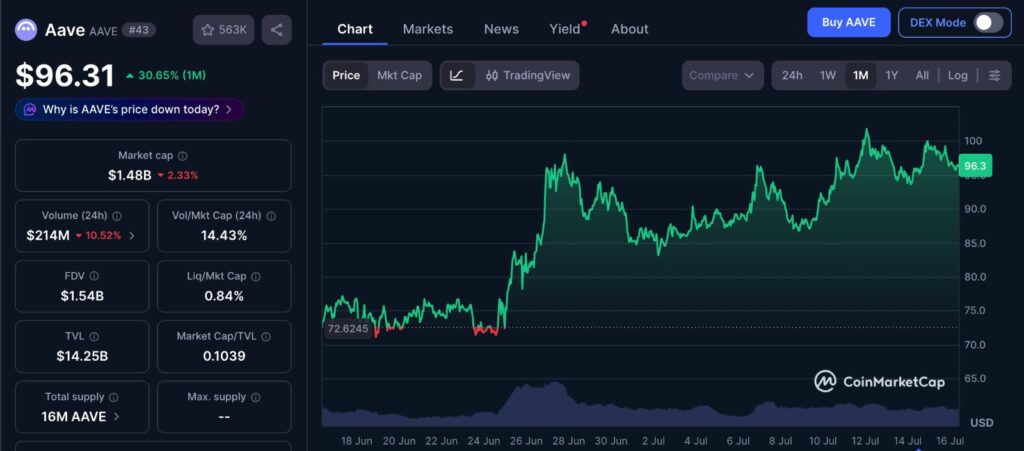
AAVE’s one-month price chart provides context for how traders are responding to the broader rollout of Aave v4. Short-term price movement may reflect announcement-driven positioning, but a sustained market response would likely require evidence that Aave v4 on Avalanche is attracting deposits, borrowers and meaningful lending activity. The chart therefore shows current sentiment around the launch, while protocol utilization will offer a clearer measure of whether tokenized collateral can develop into a lasting source of demand.
If AAVE holds gains while usage grows on Avalanche, the market may begin pricing v4 as more than a deployment headline. If the price fades despite the launch, traders may be waiting for evidence that tokenized lending demand can produce meaningful protocol activity.
Tokenized Lending Still Depends on Risk Infrastructure
The case for tokenized collateral is not that traditional assets will replace crypto collateral. It is that DeFi lending could support a wider range of financial activity using assets with different risk and return profiles.
Treasury products may appear more stable than many cryptocurrencies, but stable prices do not guarantee easy liquidation.
Tokenized assets still depend on issuers, legal rights, transfer rules and redemption access. If those systems fail or slow down, the collateral may become difficult to sell even if its quoted value has not moved sharply.
This directly affects lending terms.
Lenders may demand higher rates or lower loan limits when collateral cannot be sold quickly. Borrowers may also receive less capital against assets that appear stable but have limited buyers during stress.
Collateral earns trust not because it looks stable, but because it can still be sold when conditions tighten.
Risk infrastructure therefore matters as much as the lending contracts themselves. Reliable oracles, transparent asset structures, compliant transfer systems and dependable redemption channels will be necessary if tokenized collateral is expected to support meaningful borrowing.
Editor’s View: Tokenization Needs Credit, Not Just Issuance
The important shift is not simply that traditional assets can move onchain. The larger question is whether they can support borrowing, liquidity management and reliable exits when market conditions become difficult.
Aave v4 gives Avalanche a structure for building those markets, but it does not guarantee demand.
Tokenized collateral still needs borrowers, lenders, accurate pricing, clear legal rights and dependable redemption channels. Without those pieces, a market may attract deposits without producing useful credit activity.
Shared liquidity can improve capital efficiency, but it also increases the need for strict limits. A weak collateral market should not be able to place safer pools under unnecessary pressure.
That is why utilization matters more than total value locked alone. Deposits show that assets are present. Borrowing and sustainable interest payments show that the market is being used.
What Comes Next for Aave v4 on Avalanche
Aave v4 on Avalanche creates the structure for specialized tokenized collateral markets, but the next stage will determine whether that structure attracts meaningful activity.
The market should watch which assets are proposed, how loan limits are set and whether each collateral type has reliable pricing, liquidity and redemption support.
Utilization will be the stronger signal. A large amount of deposited collateral can increase total value locked, but a functioning credit market requires borrowers, lenders and sustainable demand for capital.
Aave v4 on Avalanche will become more significant if liquidity, borrower demand and reliable exits develop together.
Tokenized lending scales not when more assets are issued, but when those assets can support credit without becoming difficult to exit under pressure.
Disclaimer: This content is for informational purposes only and does not constitute financial advice.
 Bitcoin
  Ethereum
  Tether
  BNB
BNB  XRP
XRP  Solana
  TRON
TRON  Dogecoin
  Litecoin
  Pepe
Pepe