
PYUSD Market Cap Drops 35% as USDC Shows Why Stablecoin Liquidity Still Matters
PYUSD market cap has fallen sharply from its March peak, turning PayPal’s stablecoin into a clear test case for the next phase of stablecoin adoption.
The decline does not show that brand trust is useless. It shows that in stablecoins, brand recognition only matters when it turns into repeated liquidity flow. A trusted name can bring attention, but it does not automatically create deep trading routes, institutional settlement flows, or dominant exchange usage.
According to recent stablecoin market data, PYUSD’s market cap has fallen about 35% from its all-time high near $4.2 billion in March. The token’s supply has since contracted to around the $2.5 billion range, with most of that value still reportedly sitting on Ethereum. PYUSD also has supply across Solana, Arbitrum, and Stellar, but its scale remains far smaller than the largest stablecoin networks.
At the same time, USDC continues to show why stablecoin dominance is built through movement, not only issuance. Market reports noted a record $4.4 billion USDC transfer linked to Coinbase and Hyperliquid activity, while additional USDC was reportedly minted on Solana. That contrast matters because stablecoins become more valuable when they are embedded in trading, settlement, and liquidity rails.
Recent sessions have shown a clear gap between tokens that are simply available and tokens that large players already use to move capital. That is the real story behind the PYUSD market cap drop. Stablecoin adoption is not just about launching a branded dollar token. It is about becoming the asset that exchanges, institutions, market makers, payment apps, and DeFi users route through every day.
Why PYUSD Market Cap Fell From Its Peak
PYUSD entered the market with a major advantage. PayPal is one of the most recognizable payment brands in the world, and its stablecoin has a clear payments-focused identity. The token is designed to maintain a dollar peg and can be used across supported blockchain networks.
However, stablecoin supply is not sticky by default. Capital can move quickly between tokens when yields, liquidity, exchange support, and transaction flows change. A market-cap decline in a stablecoin usually reflects a contraction in circulating supply rather than a price crash, since the token is designed to remain close to $1.
That makes PYUSD different from a volatile crypto asset. The issue is not whether traders are dumping PYUSD because they expect the price to fall. The issue is whether enough users need to hold and move PYUSD at scale when USDT and USDC already dominate most stablecoin activity.
This is where the contraction becomes more important. PYUSD has brand trust, but USDT and USDC already sit inside stronger liquidity networks. They are integrated into more trading pairs, settlement routes, custody workflows, DeFi pools, and institutional processes.
This matters because stablecoin liquidity tends to gather where activity already exists. Once exchanges, traders, and payment flows settle around a few tokens, each new transfer reinforces the same routes and makes alternatives harder to scale.
That is the mechanism behind stablecoin dominance: every large transfer, trading pair, and settlement route makes the strongest rails harder to replace.
Stablecoin markets reward utility that repeats daily. A one-time launch can create attention, but repeated flows create staying power.
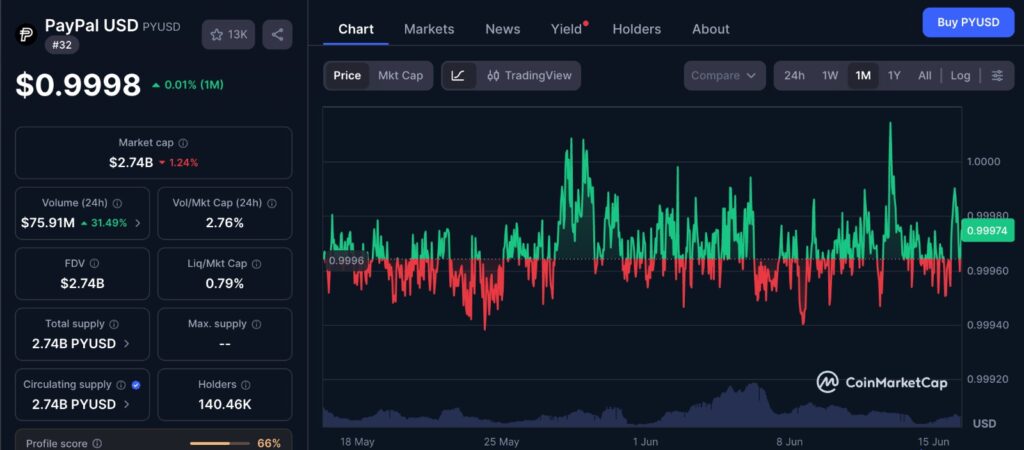
The 1-month PYUSD price chart shows the stablecoin continuing to trade close to its $1 peg, which is important context for readers. The issue is not a price crash or a clear peg failure. Instead, the sharper signal sits in PYUSD’s shrinking market cap, which points to circulating supply contraction as capital moves toward deeper stablecoin liquidity routes. For a stablecoin, holding the peg is only one part of the story. The bigger test is whether users keep holding, moving, and routing value through it.
USDC’s Record Transfer Shows the Other Side of Adoption
USDC’s large transfer activity shows how different the adoption curve can look when a stablecoin sits inside core market infrastructure.
A $4.4 billion USDC movement is not only a headline number. It points to the size of the routes that USDC can support between major trading venues and liquidity destinations. For institutions and large traders, that matters because a stablecoin is only useful if it can move large amounts without friction, delays, or weak counterparties.
That gives USDC an advantage in markets where regulated access, exchange connectivity, and institutional comfort matter. USDT remains the largest stablecoin by overall market share, but USDC continues to hold a strong position in U.S.-linked exchange flows, DeFi integrations, and institutional routing.
PYUSD is trying to enter that same battlefield from a payments angle. PayPal’s distribution gives it a real advantage, especially if usage expands through merchant payments and cross-border settlement. But the current market-cap drop shows that distribution must convert into repeat movement before it becomes durable stablecoin demand.
PYUSD has distribution. USDC has routing.
The stablecoin market is not short of dollar tokens. It is short of tokens that users keep using because the rails around them are already deep.
Stablecoin Adoption Depends on Liquidity, Not Just Trust
Trust matters in stablecoins, but it is only the first layer. Users need to believe a token is properly backed and redeemable. After that, the market asks a harder question: where can the token actually be used? That is why broader stablecoin market risk cannot be judged only by whether a token holds its peg, but also by whether liquidity, redemption confidence, and repeat usage remain durable.
For PYUSD, that question is still open. PayPal gives it a strong consumer and payments narrative, but stablecoin scale is usually built where liquidity already lives. Exchanges, liquidity providers, DeFi protocols, and institutional desks tend to prefer the tokens with the deepest pools and widest routing options.
That creates a circular advantage for USDT and USDC. More usage creates deeper liquidity. Deeper liquidity attracts more usage. Over time, that loop becomes difficult for newer stablecoins to break.
This is also why stablecoin competition is not only a branding contest. It is an execution contest. Large users do not choose a stablecoin only because it is familiar; they choose the one that lets them enter, exit, settle, and rotate capital with the least disruption.
Liquidity is not just about how much supply exists. It is about how easily that supply can move when size matters.
When liquidity is thin, even a trusted token can become less useful for larger transfers. When liquidity is deep, the same asset becomes easier to route, easier to price, and harder to replace.
This does not make PYUSD irrelevant. It makes PYUSD’s next stage more demanding. The token needs more than availability across networks. It needs repeated reasons for users to hold it, move it, settle with it, and build around it.
Stablecoins do not win because they exist. They win because the market keeps finding reasons to use them.
What PYUSD Needs To Prove Next
The next test for PYUSD is not whether it can recover its previous market cap. The more important test is whether its supply becomes tied to durable activity.
If PYUSD growth comes mainly from short-term incentives or temporary campaigns, supply can contract when those incentives fade. If growth comes from merchant settlement, exchange usage, payment corridors, DeFi liquidity, and institutional routing, then the market cap becomes more durable.
That distinction matters because stablecoin supply can look strong during expansion phases but weaken quickly when capital finds better routes elsewhere. PYUSD’s 35% decline is a reminder that stablecoins are judged by retention as much as growth.
For PayPal, the long-term opportunity is still meaningful. A payments giant with direct user access has advantages that many crypto-native issuers do not have. But to compete with USDT and USDC, PYUSD needs to turn that access into measurable on-chain and exchange activity.
The market is not saying PayPal cannot build a major stablecoin. It is saying the stablecoin market already has strong incumbents, and those incumbents are protected by liquidity, integrations, and habit.
In stablecoins, distribution opens the door. Liquidity decides whether users stay.
PYUSD Market Cap Drop Is a Stablecoin Reality Check
PYUSD’s market-cap decline should be read as a stablecoin reality check rather than a simple bearish signal.
The token still has a major brand behind it, multi-chain presence, and a clear payments use case. However, the current contraction shows that stablecoin adoption is harder than launching a compliant, dollar-backed asset.
USDC’s large transfer activity highlights the difference between availability and deep market use. PYUSD is available. USDC is already routed through major liquidity channels. That gap is where stablecoin competition is being decided.
For now, USDT and USDC remain the strongest players because they are not only trusted. They are liquid, widely integrated, and already part of the market’s daily operating system.
PYUSD can still grow, but the next phase will depend on whether PayPal can convert brand trust into actual stablecoin flow. A stablecoin does not become important when it is launched. It becomes important when capital keeps choosing it as the easiest route to move.
Disclaimer: This content is for informational purposes only and does not constitute financial advice.
Keep yourself updated with the latest crypto news with FYI Gazette
Keep yourself updated with the latest Altcoin News with FYI Gazette
 Bitcoin
  Ethereum
  Tether
  BNB
BNB  XRP
XRP  Solana
  TRON
TRON  Dogecoin
  Litecoin
  Pepe
Pepe