

Bitcoin Rate Cut Risk Grows as Warsh FOMC Keeps Crypto Liquidity Tight
Bitcoin rate cut risk is becoming the bigger problem for crypto markets as traders move past the first reaction to Iran headlines and refocus on liquidity.
The market is not ignoring geopolitics. Comments around the US-Iran situation still matter because energy prices can affect inflation expectations, Treasury yields, and risk appetite. However, Bitcoin’s weakness now looks less like a simple headline reaction and more like a test of whether liquidity conditions can support another recovery attempt.
That is where Warsh’s first FOMC meeting becomes important. The Federal Reserve’s decision to hold interest rates steady was widely expected, but the market is now trying to understand what new Fed leadership means for future rate cuts, inflation tolerance, and financial conditions.
For crypto, that uncertainty matters because Bitcoin does not trade only on narratives. It also trades on available liquidity, institutional demand, and the willingness of buyers to absorb supply when macro pressure rises.
When liquidity is loose, traders are more willing to buy weakness. When liquidity is uncertain, the same dip can become a waiting game.
Bitcoin Rate Cut Risk Turns Into a Liquidity Test
Bitcoin has struggled to regain stronger upside momentum as rate-cut expectations remain unclear. When traders believe lower rates are near, risk assets usually get more room to recover because liquidity expectations improve. When rate cuts look less certain, buyers tend to become more selective.
That does not mean Bitcoin must fall because the Fed remains cautious. It means the market has less room for weak demand.
This is the key difference. A geopolitical headline can create a fast move, but monetary policy can decide whether that move becomes a trend. If investors believe the Warsh Fed will keep liquidity tight for longer, Bitcoin needs stronger spot demand to defend support levels and rebuild confidence. That makes Bitcoin demand weakness an important part of the current macro setup, because tight liquidity leaves less room for weak buyer participation.
At the moment, that demand signal still looks uneven.
Recent market data showed Bitcoin under pressure near the mid-$64,000 area, while US-listed spot Bitcoin ETFs have reportedly seen about $2.1 billion in net outflows so far in June. At the same time, Coinbase Bitcoin pricing has traded at a discount compared with international USDT pairs for several weeks, suggesting that US-based demand has not been strong enough to lead the market.
That combination matters more than the price level alone.
Bitcoin can absorb negative headlines when buyers are active. It becomes more vulnerable when macro uncertainty appears at the same time as institutional flows weaken.
Iran Headlines Still Feed the Rate-Cut Debate
The US-Iran situation remains a market risk because energy prices can feed directly into inflation expectations. If oil supply fears return, investors may worry that inflation stays stickier for longer. That is why Bitcoin oil risk remains important when geopolitical headlines affect inflation expectations and the timing of future rate cuts. That can make the Fed less willing to cut rates quickly.
This is why crypto traders cannot fully separate geopolitics from monetary policy. Iran headlines may be the visible trigger, but the deeper issue is what those headlines do to inflation and rate expectations.
Brent crude recently eased from its latest spike, reducing some immediate pressure. However, Treasury yields remained firm, showing that bond traders were not fully convinced that inflation risk had disappeared.
That is the link that matters for Bitcoin.
If oil risk cools but yields stay elevated, the market is saying the problem is not only energy. It is broader uncertainty around inflation, policy credibility, and the timing of rate cuts.
Bitcoin tends to perform best when liquidity expectations are improving. Right now, the market is still waiting for proof that those conditions are changing.
Why Rate-Cut Expectations Matter More Than the Headline
The biggest risk for Bitcoin is not one Fed decision. It is the possibility that traders entered this phase expecting easier policy, only to find that the path toward rate cuts remains unclear.
That creates a difficult setup. If the Fed sounds cautious, liquidity expectations stay tight. If inflation risks rise again, rate cuts become harder to price. If institutional flows remain weak, Bitcoin has fewer buyers ready to absorb selling pressure.
This is how a macro headline becomes a liquidity problem.
Markets do not move because uncertainty exists. They move when uncertainty changes buyer behavior.
That is why Warsh’s first FOMC meeting matters. Investors are not only asking whether rates stayed unchanged. They are asking whether Fed communication under Warsh will give risk assets enough confidence to price easier conditions ahead.
So far, Bitcoin has not received a clear answer.
This matters because execution changes when confidence is low. Tight liquidity does not only reduce buying power. It changes execution. Buyers lower bids, wait for confirmation, and force price to travel farther before real demand appears.
Liquidity is not continuous. Once nearby demand is absorbed, price has to move lower to find the next group of buyers willing to step in.
Recent sessions have shown that Bitcoin’s problem is not only the size of each decline, but the lack of strong follow-through after each bounce. That is often where positioning matters, because uncertain traders reduce exposure quickly and rebuild it slowly.
ETF Outflows and Coinbase Discount Keep Recovery Fragile
Spot Bitcoin ETF flows remain one of the clearest signals to watch because they show whether institutional buyers are adding exposure or stepping back.
ETF outflows do not automatically mean Bitcoin is entering a deeper breakdown. However, persistent Bitcoin ETF outflows can reduce the strength of recovery attempts when macro liquidity is already tight. They do, however, reduce the strength of recovery attempts. When ETFs are absorbing supply, Bitcoin has a stronger base beneath the market. When ETFs are leaking capital, price rallies need support from other buyers.
That support has not been obvious.
The reported Coinbase discount versus international markets also matters because it suggests US spot demand has been weaker than offshore activity. That keeps US Bitcoin demand central to whether BTC can rebuild support without relying only on short-term relief. In stronger phases, Coinbase premiums often reflect aggressive US buying. A persistent discount sends the opposite message.
It shows that Bitcoin’s problem is not only fear. It is participation.
If buyers return through ETFs and US spot markets, Bitcoin can stabilize even with macro uncertainty. If they do not, every rally risks depending more on short-term positioning than durable demand.
That is the structural issue. A market can bounce on short covering or headline relief, but it needs real buyers to hold higher levels. Without that follow-through, rallies can look convincing for a few sessions before running into the same liquidity problem again.
Bitcoin Price Chart Shows the Liquidity Test
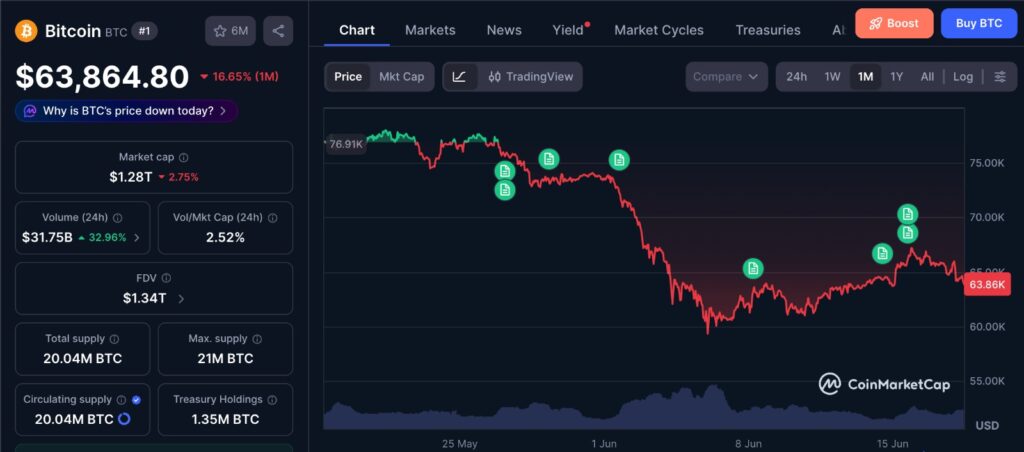
The 1-month Bitcoin chart shows how BTC has struggled to rebuild steady momentum as rate-cut uncertainty, ETF outflows, and weaker US spot demand keep liquidity conditions tight. The key signal is not only whether Bitcoin rebounds from short-term weakness, but whether buyers can hold higher levels after each recovery attempt. If price keeps fading despite quieter headlines, it would suggest the market is still waiting for stronger liquidity confirmation rather than reacting to macro relief alone.
If BTC rebounds while flows improve, the market may be starting to rebuild support. If price keeps fading despite quieter headlines, it would suggest the liquidity problem is still driving the move.
Strategy Concerns Add Another Layer of Caution
Strategy-related concerns add another layer of caution because the company remains one of the most visible Bitcoin treasury holders.
There is no evidence that Strategy is being forced to sell BTC, but stress around its preferred equity structure can still weigh on psychology. For Bitcoin traders, the issue is less about immediate selling and more about confidence.
In a market already dealing with ETF outflows, weak US spot demand, and uncertain rate-cut expectations, even symbolic pressure can make buyers more patient.
That waiting behavior is often what weakens support. Price does not always fall because sellers are overwhelming. Sometimes it falls because the buyers expected to defend the market choose patience instead of urgency.
Bitcoin Needs More Than Relief From Geopolitics
A calmer Iran backdrop could help risk assets, especially if oil prices stay contained. However, that alone may not be enough to repair Bitcoin’s structure.
The market needs evidence that liquidity conditions are improving. That could come from stronger ETF inflows, a recovery in US spot demand, softer inflation signals, or clearer Fed communication around future rate cuts.
Until then, Bitcoin remains exposed to a narrow path.
If macro pressure cools and institutional demand returns, the current weakness could become a base-building phase. If rate-cut expectations keep fading while ETF outflows continue, Bitcoin may struggle to turn relief rallies into sustained recoveries.
This is the difference between a market reacting and a market recovering.
A reaction can happen quickly when headlines improve. A recovery needs buyers willing to absorb supply across multiple sessions.
For now, Bitcoin’s next important signal may not come from one dramatic headline. It may come from whether buyers consistently appear when liquidity is still uncomfortable.
Editor’s View
Bitcoin’s current setup is not just about Iran, oil, or one Fed meeting. It is about whether the market still has enough liquidity confidence to support risk exposure.
Warsh’s first FOMC meeting has made that question harder to ignore. Traders may have expected policy clarity, but they are instead facing a market where rate cuts remain uncertain, Treasury yields are firm, and institutional Bitcoin demand has not yet shown a strong reset.
That leaves Bitcoin vulnerable, not because the long-term thesis has disappeared, but because the near-term liquidity backdrop is still fragile.
Bitcoin does not need perfect macro conditions to recover. It does need buyers who are willing to act before every risk is resolved.
For now, flows matter more than headline relief. If ETF demand improves and US spot participation strengthens, Bitcoin has a clearer path to rebuild support. If those signals stay weak, quieter headlines may not be enough.
Bitcoin Rate Cut Risk Leaves Recovery Dependent on Flows
Bitcoin rate cut risk remains the core issue because the Warsh Fed has not yet given markets a clear path toward easier liquidity. Iran and oil headlines still matter, but mainly because they can influence inflation expectations, Treasury yields, and the timing of future rate cuts.
That makes ETF flows and Coinbase pricing important signals. They show whether real buyers are returning or whether the market is still relying on short-term relief.
Bitcoin will not strengthen because the headlines become quieter. It will strengthen when real demand starts absorbing supply before the market gets perfect clarity.
Disclaimer: This content is for informational purposes only and does not constitute financial advice.
Keep yourself updated with the latest crypto news with FYI Gazette
 Bitcoin
  Ethereum
  Tether
  BNB
BNB  XRP
XRP  Solana
  TRON
TRON  Dogecoin
  Litecoin
  Pepe
Pepe