
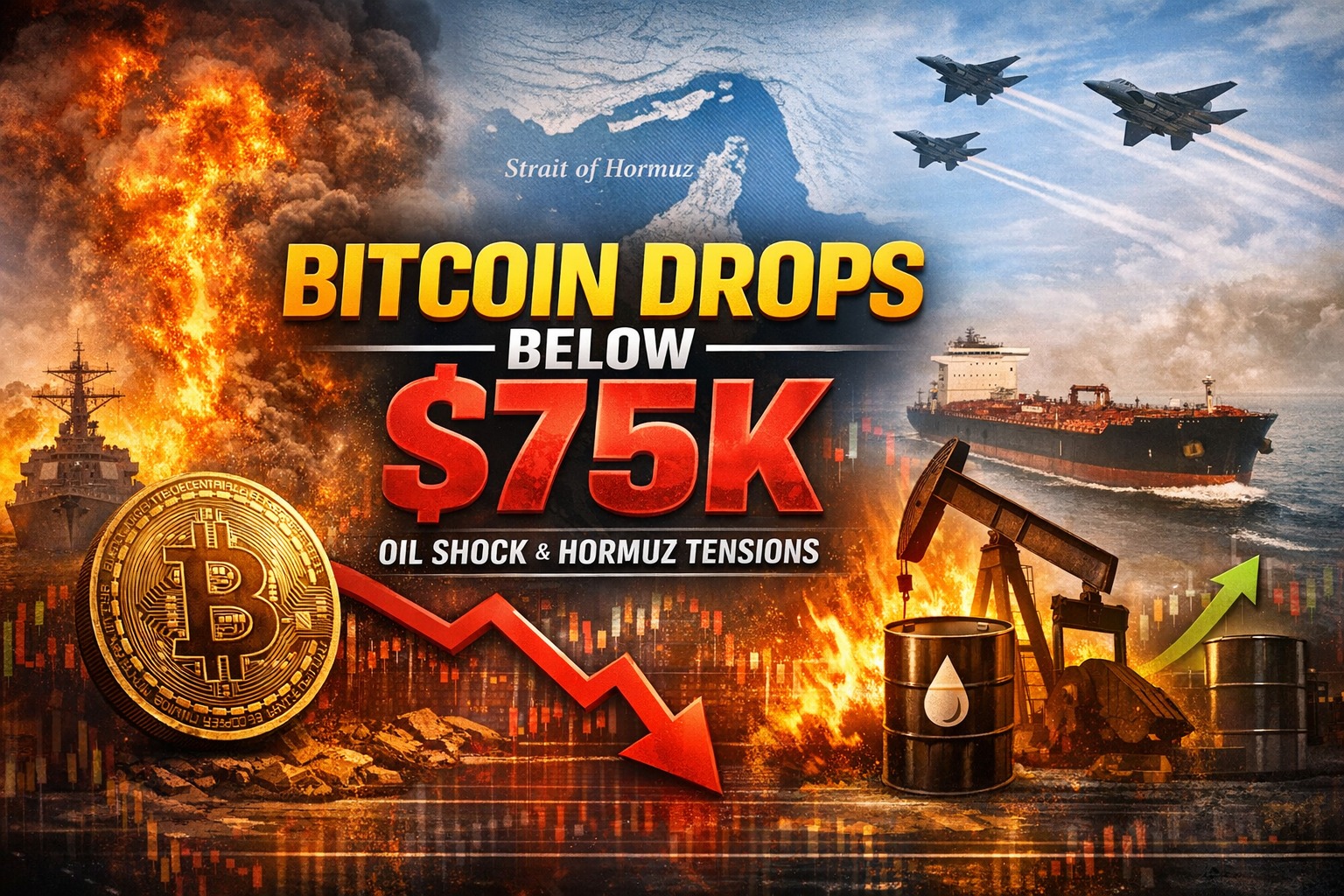
Bitcoin Drops Below $75K as Hormuz Tensions Push Oil Higher and Risk Appetite Weakens
Bitcoin price drop below $75K is not just a technical move, it reflects how quickly global liquidity conditions can shift when macro pressure builds. Markets react less to headlines and more to what those headlines do to capital flows, inflation expectations, and risk tolerance. The renewed focus on the Strait of Hormuz has turned what looked like a stable recovery into a more fragile environment. When energy markets destabilize, crypto adjusts rather than leads.
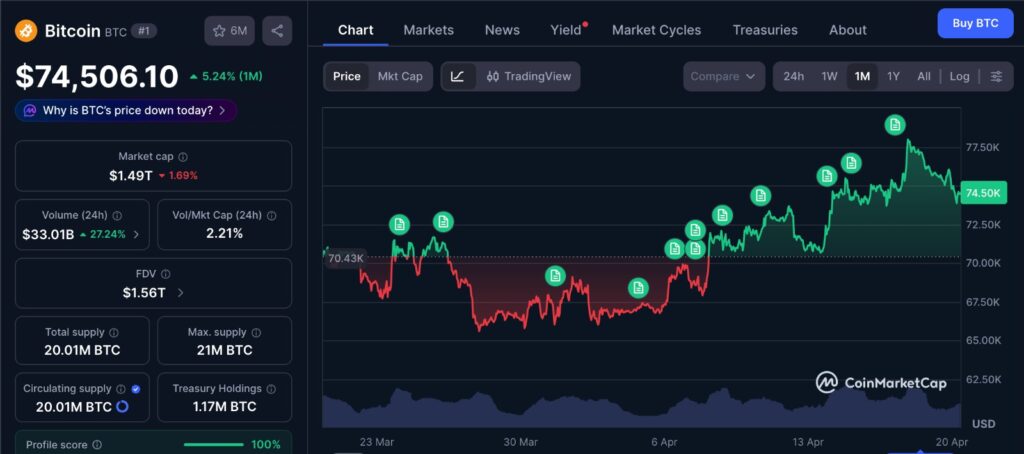
Bitcoin’s recent price action reflects this shift in conditions. The chart shows how price struggled to maintain upward momentum after approaching higher levels, with pullbacks aligning closely with periods of increased macro uncertainty. Rather than a sudden breakdown, the movement appears more like a controlled adjustment, where buyers become less aggressive as external pressure builds. This kind of behavior typically signals that the market is not losing interest, but becoming more cautious as liquidity conditions tighten.
Bitcoin Falls as Oil Shock Reshapes Market Sentiment
Bitcoin slipped back toward the $75,000 region after a sharp rise in oil prices triggered a broader risk-off shift across global markets. The move followed renewed geopolitical tension around the Strait of Hormuz, bringing energy supply risks back into focus.
Oil’s reaction matters because it feeds directly into expectations.
When oil rises quickly, markets reassess inflation risk. That shift influences how capital is allocated, especially in assets that rely on supportive liquidity.
The sequence is consistent:
- Oil rising shifts inflation expectations
- Inflation expectations influence policy outlook
- Policy outlook affects liquidity conditions
- Liquidity conditions shape demand for risk assets
Bitcoin’s pullback fits into this chain. It is responding to a change in financial conditions rather than the event itself.
The Strait of Hormuz Effect: Why This Event Matters
The Strait of Hormuz remains one of the most critical energy routes globally, with a significant portion of oil supply passing through it. Any disruption quickly translates into global pricing pressure.
When risk around the strait increases:
- Oil prices move sharply
- Supply uncertainty spreads across markets
- Energy costs feed into inflation expectations
- Capital becomes more selective
This is where the connection to crypto becomes clearer.
Markets are reacting to uncertainty, not the event itself. That uncertainty reduces the willingness to hold leveraged or risk-sensitive positions, including Bitcoin.
At a structural level, rising energy costs tighten liquidity at the margins. When that happens, leveraged positions become harder to maintain, forcing participants to reduce exposure even if their broader view has not changed.
Recent sessions have shown this clearly. As oil moved higher, Bitcoin struggled to hold momentum near local highs, reflecting how quickly positioning adjusts when conditions shift.
This Is Not Panic Selling, It Is Positioning Adjustment
The recent drop does not show signs of panic-driven selling or disorderly exits.
Instead, it reflects a shift in positioning.
Participants had begun to price in improving conditions:
- Expectations of stability
- Reduced geopolitical risk
- Stronger risk asset performance
When those assumptions changed, positioning had to adjust.
Markets do not need fear to move lower. They only need positioning that no longer fits the environment.
This adjustment happens quickly because leveraged and short-term exposure reacts faster than long-term conviction. This dynamic becomes more visible during sharp moves, where large crypto liquidation events show how quickly leveraged positions can unwind once conditions shift.
Why Oil Drives Crypto More Than People Think
The relationship between oil and Bitcoin is indirect, but structurally important.
Oil does not affect crypto through direct demand. It influences expectations.
- Higher oil prices increase inflation pressure
- Higher inflation pressure affects monetary expectations
- Monetary expectations influence liquidity availability
- Liquidity availability determines how much risk capital can stay in the market
This also explains why Bitcoin demand lag becomes more visible during uncertain conditions, where price struggles not because interest disappears, but because sustained buying pressure fails to build.
This is why Bitcoin often behaves like other risk assets during macro-driven events.
Markets don’t move because news appears, they move because liquidity adjusts.
Once liquidity expectations tighten, even strong assets can lose momentum without any change in their underlying narrative.
Short-Term Stability Depends on One Thing
The current environment is less about upside catalysts and more about stability.
That stability depends largely on whether energy markets settle.
If oil remains volatile:
- Risk appetite is likely to stay constrained
- Positioning will remain cautious
- Bitcoin may continue to reflect that hesitation
If conditions stabilize:
- Inflation expectations ease
- Liquidity outlook improves
- Risk exposure becomes easier to maintain
Recent price behavior shows how quickly this can shift, with Bitcoin moving in line with changes in energy-driven sentiment rather than independent crypto developments.
Editor’s View: This Is a Liquidity Story, Not a Crypto Story
What stands out is how dependent Bitcoin has become on broader financial conditions. This is not a case of demand disappearing. It is a case of conditions becoming less supportive for that demand to remain in place. Price does not fall because buyers vanish, it falls when holding risk becomes less comfortable. The Hormuz situation is simply a trigger. The real driver is how quickly capital adjusts when uncertainty enters the system. Bitcoin is no longer operating on the edge of the financial system. It is reacting from within it.
Disclaimer: This content is for informational purposes only and does not constitute financial advice.
Keep yourself updated with the latest crypto news with FYI Gazette
Read more about Memecoins with FYI Gazette
Keep yourself updated with the latest Altcoin News with FYI Gazette
 Bitcoin
  Ethereum
  Tether
  BNB
BNB  XRP
XRP  Solana
  TRON
TRON  Dogecoin
  Litecoin
  Pepe
Pepe