

Bitcoin ETF Outflows Test Market Exhaustion as Record Streak Raises a Bigger Question
Bitcoin ETF outflows are sending a clear warning signal, but the market may need to look beyond the surface of the data.
U.S. spot Bitcoin ETFs have reportedly recorded a record 10-day outflow streak, with nearly $3 billion leaving the products over the period. At first glance, the message looks simple. Investors are reducing exposure, institutional demand has weakened, and confidence has taken a visible hit.
That part is true.
But the bigger question is whether the market is only seeing weak ETF demand, or whether it is also watching the later stage of a crowded selling cycle.
Bitcoin ETF outflows are negative because they show investors pulling capital from Bitcoin exposure. They matter because spot Bitcoin ETFs have become one of the clearest public signals of regulated market demand. When inflows are strong, they support the idea that larger allocators are adding exposure. When redemptions persist, they show risk reduction, caution, and frustration from investors who no longer want to sit through volatility.
Markets rarely turn when the data looks comfortable. They often begin to stabilize when positioning becomes one-sided and sellers have already acted.
That is why this ETF streak matters.
Bitcoin ETF Outflows Show Real Demand Weakness
The current Bitcoin ETF outflows cannot be dismissed as noise. A multi-day run of redemptions shows that investors are not simply pausing. They are actively removing capital from products that were previously treated as one of Bitcoin’s strongest demand channels.
That weakens the near-term setup.
ETF selling reduces one of Bitcoin’s most visible demand pillars. It also changes how other participants behave. Traders become less willing to chase rebounds, market makers become more cautious, and short-term buyers often wait for clearer signs of support before stepping in. This is not the first time ETF pressure has weighed on Bitcoin’s momentum, as earlier Bitcoin ETF outflows showed how redemptions can stall BTC near major price zones.
This matters because liquidity is not only about how much capital exists. It is about how willing buyers are to execute while sellers are still active. When withdrawal pressure stays visible, many buyers delay their bids, which can make even normal selling feel heavier.
For Bitcoin, that matters when price is already struggling to build momentum. A market can absorb bad news when liquidity is strong and buyers are confident. It becomes more fragile when ETF redemptions, weak spot demand, cautious risk appetite, and broader uncertainty appear at the same time. The pressure also fits with a broader theme already seen in Bitcoin’s bull run demand lag, where price strength has struggled without stronger follow-through from buyers.
Recent sessions have shown how quickly sentiment can shift when a major demand channel turns from support into pressure.
The streak is therefore not bullish by itself. It confirms that investors have been de-risking. But it also opens a second question: how much of that risk reduction has already happened?
Why a Record Outflow Streak Can Become a Contrarian Signal
The more interesting part of this move is not simply that Bitcoin ETF outflows are large. It is that they have become persistent enough to look crowded.
When redemptions stretch across several sessions, they can show more than weak demand. They can also show that a large portion of nervous holders have already taken action. That is where the exhaustion question begins.
Markets do not stabilize because everyone turns bullish. They stabilize when the next seller becomes harder to find.
That is the difference between weak demand and exhausted selling pressure.
Weak demand means buyers are not stepping in strongly enough. Exhausted selling means sellers may be running out of urgency. Both can exist at the same time. That creates a transition phase where price remains heavy, but downside momentum becomes harder to extend.
The contrarian signal is not the outflow itself. It is the possibility that the most urgent sellers have already acted.
That does not guarantee a rebound. Extreme redemptions can become a contrarian test only if Bitcoin stops reacting badly to them. If price keeps falling easily, the market is still showing weak absorption. If price begins to hold despite continued flow pressure, the selling pressure may be losing force.
The question is not only, “Are ETF investors selling?”
The better question is, “How much selling pressure is still left after this streak?”
Bitcoin Needs Absorption, Not Just Better Headlines
For Bitcoin, the next major signal is not whether traders call ETF outflows bullish or bearish. The real signal is whether the market can absorb the selling without losing structure.
Absorption is now the key test.
If redemptions continue and Bitcoin keeps falling easily, demand remains too weak. That would suggest the market has not yet found enough buyers to handle capital leaving the products, profit-taking, or broader risk reduction.
But if flow pressure remains elevated while Bitcoin stops reacting as violently, that would be more meaningful. It would suggest that sellers are still present, but their impact is weakening.
A market does not always bottom on good news. Sometimes it bottoms when bad news stops producing the same downside response.
The ETF flow number matters, but the price reaction to that number matters even more.
If billions leave Bitcoin ETFs and price continues to break down, the signal remains a clear warning. If billions leave and Bitcoin begins holding key zones despite the pressure, then the market may be showing that buyers are absorbing supply.
Liquidity is not continuous. Once nearby buy orders are filled, price has to move lower to find the next group of willing buyers. That is why absorption matters more than the headline number.
Price does not need perfect news to stabilize. It needs enough real demand to absorb the bad news already in front of it.
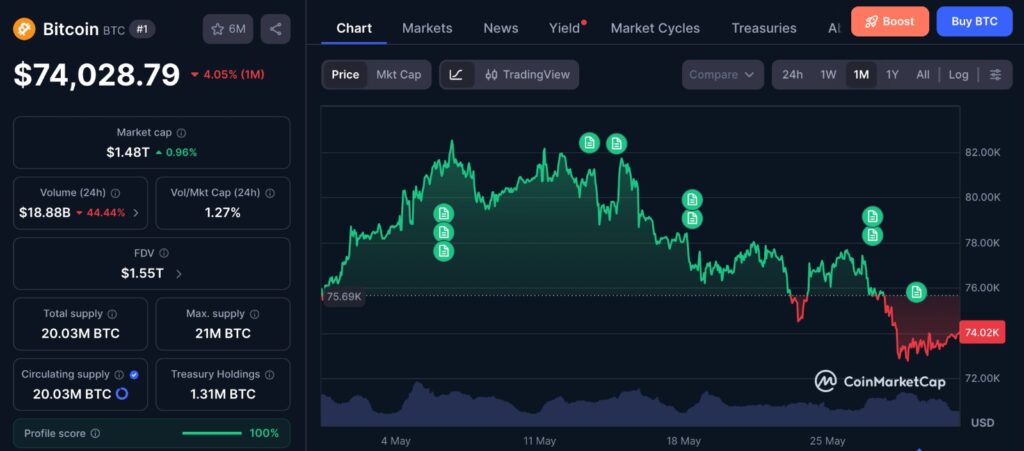
The one-month BTC chart from CoinMarketCap helps show why the current Bitcoin ETF outflows matter beyond the headline number. The chart reflects how price has been reacting during a period of sustained ETF redemption pressure, which makes the next move especially important. If Bitcoin continues to weaken while capital leaves the products, it would suggest demand is still too thin to absorb the selling. But if BTC begins holding steadier despite continued outflows, it may show that the most urgent sellers have already acted and that absorption is starting to improve.
ETF Outflows Also Reveal a Sentiment Problem
The current ETF streak also shows how quickly sentiment can reverse in Bitcoin.
Earlier, spot Bitcoin ETFs were treated as a structural demand engine. Strong inflows were often used as proof that institutional adoption was still expanding and regulated capital was supporting the market. Now, the same channel is being watched for signs of stress.
That shift matters because ETF investors are not always long-term holders with unlimited patience. Some are tactical allocators. Some are portfolio managers adjusting exposure. Some entered through familiar brokerage products and may leave when volatility rises.
When inflows are strong, they create confidence. When redemptions extend, they create doubt. That doubt can spread into the broader market, especially when traders begin treating ETF selling as evidence that larger investors are stepping away. That caution has also appeared in broader market sentiment, with the Crypto Fear and Greed Index showing a more neutral Bitcoin market near key price levels.
But sentiment extremes are rarely clean signals. Heavy withdrawals can mean investors are giving up near a weak point. They can also mean the market is repricing real risk. Both can be true at the same time.
That is why the safest reading is balanced.
Bitcoin ETF outflows are clearly negative on the surface, but a record streak may also show that selling pressure is becoming crowded.
The Market Is Testing Whether Fear Has Gone Too Far
The current setup does not give Bitcoin a free bullish signal. It gives the market a test.
If redemptions slow in the coming sessions, that would suggest the strongest phase of withdrawal pressure may be easing. If they remain heavy but Bitcoin holds firm, that would also be constructive because it would show improved absorption.
However, if ETF selling accelerates and price continues to lose important support areas, the exhaustion argument becomes weaker. In that case, the market would still be dealing with active distribution rather than late-stage selling fatigue.
That is why this moment should not be reduced to a simple bullish or bearish headline.
The ETF data shows pressure. The streak shows stress. But the extremity of the move raises a second possibility: investors may be selling after much of the fear has already been priced in.
For Bitcoin, the next phase depends on whether demand appears while the market is still uncomfortable.
Editor’s View
The strongest signal from Bitcoin ETF outflows is not the outflow number alone. It is the relationship between flows and price reaction.
A record outflow streak shows that investors have been reducing exposure aggressively. That is real stress. But when selling becomes this visible, the market also starts testing whether that pressure is already crowded.
The real risk is not that ETFs had redemptions. The real risk is that Bitcoin fails to stabilize even after those redemptions become extreme.
This is not a clean bullish setup. It is an exhaustion test.
Bitcoin ETF Outflows Put the Market at a Critical Test
Bitcoin ETF outflows show real stress in one of the market’s most visible demand channels. The record streak confirms that investors have been reducing exposure, but it also raises a more important question: whether the most urgent selling has already happened.
The next signal is not the size of the streak alone. It is whether Bitcoin keeps falling easily on continued redemptions, or begins holding firm despite them. That reaction will say more about market strength than the headline flow number.
Bitcoin does not recover because outflows look extreme. It stabilizes when sellers lose control of the move and buyers absorb the pressure.
Disclaimer: This content is for informational purposes only and does not constitute financial advice.
Keep yourself updated with the latest crypto news with FYI Gazette
 Bitcoin
  Ethereum
  Tether
  BNB
BNB  XRP
XRP  Solana
  TRON
TRON  Dogecoin
  Litecoin
  Pepe
Pepe