
Crypto Fear and Greed Index Turns Neutral as Bitcoin Holds $80K, But Liquidity Still Matters
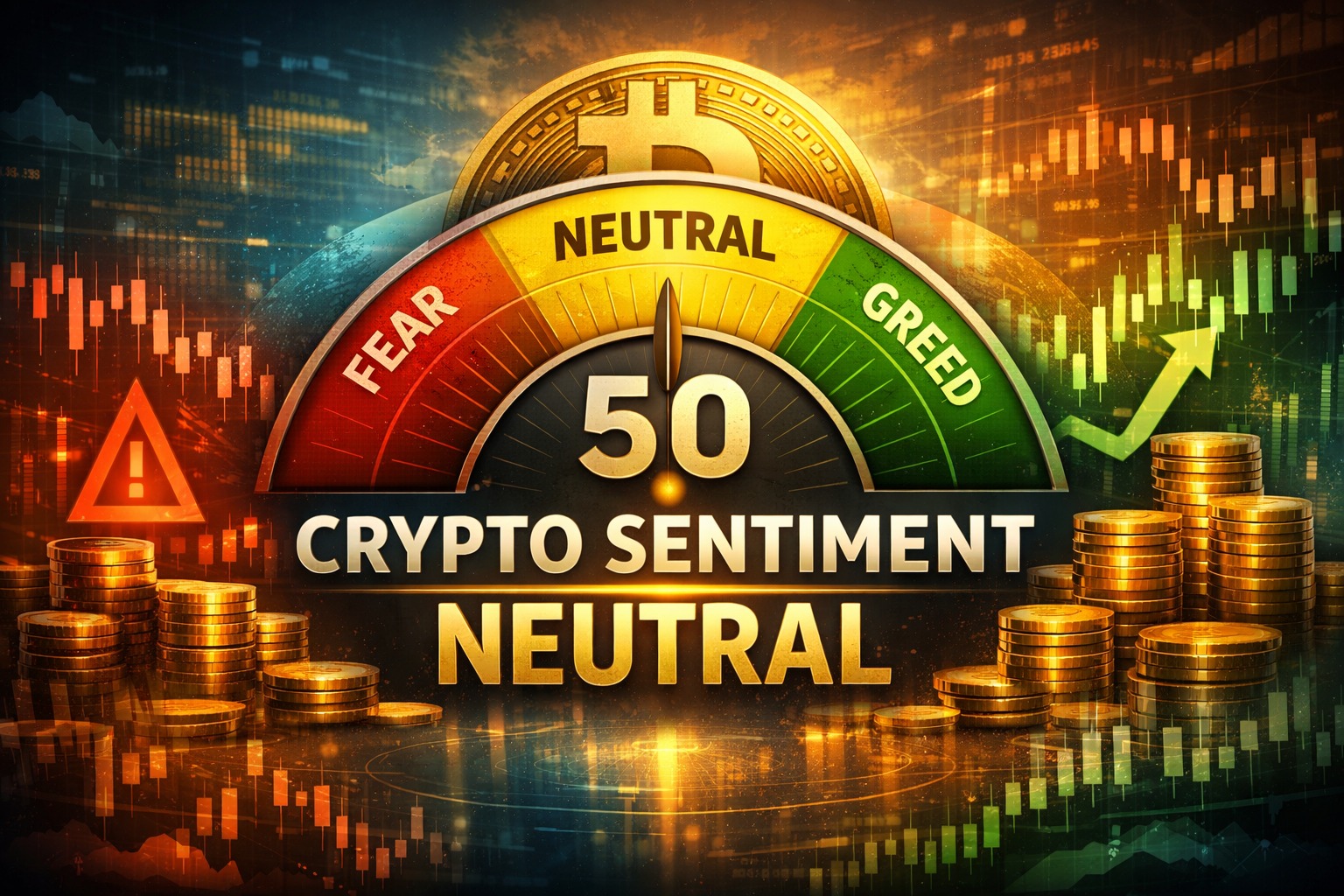
Crypto Fear and Greed Index readings have moved back to neutral for the first time since January, giving the crypto market one of its clearest sentiment shifts in months.
The index reached 50 this week, moving out of the fear zone after a long stretch of weak sentiment. This was the first neutral reading since Jan. 17 and ended a 108-day period where market psychology remained mostly defensive.
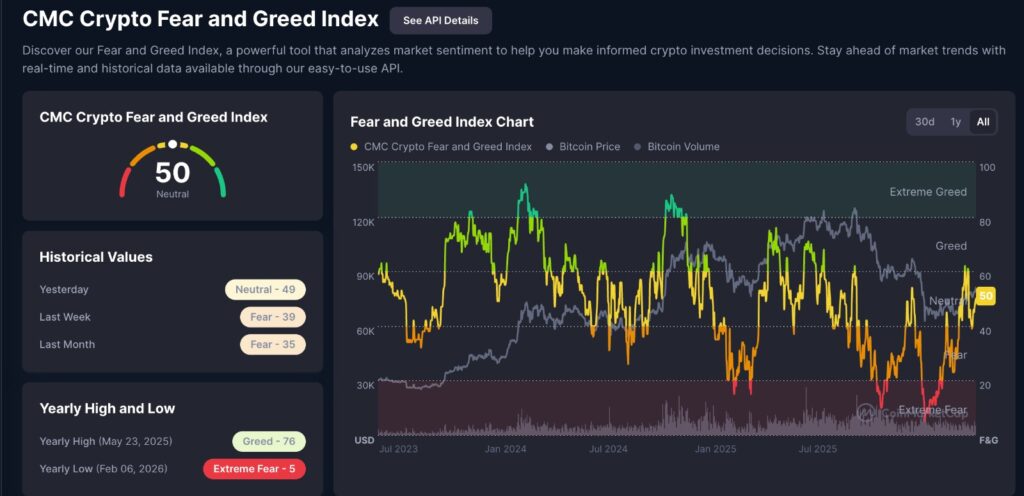
The CMC Fear and Greed Index chart shows how quickly market psychology has shifted from defensive to balanced. The current reading of 50 places sentiment in neutral territory, compared with 39 last week and 35 last month, showing that fear has eased as Bitcoin held higher levels. Still, the chart also shows why this shift should not be treated as a full risk-on signal. Neutral sentiment means panic has faded, but the next move still depends on whether buyers have enough liquidity to absorb supply near current prices.
That does not automatically mean the market has turned bullish.
But it does show that investors are no longer reacting to every price move from a position of fear. Bitcoin holding near the $80,000 level has helped rebuild confidence, while broader crypto market capitalization has also recovered from earlier weakness.
Recent sessions have shown a more balanced market: Bitcoin has held higher levels, sellers have struggled to force a deeper pullback, and sentiment has moved away from defensive positioning.
This shift matters because crypto prices often recover before sentiment fully changes. By the time sentiment indicators move from fear to neutral, the market has usually already absorbed part of the earlier selling pressure.
The question now is whether neutral sentiment can turn into sustained demand, or whether this is only a pause after a strong recovery.
Markets do not move higher because fear disappears. They move higher when buyers keep absorbing supply at higher prices.
Why the Sentiment Shift Matters
The Crypto Fear and Greed Index measures market mood using factors such as volatility, momentum, trading volume, and social activity. A low reading usually reflects defensive behavior, while a higher reading suggests stronger risk appetite.
A move to neutral is not the same as greed. It simply means fear is no longer controlling the market.
That difference matters.
When markets are in extreme fear, buyers often hesitate even when prices look attractive. Traders reduce exposure, long-term holders become cautious, and short-term participants focus more on downside risk than opportunity.
In that environment, rallies can fade quickly because fewer participants are willing to buy into strength. Sellers may become less aggressive, but buyers still need confidence before committing fresh capital. Large liquidation events can also accelerate sentiment shifts, especially when forced selling clears weak positioning and allows the market to stabilize, as seen in the recent crypto liquidations surge across Bitcoin positions.
Neutral sentiment changes that behavior. Buyers become more willing to step in, panic selling weakens, and traders reduce some downside hedges.
This matters structurally because a market becomes healthier when fewer sellers are forced to exit and buyers no longer need deep discounts before entering. That balance gives price more room to stabilize.
Still, neutral sentiment is a checkpoint, not confirmation.
Bitcoin Holding $80K Is the Key Signal
Bitcoin’s ability to remain near the $80,000 area is the main reason sentiment has improved. When Bitcoin stabilizes above a major psychological zone, the rest of the market usually becomes more willing to take risk. That makes the recent Bitcoin weekly close near the $80K resistance zone an important reference point for understanding why sentiment has improved.
But price stability is different from price expansion.
A market can hold support without having enough fresh liquidity to continue higher. Bitcoin holding $80,000 shows that sellers have not been able to force a deeper breakdown, but buyers still need to prove they can absorb supply above this level. This is also why a clean Bitcoin support-resistance flip in market structure matters, because former resistance only becomes useful support if buyers continue defending it.
For the next leg higher, demand needs to remain active as price rises.
This is where many sentiment-based rallies become fragile. A market can look calm on the surface while still depending on a narrow group of buyers underneath. If fresh demand slows, even a stable market can lose momentum quickly.
The reason this happens is simple: higher prices usually bring out new sellers. Short-term holders take profits, late buyers hesitate, and larger traders become more careful with execution. Without fresh demand, the market has less room to absorb that supply smoothly.
Liquidity is not continuous. Once nearby buy orders are filled, price needs fresh interest, or it must move lower to find buyers willing to step in again.
That is the difference between a relief rally and a durable trend.
Market Cap Recovery Shows Confidence Is Returning
The broader crypto market has also strengthened. Cointelegraph reported that total crypto market capitalization has risen 5.45% in May and 16.51% since March, climbing from $2.28 trillion to $2.66 trillion.
That recovery supports the idea that this is not only a Bitcoin move. Capital has started to return across the market, which usually happens when investors become more comfortable with risk.
However, market cap expansion can sometimes look stronger than the underlying liquidity picture. If prices rise while available buying power thins, the market becomes more sensitive to sudden selling. That is why Bitcoin’s recovery still needs to be measured against whether Bitcoin bull run demand is actually keeping pace with the move.
That is why the next phase depends less on sentiment headlines and more on liquidity behavior.
A stronger market is not only one where prices rise. It is one where supply keeps getting absorbed without needing constant excitement.
Stablecoin Outflows Could Limit Momentum
The biggest caution signal in the current setup comes from stablecoin flows.
CryptoQuant data showing that Binance stablecoin netflows have recorded a cumulative outflow of $11.8 billion since April 25. Daily outflows have also exceeded $1.5 billion across multiple sessions.
This matters because stablecoins on exchanges often represent deployable buying power. When stablecoin reserves increase, it can suggest that traders are preparing to buy crypto assets. When stablecoins leave exchanges, available spot liquidity can become thinner.
Earlier in April, Binance saw stronger stablecoin inflows as Bitcoin moved from around $74,000 toward $78,000. That supported the rally because fresh capital was available to meet selling pressure.
Now, that flow has reversed.
This does not mean Bitcoin must fall. It means the market may have less immediate fuel than the sentiment shift suggests.
A sentiment recovery without stablecoin support can still push prices higher for a while, especially if sellers remain weak. But without fresh liquidity, the move becomes more dependent on existing participants rather than new capital entering the market.
That makes execution more important. If buyers are patient and supply remains light, the market can stay stable. If buyers step back while sellers return, the lack of fresh stablecoin support becomes harder to ignore.
The Market Is No Longer Fearful, But It Is Not Fully Confident Yet
The most important takeaway is that crypto has moved from fear into balance.
That is healthier than extreme fear, but it is not the same as a confirmed breakout environment. Neutral sentiment tells us that investors are no longer running away from risk. It does not prove they are aggressively adding exposure.
This is why the current market should be viewed as a transition phase.
Bitcoin holding $80,000 shows strength. The broader market cap recovery shows confidence is improving. The Fear and Greed Index returning to neutral shows that panic has faded.
But stablecoin outflows show that the market still needs stronger liquidity support before the move becomes more convincing.
The market has stopped acting afraid. Now it needs to prove that buyers can stay active without relying only on sentiment.
Editor’s View: Sentiment Is Improving, But Liquidity Decides the Next Move
The market’s mood has clearly changed, but the structure is still not simple. A neutral Crypto Fear and Greed Index shows that fear is no longer controlling behavior, yet it does not prove that buyers have unlimited strength.
This is where sentiment data can be misleading. A higher index reading shows that traders are more willing to take risk, but willingness is not the same as buying power.
Right now, the market appears more balanced. The next question is whether enough capital remains available to support higher prices when sellers test the move.
That is why this moment should be read with patience. The improvement is real, but confirmation still has to come from how buyers behave when price meets resistance and supply returns.
What Comes Next for Crypto?
For Bitcoin and the broader crypto market, the next phase depends on three signals.
First, Bitcoin needs to keep holding the $80,000 region without sharp rejection. If price remains stable near this level, neutral sentiment can slowly build into stronger confidence.
Second, stablecoin flows need to improve. If exchange stablecoin reserves begin rising again, it would suggest that fresh buying power is returning.
Third, market cap growth needs to continue without becoming too dependent on leverage. A healthier rally usually has spot demand, stable liquidity, and controlled derivatives exposure working together.
For now, the Crypto Fear and Greed Index turning neutral is a meaningful improvement. It shows that the market has moved away from defensive positioning and back toward balance.
But the next move will not be decided by sentiment alone.
It will be decided by whether buyers can absorb supply while fresh capital returns to the market.
Price does not rise because the market feels better. It rises when available demand is strong enough to remove supply without losing momentum.
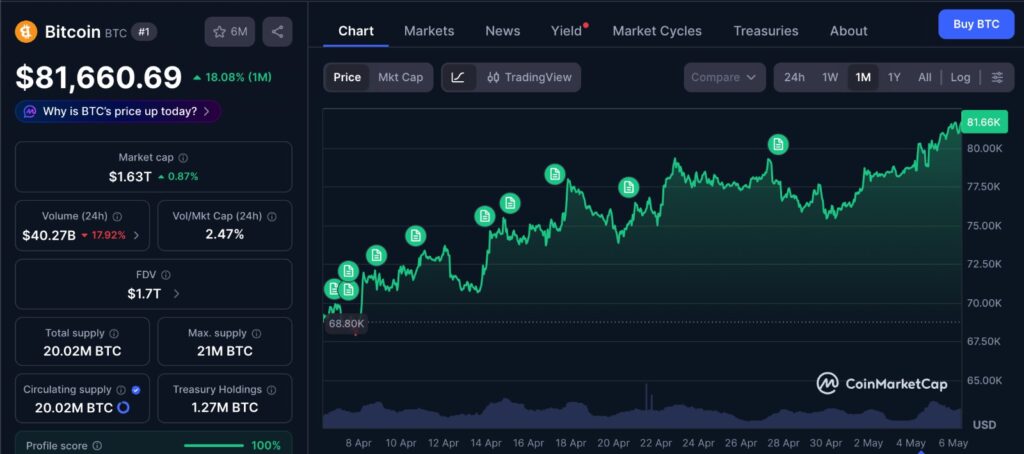
The 1-month Bitcoin chart shows why sentiment has improved but also why the market still needs confirmation. Bitcoin has held higher levels after recovering from earlier weakness, which has helped push the Crypto Fear and Greed Index back to neutral. However, the chart also shows that holding price is not the same as expanding with strength. For the move to become more convincing, buyers need to keep absorbing supply near current levels instead of relying only on improved sentiment.
Disclaimer: This content is for informational purposes only and does not constitute financial advice.
Keep yourself updated with the latest crypto news with FYI Gazette
Keep yourself updated with the latest Altcoin News with FYI Gazette
 Bitcoin
  Ethereum
  Tether
  BNB
BNB  XRP
XRP  Solana
  TRON
TRON  Dogecoin
  Litecoin
  Pepe
Pepe