

Bitcoin Risk-On Rally Builds, But $85K Still Depends on Market Absorption
Bitcoin Risk-On Rally is back in focus after BTC climbed toward the $80,000 area, supported by stronger risk appetite, improving miner profitability, and renewed confidence across ETF and options markets.
Recent market data showed Bitcoin moving to $80,000 for the first time in three months, while roughly $270 million in leveraged short positions were liquidated during the move, adding to a broader pattern of crypto liquidation pressure across Bitcoin-led rallies. The rally also came as tech stocks pushed toward record levels, showing that Bitcoin’s latest strength is moving with a broader risk-on shift across markets.
Recent sessions have shown a clear change in behavior: sellers have been less able to force deep pullbacks, while buyers have been more willing to step in near higher levels.
That matters because Bitcoin rarely moves on one signal alone.
A strong price candle can attract attention, but a durable move usually needs several layers working together: buyers willing to absorb supply, miners facing less pressure to sell, derivatives traders reducing downside hedges, and institutional flows staying supportive.
Right now, those layers are improving. But they are not confirmation by themselves.
The question is not simply whether Bitcoin can reach $85,000. The better question is whether Bitcoin demand still needs confirmation before the market can keep absorbing sellers as price moves higher.
Why Bitcoin’s Move Looks Different This Time
Bitcoin’s latest move is being watched closely because it combines price strength with improving market conditions.
Recent market behavior shows Bitcoin’s price action remaining closely tied to the Nasdaq 100, while US stocks have been trading near record levels. That connection matters because Bitcoin is still behaving like a risk asset when liquidity conditions improve. When investors feel more comfortable taking risk in equities, Bitcoin often benefits from the same shift in sentiment.
But Bitcoin is not simply copying stocks.
Even as equities have pushed toward new highs, Bitcoin remains below its previous peak. That creates a different setup. Stocks are showing confidence, while Bitcoin is still trying to rebuild confirmation after a weaker phase.
This is why Bitcoin’s $80K resistance area matters. It is not just a round number. It is a test of whether recent buying is strong enough to turn a recovery into structure.
A move can be sharp when shorts are forced out. A healthier move needs fresh buyers to step in after the squeeze is over.
Strength is not proven by the first jump. It is proven by what the market does after forced buying fades.
Miner Profitability Is Reducing One Key Fear
One of the more important changes is happening in the mining sector.
Recent mining data showed that Bitcoin miner profitability has improved, with the expected daily return for 1 petahash per second rising to $37, a level not seen since Jan. 30. This comes after total hashrate declined 13% over the last quarter, while miner reserves have been near 10-year lows.
That combination explains why traders were nervous.
When miner reserves are low and mining conditions are difficult, the market worries that miners may sell more Bitcoin to manage expenses, debt, or business investment needs. Miner selling does not always crash the market, but it can create a steady supply source that limits rallies when demand is not strong enough.
Improved miner profitability changes that pressure.
It does not mean miners will stop selling completely. It means the market may become less fearful of forced or defensive selling from miners. That matters because rallies often struggle when supply appears at every higher level.
If miners are under less stress, they may have more flexibility in how they manage their holdings. That does not remove supply from the market, but it can reduce the pressure to sell into strength immediately.
This matters structurally because less forced supply gives buyers more room to control the range. When fewer participants need to sell quickly, demand does not have to work as hard to keep price stable.
If miner pressure eases while spot demand improves, Bitcoin has more room to test higher levels without meeting the same resistance from supply.
ETF Demand Is Still Doing Heavy Work
Another key part of the setup is ETF demand.
Recent fund-flow data showed strong net inflows into US-listed spot Bitcoin ETFs, including $630 million in net inflows on Friday. Combined assets under management for Bitcoin and Ether exchange-traded products also reached $147 billion, based on an April 27 CoinShares report.
This is important because ETF demand changes how Bitcoin absorbs supply.
In older cycles, Bitcoin rallies often depended heavily on retail momentum, leverage, and exchange-driven speculation. ETF flows introduce a steadier type of demand than short-term futures positioning.
That does not make Bitcoin risk-free. ETF flows can slow, reverse, or weaken if broader markets turn lower. But when inflows are strong, they give the market a clearer demand base.
For Bitcoin to move toward $85,000, ETF demand does not need to be explosive every day. It needs to remain strong enough to absorb selling without allowing price to fall back into the same range.
That is the real test.
Liquidity is not continuous. Once nearby sell orders are absorbed, price must move higher to find the next area where sellers are willing to act.
Bitcoin Dominance Shows Capital Is Becoming More Selective
Bitcoin’s rising dominance is another important signal.
Bitcoin’s market share, excluding stablecoins, has climbed to its highest level since July 2025. This has happened while demand for memecoins, governance tokens, and several broader altcoin sectors has remained weaker.
This does not automatically mean the entire crypto market is strong.
It may mean capital is becoming more selective. Investors may be willing to take crypto exposure, but they are choosing the most liquid and institutionally supported asset first.
That tells us something important about the current market mood.
This is not the kind of environment where every token is being rewarded equally. It is a market where capital is flowing toward perceived quality, liquidity, and relative safety inside crypto.
That supports Bitcoin, but it also shows that risk appetite has limits. Traders may be risk-on, but they are not blindly risk-on.
For the broader crypto market, this distinction matters. A Bitcoin-led rally can improve sentiment, but it does not always create the same conditions for smaller assets. If capital remains concentrated in BTC, altcoins may still struggle even while the headline market looks stronger.
Options Data Shows Fear Has Eased, Not Vanished
The options market is also sending a more constructive signal.
Recent options data showed that demand for Bitcoin call option premiums exceeded demand for equivalent put options by 24% on Monday. That was a sharp change from the weekend, when call premiums were 25% lower than put premiums.
In simple terms, traders were paying more for upside exposure after previously favoring downside protection.
That shift matters because options pricing often reflects how professional traders are positioning around risk. When put demand is high, traders are usually paying to protect against price declines. When call demand rises, traders are showing more interest in upside exposure.
Still, this should not be overstated.
Options data can change quickly. A move from fear toward optimism does not guarantee a breakout. It only shows that the market is no longer pricing the same level of immediate downside concern.
That is useful, but not final confirmation.
The stronger signal will come from how Bitcoin behaves after positioning resets. If price holds steady after short liquidations cool down, the move becomes more meaningful. If price fades quickly, it may suggest the rally relied more on forced buying than fresh demand.
What Needs to Happen for $85K Bitcoin
Bitcoin’s path toward $85,000 looks more realistic when several conditions line up: miners face less pressure, ETFs continue attracting demand, dominance remains strong, and options traders stop aggressively hedging downside.
Those conditions are improving now.
But the market still needs confirmation around absorption.
If Bitcoin moves higher but quickly rejects near resistance, the rally may still be driven by short covering and sentiment rather than durable demand. If Bitcoin holds higher levels after liquidations cool down, it would support a stronger Bitcoin support and resistance structure as buyers begin accepting the new range.
The difference is important.
A squeeze removes sellers. Absorption proves buyers are still there afterward.
That is why the $85,000 level should be viewed less as a prediction and more as a market test. If buyers continue stepping in near higher levels, the rally gains structure. If demand weakens once momentum slows, Bitcoin may need more time before the move becomes convincing.
Editor’s View: The Rally Is Stronger, But Not Yet Untouchable
The strongest part of this Bitcoin setup is not the $85,000 target. It is the fact that several pressure points have improved at the same time.
Miner profitability is better. ETF demand is visible. Bitcoin dominance shows capital preference. Options traders are no longer leaning as heavily toward fear.
That gives the rally more depth than a simple headline-driven move.
But markets often become most fragile when every signal starts looking clean at once. Better conditions can attract buyers, but they can also attract late positioning from traders reacting after the move has already started.
For now, Bitcoin’s risk-on rally has improved. The next phase depends on whether buyers can keep absorbing supply once the first wave of momentum fades.
Price does not move higher because the story improves. It moves higher when available supply stops being enough to contain demand.
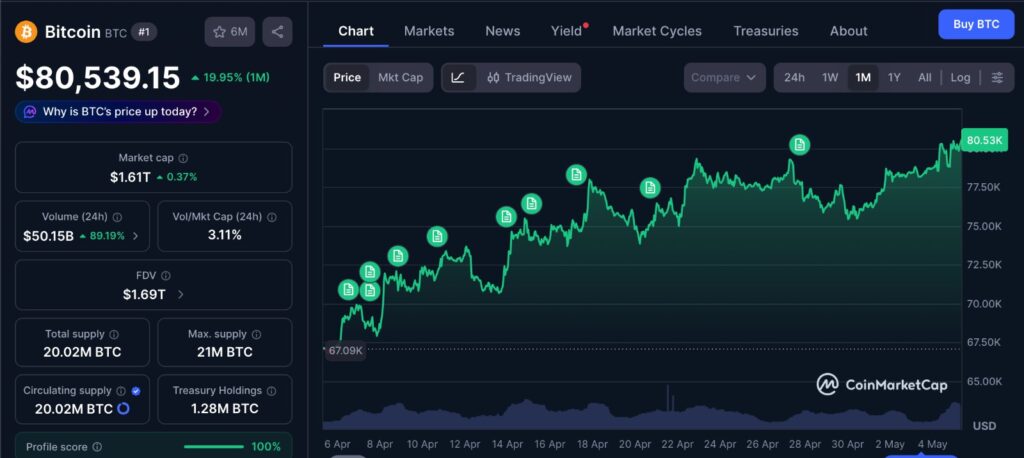
The 1-month CoinMarketCap Bitcoin chart can help readers see how BTC has moved during this recent recovery phase. This chart is useful because it shows whether the Bitcoin Risk-On Rally is being supported by a steady climb, a sharp breakout, or a volatile move with repeated pullbacks. If price remains near higher levels after the recent rally, it may suggest stronger buyer absorption. If the chart shows quick rejection from the upper range, it would indicate that traders are still testing whether the move has enough demand behind it.
Disclaimer: This content is for informational purposes only and does not constitute financial advice.
Keep yourself updated with the latest Altcoin News with FYI Gazette
 Bitcoin
  Ethereum
  Tether
  BNB
BNB  XRP
XRP  Solana
  TRON
TRON  Dogecoin
  Litecoin
  Pepe
Pepe