

XRP Holders Back in Profit Why This Setup Could Trigger a 55% Breakout
XRP holders back in profit is not just a sentiment shift. It reflects a structural change in how supply behaves around price.
When a large portion of holders moves back into profit, the market enters a different phase. Selling pressure eases, positioning resets, and price no longer has to work through trapped supply. That shift matters because it changes how easily price can move, not because it guarantees direction.
Recent data shows that a growing share of XRP holders are now back in profit after recovering from earlier drawdowns. This kind of transition typically follows accumulation phases, where weaker hands exit and stronger hands hold. It improves conditions, but only leads to expansion if demand is strong enough to meet the reduced supply.
The key question is not whether holders are in profit. The real question is what they do next.
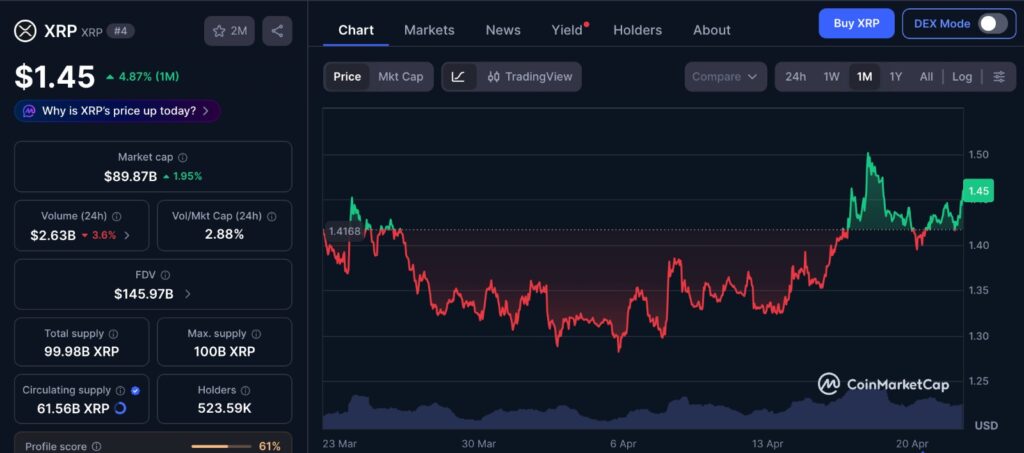
Over the past month, XRP’s price action has reflected a gradual transition from reactive selling to more balanced participation. The chart shows periods where upward moves are followed by stabilization rather than sharp reversals, suggesting that selling pressure is being absorbed instead of expanding. This kind of structure often appears when supply from earlier positions has already been reduced, allowing price to move with less resistance, but still requiring consistent demand to sustain any further expansion.
Profitability Changes Behavior Not Just Price
When holders are underwater, rallies tend to face resistance. Every bounce becomes an opportunity to exit, creating steady selling pressure into strength.
Once holders return to profit, that pressure begins to fade. Instead of selling immediately, participants often hold for higher levels, reducing the amount of supply hitting the market at current prices.
Recent sessions have shown XRP stabilizing after reclaiming key levels rather than pulling back sharply. This suggests that selling pressure is not expanding alongside price, and that buyers are able to meet available supply without forcing price lower.
This matters because once forced sellers are cleared, the market relies on new sellers stepping in at higher levels. If that supply does not appear quickly, price can move with less resistance.
The 55% Breakout Setup What It Actually Represents
The widely discussed 55% move reflects how tightly price has been compressed over time, similar to earlier phases of XRP consolidation before breakout. XRP has spent multiple sessions trading within a narrowing range, where both buyers and sellers are active but neither side is able to take control.
This kind of compression builds liquidity on both sides of the market. Stop orders, breakout trades, and resting liquidity begin to cluster around key levels. When price finally moves beyond that range, it is not just breaking a pattern, it is moving through areas where liquidity has already been positioned.
The reason this leads to sharp moves is simple. Once price starts triggering those clustered orders, it creates a chain reaction of execution, where one side of the market is forced to react.
But for that move to sustain, demand still needs to absorb profit taking and any new supply that appears. Without that balance, expansion quickly slows.
Why This Phase Is More Fragile Than It Looks
There is a common assumption that more holders in profit supports upside. That is only partly true.
High profitability changes the type of pressure in the market. Instead of forced selling, the market becomes exposed to voluntary selling through profit taking.
When a large share of participants is in profit, even small moves into resistance can trigger selling. Not because traders are forced out, but because they choose to lock in gains.
Over the past week, XRP has shown periods of stability after upward moves rather than immediate continuation. This suggests that some of this profit taking is already being absorbed, leading to short consolidation phases where supply is redistributed. That same positioning behavior has also appeared in other major altcoins, including this case of Solana open interest surge and positioning shift.
This creates a more balanced market, but also one where upside progress becomes slower and more dependent on continued participation.
The Role of Larger Players in This Move
This is where larger participants begin to matter more. Price does not move because retail traders act at the same time. It moves when liquidity allows size to be executed without disruption.
Large participants tend to enter during periods of uncertainty and low volatility, when liquidity is available and attention is limited. As price begins to move, they shift from accumulation to managing positions.
They do not chase breakouts. They position into conditions that allow them to act without moving the market against themselves. A similar pattern appears in derivatives activity, where rising exposure can show how traders are building positions before a move, as seen in this ether open interest surge and trader exposure analysis.
If the current move is supported by continued accumulation, selling pressure remains contained and price can expand. If not, the move risks becoming a short-lived push used to distribute into strength.
Markets don’t move when buyers are active. They move when selling pressure fails to keep up.
Why Price Does Not Move Just Because Supply Improves
One of the most common assumptions is that improving conditions automatically lead to higher prices. They do not.
XRP’s improving holder profitability is a condition. But price only moves when that condition interacts with timing, participation, and execution.
The reason this matters is because buyers still need to step in at higher levels without pushing price too quickly against themselves. If demand is not consistent, even reduced supply is not enough to sustain a move.
Recent sessions suggest that XRP is transitioning from a reactive phase into a more balanced one, where movement depends on how supply and demand interact around key levels. That transition is where most expansion attempts either build or fade.
Editor’s View This Is a Positioning Shift Not a Signal
The current XRP setup is less about prediction and more about positioning. A market where holders are back in profit behaves differently from one under pressure. It becomes more patient, but also more selective.
The breakout narrative highlights potential, but the underlying shift is in how supply is being held and released. If demand continues to meet reduced selling pressure, price can move higher. If not, this becomes a phase of redistribution rather than expansion.
The move does not begin when conditions improve. It begins when the market can no longer find enough sellers to hold price in place.
Disclaimer: This content is for informational purposes only and does not constitute financial advice.
Keep yourself updated with the latest crypto news with FYI Gazette
Keep yourself updated with the latest Altcoin News with FYI Gazette
 Bitcoin
  Ethereum
  Tether
  BNB
BNB  XRP
XRP  Solana
  TRON
TRON  Dogecoin
  Litecoin
  Pepe
Pepe