
XRP Consolidation Breakout Builds Pressure Around $1.40 Level
XRP consolidation breakout conditions are not defined by volatility, but by how long the market has refused to resolve direction. When price compresses into the same zone repeatedly, it reflects a standoff between participants who are waiting rather than acting. This structure does not weaken a market, it concentrates decision making. The longer that tension persists near a clearly defined level like $1.40, the less adaptable liquidity becomes when price finally moves.
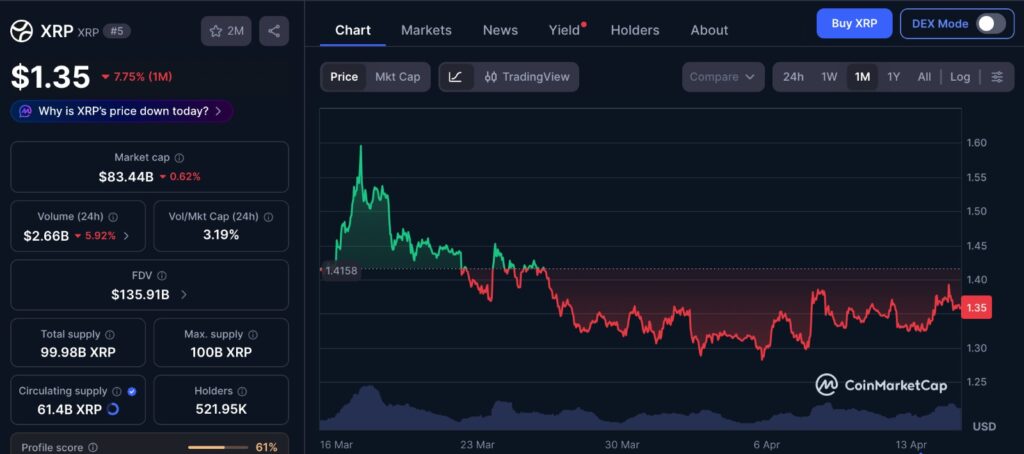
The 1-month chart reflects compression rather than directional conviction. Price movement remains contained within a defined range, with multiple attempts to expand failing to sustain follow-through. This type of structure suggests that liquidity is still being absorbed rather than displaced, meaning participation is present but not yet aggressive enough to force a breakout. Over this period, similar patterns have shown that expansion typically follows once this absorption weakens, not during it.
XRP Consolidation Around $1.40 Reflects Structural Compression
XRP has been trading within a tight range, largely between $1.35 and $1.45, with repeated reactions around the $1.40 level. This is not just sideways movement, it is controlled compression.
Transaction activity and exchange flows suggest that similar phases have preceded expansion, but the key factor here is the structure itself.
When price repeatedly returns to the same level without breaking it, two underlying shifts occur:
- Liquidity becomes concentrated around that level
- Participants shift from reacting to positioning
Over time, this reduces the market’s ability to absorb imbalance smoothly. Orders cluster, execution becomes more sensitive, and even small changes in participation can move price more than expected. This happens because liquidity providers begin to pull back or reposition, increasing execution risk and leaving less depth available to absorb incoming orders.
Markets do not move because pressure builds, they move because resistance becomes insufficient.
Why the $1.40 Level Matters More Than It Appears
The $1.40 zone has acted as both support and resistance in recent sessions, making it structurally important. Its significance is not technical, it is behavioral.
When a level is tested repeatedly:
- Sellers become less aggressive at the same price
- Buyers gain confidence defending it
- Liquidity providers adjust exposure rather than adding to it
This gradually reduces the depth available at that level. What appears stable often reflects a slow thinning of resistance.
Recent sessions have shown XRP holding near this region despite reduced volatility, indicating that participation is becoming more selective rather than disappearing. That selectivity changes how easily price can move once a decision is made.
Consolidation Does Not Signal Weakness It Signals Positioning
It is easy to interpret consolidation as indecision, but structurally, it reflects preparation.
Low volatility phases tend to:
- Reduce forced liquidations
- Reset leveraged positioning
- Allow larger participants to accumulate or distribute without disruption
This creates a more stable base for any future move. When leverage is high, price becomes reactive and unstable. When leverage is reduced, price responds more to actual participation.
In this context, consolidation is not delaying a move, it is shaping the conditions under which that move will occur.
The Break Above $1.40 Is About Structure Not Momentum
A move above $1.40 is often framed as a breakout trigger, but the move itself is not the signal, the reaction is.
If price moves above this level and holds:
- It suggests that liquidity above the range has already thinned
- It indicates that sellers are no longer defending the level with the same intensity
- It shifts the market from negotiation to expansion
Previous attempts to move above the mid $1.40 range have lacked follow through, showing that breakouts require participation, not just price movement.
A breakout level is not where price accelerates, it is where resistance disappears.
What Happens If XRP Fails to Hold the Range
While attention is focused on the upside, the downside structure remains equally important.
If XRP fails to hold the lower boundary near $1.30 to $1.35:
- The compression structure breaks
- Liquidity shifts from absorption to release
- Price may move quickly toward levels where demand was previously established
This is not about bearish momentum, it is about structural invalidation.
When a range fails, it rarely unwinds slowly. It re prices faster because the liquidity that supported it is no longer present to slow the move.
Editor’s View Why This Setup Is Often Misread
Editor’s View: Consolidation is often mistaken for inactivity, but it is one of the most decision heavy phases in a market. What looks quiet on the chart is where participants refine positioning with less urgency and more precision. XRP’s current structure reflects a market that is waiting for clarity rather than reacting to it. When that shift resolves, the move tends to feel sudden, even though the conditions were already in place.
How This Impacts the Broader Crypto Market
XRP’s structure is not isolated, it reflects a broader market condition.
Across crypto:
- Many assets are showing reduced volatility
- Liquidity is becoming more concentrated at key levels
- Breakouts are increasingly dependent on participation rather than sentiment
This points to a shift toward liquidity driven movement, where price responds more to structural conditions than short term narratives.
If XRP resolves its range with a clean move, it reinforces the role of compression phases in shaping larger trends. If it does not, it suggests that participation remains limited and that range bound behavior may persist.
Either outcome matters because it reveals how the market is functioning beneath the surface.
Final Takeaway
XRP is not simply consolidating, it is compressing within a structure that is becoming increasingly sensitive to imbalance.
The $1.40 level matters not because of its position on the chart, but because of how often it has been tested without resolution.
That repetition changes behavior.
And in markets, behavior changes before price does.
Disclaimer: This content is for informational purposes only and does not constitute financial advice.
Keep yourself updated with the latest crypto news with FYI Gazette
Read more about Memecoins with FYI Gazette
Keep yourself updated with the latest Altcoin News with FYI Gazette
 Bitcoin
  Ethereum
  Tether
  BNB
BNB  XRP
XRP  Solana
  TRON
TRON  Dogecoin
  Litecoin
  Pepe
Pepe