

Ethereum Foundation Unstakes 17K ETH: Supply Shift or Strategic Rebalance?
Ethereum is drawing attention again, not through price action, but through a subtle shift in on-chain behavior.
The Ethereum Foundation has unstaked 17,035 ETH, valued at roughly $40 million, shortly after approaching a key internal milestone of around 70,000 ETH staked.
At face value, this looks like reduced exposure. Structurally, it reflects a shift in how capital is being positioned rather than a simple withdrawal.
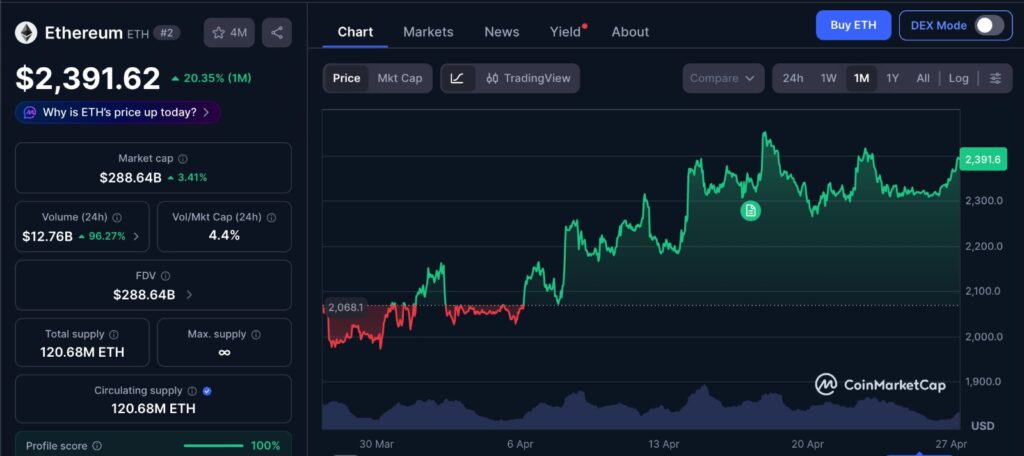
The 1-month ETH price chart reflects a phase of controlled movement rather than expansion. Despite periods of volatility, price has largely remained within a defined range, indicating balanced participation rather than aggressive directional conviction. This type of structure often suggests that liquidity is being absorbed gradually, rather than chased. In this context, the Ethereum Foundation’s decision to unstake aligns with a market environment where flexibility may matter more than passive positioning, especially as capital waits for clearer conditions before committing.
A Strategic Move, Not a Reaction
The unstaking process involved converting wrapped staked ETH (wstETH) via Lido’s withdrawal system, meaning the ETH is not instantly liquid and must pass through a queue before becoming accessible.
This matters.
It indicates this is not a reactive sell decision, but a planned repositioning of capital.
The timing reinforces that view. The move comes just after the foundation nearly reached its 70K ETH staking target, suggesting the milestone acted as a checkpoint rather than an endpoint.
This is how large participants typically operate:
- Accumulate to a target
- Rebalance exposure
- Maintain flexibility
Not hold passively.
Staking locks capital into a slower system. Unstaking restores flexibility. The reason this matters is simple: capital that cannot move cannot respond. Once unlocked, it can be directed toward areas where liquidity is thinner or opportunities are clearer.
What Unstaking Actually Changes
In Ethereum’s proof-of-stake system, staked ETH is effectively removed from liquid circulation.
So when ETH is unstaked, the immediate assumption is:
→ More supply could return to the market
But that view is incomplete.
Unstaking introduces potential supply, not immediate selling pressure.
The ETH must:
- Exit the validator system
- Clear the withdrawal queue
- Be moved to exchanges if selling is intended
Until then, the impact remains conditional.
Liquidity is not continuous. Once nearby buy or sell orders are absorbed, price must move to find the next area of interest. That is where unlocked supply begins to matter.
Liquidity vs Supply: The Real Shift
The more important layer here is liquidity.
When large entities like the Ethereum Foundation adjust staking positions, they are shifting where liquidity sits within the system, not just changing total supply.
Staked ETH:
- Reduces available trading liquidity
- Supports network participation
Unstaked ETH:
- Increases flexibility
- Makes capital easier to deploy
This is less about direction and more about capital mobility.
This aligns with recent execution trends, where Ethereum taker volume has surged, highlighting active liquidity demand during key price levels.
Over the past week, price action across major assets has remained relatively contained despite stable conditions, suggesting that available liquidity, not total supply, is becoming the more decisive factor.
Because price is ultimately shaped by how much supply is available at key levels when demand appears.
Why This Matters for Market Structure
Recent sessions show that supply constraints alone are not driving price expansion. Instead, positioning and access to liquidity are playing a larger role.
This shift becomes more relevant when viewed alongside rising derivatives activity, where ether open interest has surged, increasing trader exposure across the market.
This makes the foundation’s move more relevant than it appears.
It reflects a shift from:
Passive yield participation
to
Active capital readiness
That transition changes how quickly capital can respond. When capital is locked, execution is delayed. When it is liquid, it can be deployed into thinner areas of the market, where even smaller flows can move price more easily.
Markets do not move when supply exists. They move when supply meets demand where liquidity is limited.
Editor’s View
This isn’t a signal about direction. It’s a signal about intent.
The Ethereum Foundation is not behaving like a passive holder optimizing yield. It is managing exposure within a changing market environment.
That distinction matters.
Similar behavior has been observed recently, where large Ethereum whale positions signaled structural intent rather than short-term speculation.
When large participants move from locked positions to flexible ones, it reduces friction in decision-making. Capital that can move quickly does not need to predict. It can respond.
In crypto, response speed often matters more than initial positioning.
The Bigger Picture
Ethereum’s staking ecosystem has become a major structural component of the crypto market.
Reaching near 70,000 ETH in staking highlights long-term commitment to network security and participation. This broader dynamic is not isolated to Ethereum, as seen in cases where Bitcoin demand has lagged despite strong structural conditions.
But this move shows that even at scale, staking is not static.
It is actively managed.
That reinforces a broader reality:
Markets are shaped by how efficiently capital moves between locked, liquid, and deployable states.
Final Takeaway
The Ethereum Foundation unstaking 17K ETH is not a directional signal.
It is a shift in capital flexibility.
In markets where liquidity is uneven, price does not wait for supply to grow. It moves when accessible capital meets gaps in liquidity.
Disclaimer: This content is for informational purposes only and does not constitute financial advice.
Keep yourself updated with the latest Altcoin News with FYI Gazette
 Bitcoin
  Ethereum
  Tether
  BNB
BNB  XRP
XRP  Solana
  TRON
TRON  Dogecoin
  Litecoin
  Pepe
Pepe