

Bitcoin Nears $65K as Trump Says Iran Deal Could Ease Hormuz Risk
Bitcoin moved toward $65,000 after U.S. President Donald Trump said an Iran peace deal could be signed as early as Sunday and that the Strait of Hormuz would be open to all.
The move gave Bitcoin a fresh geopolitical relief catalyst after weeks of pressure tied to Middle East tensions, oil market risk, and uncertainty around one of the world’s most important shipping routes.
BTC traded near $64,000 into the weekly close after reaching local highs around $64,750. The rebound came as traders reacted to the possibility that Hormuz-related risk could ease if a diplomatic breakthrough reduces pressure around energy markets and shipping access.
That makes this Bitcoin Iran peace deal story different from the earlier phase of the market selloff. Before, Bitcoin was reacting to rising oil and Hormuz risk. Now, it is testing whether a possible geopolitical relief headline can turn that same risk premium into a short-term bid.
However, the setup remains unconfirmed. Reports also noted uncertainty around the exact signing timeline, which means Bitcoin still needs follow-through before the rebound can be treated as more than a relief move.
Why the Bitcoin Iran Peace Deal Matters
The Strait of Hormuz matters because it is one of the most important routes for global energy flows. When tension rises around the strait, oil markets can quickly price in supply risk. That can pressure risk assets because higher oil prices may feed inflation concerns, complicate central bank expectations, and weaken liquidity conditions.
Bitcoin is not an oil asset, but it trades inside the same global risk environment. When energy risk rises sharply, traders often reduce exposure across volatile assets first. When that risk eases, Bitcoin can benefit from a short-term improvement in sentiment.
That appears to be the immediate market reaction.
Trump said a peace deal could be signed as early as Sunday and that the Hormuz Strait would be open to all after a deal. The market response suggests traders treated the statement as a possible reduction in geopolitical pressure, not as a completed outcome.
Still, relief and confirmation are different. A political claim can move price quickly, but Bitcoin needs sustained demand to prove the move can hold.
Markets do not move when a headline sounds positive. They move when that headline changes positioning, liquidity, and buyer behavior.
Bitcoin Rebound Is Now Testing the $65K Zone
Bitcoin’s move toward $65,000 puts the market near an important short-term test.
The $65,000 to $67,000 area matters because it sits near recent market structure and a zone where traders may decide whether the rebound has enough strength to challenge the bearish case. A clean move through that area would show that buyers are not only reacting to news, but also absorbing sell pressure around visible resistance.
A relief move can lift price quickly when fear fades. A stronger recovery needs buyers to keep bidding after the first wave of optimism is priced in.
That is the execution test. If sellers use the $65,000 to $67,000 zone to exit positions and buyers still absorb that supply, the rebound becomes more credible. If price reaches the zone and quickly loses momentum, it would suggest the market is still using strength to reduce risk.
Liquidity is not evenly spread across the market. Once nearby orders are absorbed, price has to move toward the next area where buyers or sellers are willing to act. That is why Bitcoin order book support matters during relief moves, especially when traders are watching whether buyers can absorb supply near resistance.
In simple terms, the first move shows reaction. The next move shows conviction.
If BTC stalls near $65,000 to $67,000, the rebound may remain headline-driven. If buyers push through that zone with stronger participation, it would show that sellers are losing control of a key liquidity area.
CMC Chart Analysis
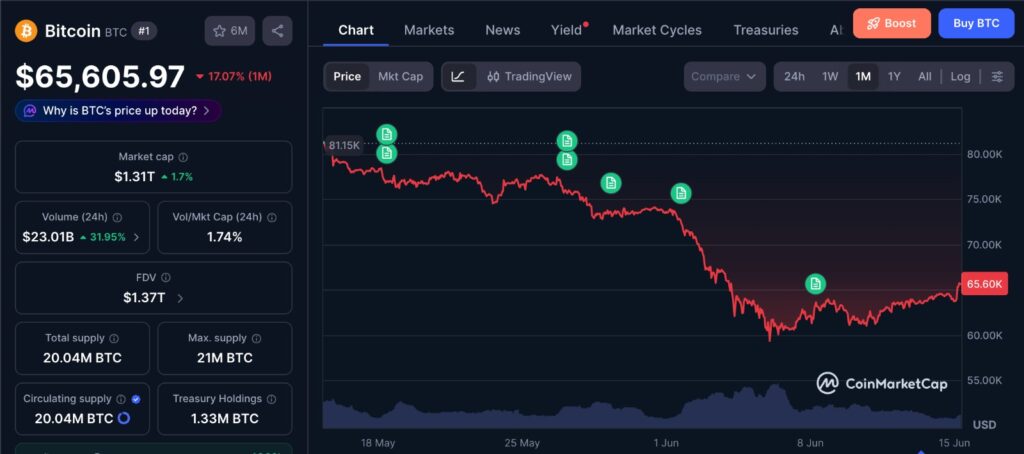
The 1-month Bitcoin chart shows BTC rebounding toward the $65,000 area after a period of pressure linked to oil-market uncertainty and Strait of Hormuz risk. The key point is not only that Bitcoin recovered from recent lows, but whether the move can hold near the $65,000 to $67,000 zone. If buyers continue absorbing supply around that area, the rebound would look more like a real relief bid. If price fades quickly, it would suggest the move was mostly a short-term reaction to the Iran deal headline.
Hormuz Risk Has Shifted, But It Has Not Disappeared
The peace-deal claim reduces one of the clearest sources of pressure on Bitcoin, but it does not remove uncertainty.
Reports also noted uncertainty around the exact signing timeline, which means traders still have to price the risk that the deal is delayed, adjusted, or challenged by further political developments. In that environment, Bitcoin may remain sensitive to new headlines around the agreement, oil markets, and shipping access through Hormuz.
That makes the current move fragile.
If a deal is signed and the Strait of Hormuz reopening process becomes clearer, Bitcoin could hold a stronger relief bid because one major macro fear would be reduced. If the timeline slips or new tensions appear, the same geopolitical premium that helped the rebound could reverse quickly.
For crypto traders, the real issue is not only whether the headline is positive. It is whether the headline lasts long enough to change positioning.
That is the mechanism behind the relief bid: if traders reduce oil-shock hedges and shorts stop pressing downside, Bitcoin can rise before the diplomatic outcome is fully confirmed.
A market can forgive uncertainty for a few hours. It rarely forgives uncertainty when leverage has already chased the move.
Open Interest and Funding Add a Second Layer
The Bitcoin Iran peace deal headline is the news trigger, but derivatives positioning adds another layer to the move.
Some traders have pointed to rising open interest and softer funding rates as a potentially constructive setup. That makes Bitcoin funding rates useful to watch because they help show whether the rebound is being supported by balanced positioning or crowded leverage. In simple terms, if open interest rises while funding stays soft, the move may not be driven only by crowded long leverage.
That matters because overheated long positioning can make rebounds unstable. When too many traders chase the same move with leverage, a small pullback can trigger forced selling and reset the rally.
The cleaner setup is different. If price rises while many traders remain cautious, short exposure can support the move as positions are forced to adjust.
This does not guarantee a breakout. It only means the rebound may have a better structure than a move driven entirely by aggressive long bets.
The important question is whether new demand is entering the market or whether price is mostly moving because existing short positions are being forced to adjust. Forced buying can lift Bitcoin quickly, but a durable recovery usually needs spot demand and patient buyers behind it.
The 200-Week SMA Remains Part of the Bigger Test
The 200-week simple moving average remains an important reference point for Bitcoin traders because it is often used as a long-term cycle marker. The recent focus on the Bitcoin 200-week SMA shows why traders are treating this rebound as a broader confidence test, not just a headline reaction. Recent price action has kept attention on whether BTC can hold above that area and rebuild structure from there.
However, the 200-week SMA should not be treated as automatic support. Bitcoin has a history of respecting major long-term averages during certain phases, but no moving average can force buyers to appear.
The better way to read it is as a confidence test.
If Bitcoin holds above long-term support while geopolitical pressure eases, the market has a better chance of turning the rebound into a broader recovery attempt. If BTC loses that support again, the peace-deal headline may only delay a deeper repricing rather than prevent it.
Support is not proven by being visible on a chart. It is proven when sellers test it and buyers still absorb the pressure.
Recent sessions have shown that Bitcoin can react quickly when fear eases, but the stronger signal will be whether buyers defend higher levels after the headline fades.
Why This Is Not the Same as the Previous Hormuz Selloff
This article is a continuation of the earlier Hormuz-risk story, not a repeat of it.
The previous market phase was about Bitcoin falling as oil and Strait of Hormuz concerns increased. That earlier pressure was visible when Bitcoin fell as oil and Hormuz risk surged, while the current setup is testing the opposite side of the same macro risk. That story focused on risk escalation, rising macro pressure, and Bitcoin’s weakness as traders reduced exposure.
This new phase is about the opposite reaction.
Bitcoin is now rebounding because Iran deal hopes may reduce the same Hormuz risk that previously pressured markets. The market has moved from pricing disruption risk to pricing possible relief.
That change gives the story fresh news value. It also creates a cleaner analytical question: is Bitcoin responding to a real shift in macro conditions, or is it only reacting to a temporary headline?
The answer depends on follow-through.
If Bitcoin holds its recovery and buyers keep absorbing supply near resistance, the market will show that the headline changed behavior. If price fades quickly, it will suggest the move was more about short-term positioning than a deeper shift in demand.
What Bitcoin Needs Next
Bitcoin needs three things to turn this rebound into something stronger.
First, BTC needs to hold the recovery instead of giving back the move once the first headline reaction fades. A strong market should not rely on the same news catalyst for several sessions.
Second, Bitcoin needs to challenge the $65,000 to $67,000 zone with enough demand to show that sellers are being absorbed. A weak rejection there would suggest that traders are still using strength to reduce exposure.
Third, the peace-deal timeline needs to become clearer. If a deal is signed and the reopening of Hormuz becomes credible, the macro backdrop could improve further. If uncertainty returns, Bitcoin may quickly lose the relief premium.
This is the real test now.
Bitcoin has a better headline than it had during the selloff, but it still needs market structure to confirm that sentiment has changed.
Bitcoin Iran Peace Deal Puts Relief Rally in Focus
Bitcoin’s move toward $65,000 shows how quickly crypto markets can react when geopolitical pressure appears to ease.
Trump’s comments about a possible Iran peace deal and an open Strait of Hormuz gave traders a reason to reduce near-term fear. That helped BTC recover from pressure tied to oil, shipping risk, and broader macro uncertainty.
But the rally is not confirmed simply because the headline improved.
Bitcoin still has to hold key support, push through nearby resistance, and prove that buyers are willing to absorb supply after the first relief move. Until that happens, the rebound should be treated as constructive but unproven.
The headline changed the tone. The real shift begins only if buyers keep showing up after the first wave of relief has passed.
Disclaimer: This content is for informational purposes only and does not constitute financial advice.
Keep yourself updated with the latest crypto news with FYI Gazette
 Bitcoin
  Ethereum
  Tether
  BNB
BNB  XRP
XRP  Solana
  TRON
TRON  Dogecoin
  Litecoin
  Pepe
Pepe