

Ether Long Liquidations Hit $170M as Latest Sell-Off Resets ETH Leverage
Ether long liquidations reportedly reached $170 million as the latest crypto market sell-off forced leveraged ETH bulls out and turned a normal price decline into a broader positioning reset.
That distinction matters.
Ether’s decline was not only about spot sellers pushing the price lower. The sharper signal came from the derivatives market, where bullish leveraged positions were closed by force as ETH moved against traders positioned for upside. When that happens, selling pressure can build quickly because liquidations do not wait for sentiment to improve.
ETH fell about 5% during Tuesday’s correction, wiping out gains from the previous 12 days, according to recent market data. The move came as Bitcoin struggled near the $62,000 area and broader crypto sentiment weakened. For Ether, however, the important takeaway is not simply that price dropped. It is that weak leverage was cleared quickly, leaving the market with a more important question.
Can fresh demand step in after the liquidation reset, or was the move a warning that buyers are still too thin?
Ether Long Liquidations Show A Positioning Problem
The reported $170 million in bullish ETH liquidations shows that many traders entered the decline with too much confidence in a rebound. Once price moved lower, those positions became vulnerable. This earlier build-up in Ether trader exposure helps explain why the liquidation flush became so important once price moved against leveraged bulls.
Liquidations matter because they can turn a sell-off into a faster unwind. A trader who chooses to sell can wait, scale out, or adjust. A leveraged position facing liquidation does not have that flexibility. When margin is no longer enough, the position is closed automatically, often adding more supply into an already weak market.
That is why this move should not be read as a simple price drop. It was also a leverage reset.
Markets do not fall sharply when sellers appear. They fall sharply when too many buyers are using leverage and not enough real demand is available to absorb the unwind.
The liquidation flush may remove excess leverage, which can help stabilize price later. But the reset only becomes constructive if new buyers return after forced selling fades. Without that follow-through, ETH has removed weak leverage without yet proving strong demand.
That is the mechanism behind the reset: forced selling clears unstable positions, but the market only improves if spot buyers replace the leverage that was removed.
In practical terms, the sell-off changed the quality of support under ETH. Before the liquidation event, part of that support came from traders expecting a rebound. After the flush, support has to come from actual buying pressure.
CMC Chart Analysis
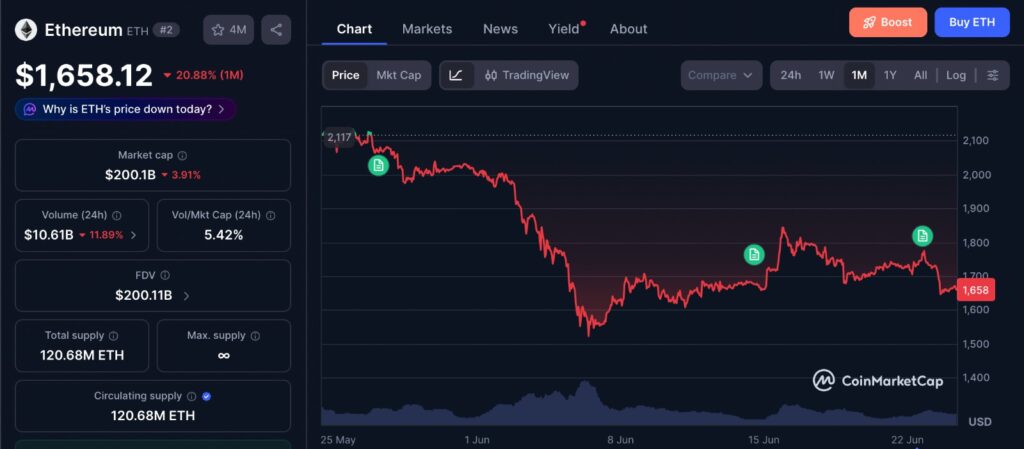
The 1-month ETH chart shows why the liquidation reset matters. Ether’s recent decline did not only erase short-term gains, it also tested whether buyers are willing to step in after forced selling fades. The key signal now is not the size of the drop alone, but how ETH behaves after the $170 million long liquidation flush. If price stabilizes after leverage has been cleared, it would suggest buyers are absorbing the reset. If the reaction remains weak, it would show that demand is still too thin to replace the leverage that just left the market.
Negative Funding Shows Bulls Lost Control
The funding rate in ETH perpetual futures briefly moved into negative territory during the sell-off, according to market data. That means bearish positioning became more expensive to hold because shorts were paying to keep positions open.
At first glance, negative funding can look like a contrarian signal. If too many traders become bearish too quickly, the market can bounce when shorts are forced to cover. But in this case, the signal should be treated carefully.
Negative funding does not automatically mean ETH is ready to recover. It shows that confidence among bullish traders weakened quickly. After a sharp correction and heavy long liquidations, the market is no longer being led by aggressive upside positioning. It is being led by caution.
That caution matters because ETH was already under pressure before the liquidation event. Ether has declined about 20% over the past 30 days, slightly worse than the broader crypto market’s roughly 17% drop over the same period, according to recent market data. That underperformance shows ETH has not only been dragged down by the wider market. It has also been dealing with its own demand problem.
A bounce from here would need more than short covering. It would need evidence that spot buyers, ETF demand, and network-linked confidence are returning together.
Short covering can lift price for a while. It cannot rebuild conviction by itself.
ETF Outflows Add Pressure To ETH Sentiment
One reason the liquidation event matters is that it happened while investment demand was already weak.
US-listed spot Ether ETFs have reportedly seen six consecutive weeks of net outflows, with about $910 million leaving the products since mid-May. Total net assets have fallen to around $9.4 billion, according to recent market data.
That matters because ETF flows have become an important measure of institutional appetite. When inflows are strong, they can help absorb volatility. When outflows persist, the market loses one potential support layer just as leveraged traders become more exposed.
This does not mean ETFs are the only driver of ETH price. But they help show whether larger buyers are using weakness as an entry point or stepping away while volatility rises.
Right now, the signal is cautious.
The sharper point is that leveraged longs were liquidated while ETF demand was already moving in the wrong direction. That combination makes the reset more important because the market now needs real buying, not just relief from forced selling.
Liquidity is not always continuous. Once nearby bids are absorbed, price has to move lower to find the next area where buyers are willing to step in. That is why sell-offs can feel faster when leverage is being cleared and larger buyers are not clearly adding exposure. That same issue has appeared in recent ETH trading, where Ethereum liquidity near key levels has mattered more than headline price moves.
Ethereum Still Leads DeFi, But Demand Has Weakened
The bearish case is not the whole story.
Ethereum still remains the largest decentralized finance network by total value locked. Recent market data shows Ethereum DeFi TVL near $38 billion, representing roughly 53% market share. When layer-2 scaling networks are included, the Ethereum ecosystem also accounts for a large share of decentralized exchange activity.
That strength matters because it separates Ethereum from weaker assets that rely only on price momentum. ETH still has deep network relevance, large developer activity, and a central role in DeFi infrastructure.
But the market is not rewarding that leadership right now.
The broader decentralized applications sector has weakened, with aggregate TVL reportedly shrinking 23% over three months. Ethereum has also faced concerns around softer network-fee activity, with 30-day fees near $11 million, according to recent data. Lower fee activity can weaken the near-term ETH investment case because it points to softer demand for blockspace.
This is the central tension for ETH.
Ethereum remains structurally important, but structural importance does not automatically create near-term price support. Price still needs active demand. That demand gap has already been visible in earlier ETH rebounds, where Ethereum price rallies faded as network demand weakened. If usage softens, ETF flows weaken, and leverage unwinds at the same time, ETH can remain under pressure even while the network keeps its long-term lead.
Strong infrastructure can explain why an asset matters. It does not guarantee that buyers must defend it today.
The Sell-Off Is A Reset, Not A Final Verdict
The $170 million liquidation event does not mean ETH is doomed. It also does not prove that the market has already found a floor.
It means ETH has gone through a sharp leverage reset at a time when confidence was already fragile. That reset can be healthy if it removes overheated positioning and gives stronger buyers a cleaner market to work with. But it can also expose weak demand if buyers fail to respond after forced selling fades.
Recent sessions have shown that ETH rallies are being judged less by how fast price rebounds and more by whether demand can hold after volatility. That is the right test now.
A stronger recovery attempt would likely need three things: funding to stabilize without becoming overheated, ETF outflows to slow, and spot demand to absorb supply without relying on leverage. Until those signals improve, ETH may continue to trade as a market looking for proof rather than a market already pricing in recovery.
The key level is not only a price level. It is a behavior test.
If ETH can hold after leverage has been flushed out, the liquidation event may later look like a painful but necessary reset. If it cannot, the sell-off may show that the market was more fragile than traders expected.
For now, the message is clear: the ETH market has not lost its long-term relevance, but it has lost short-term leverage confidence.
The next move will not be shaped by liquidations alone. It will be shaped by whether spot demand appears after forced selling is gone and whether buyers can replace the leverage that just left the market.
Disclaimer: This content is for informational purposes only and does not constitute financial advice.
Keep yourself updated with the latest crypto news with FYI Gazette
Keep yourself updated with the latest Altcoin News with FYI Gazette
 Bitcoin
  Ethereum
  Tether
  BNB
BNB  XRP
XRP  Solana
  TRON
TRON  Dogecoin
  Litecoin
  Pepe
Pepe