
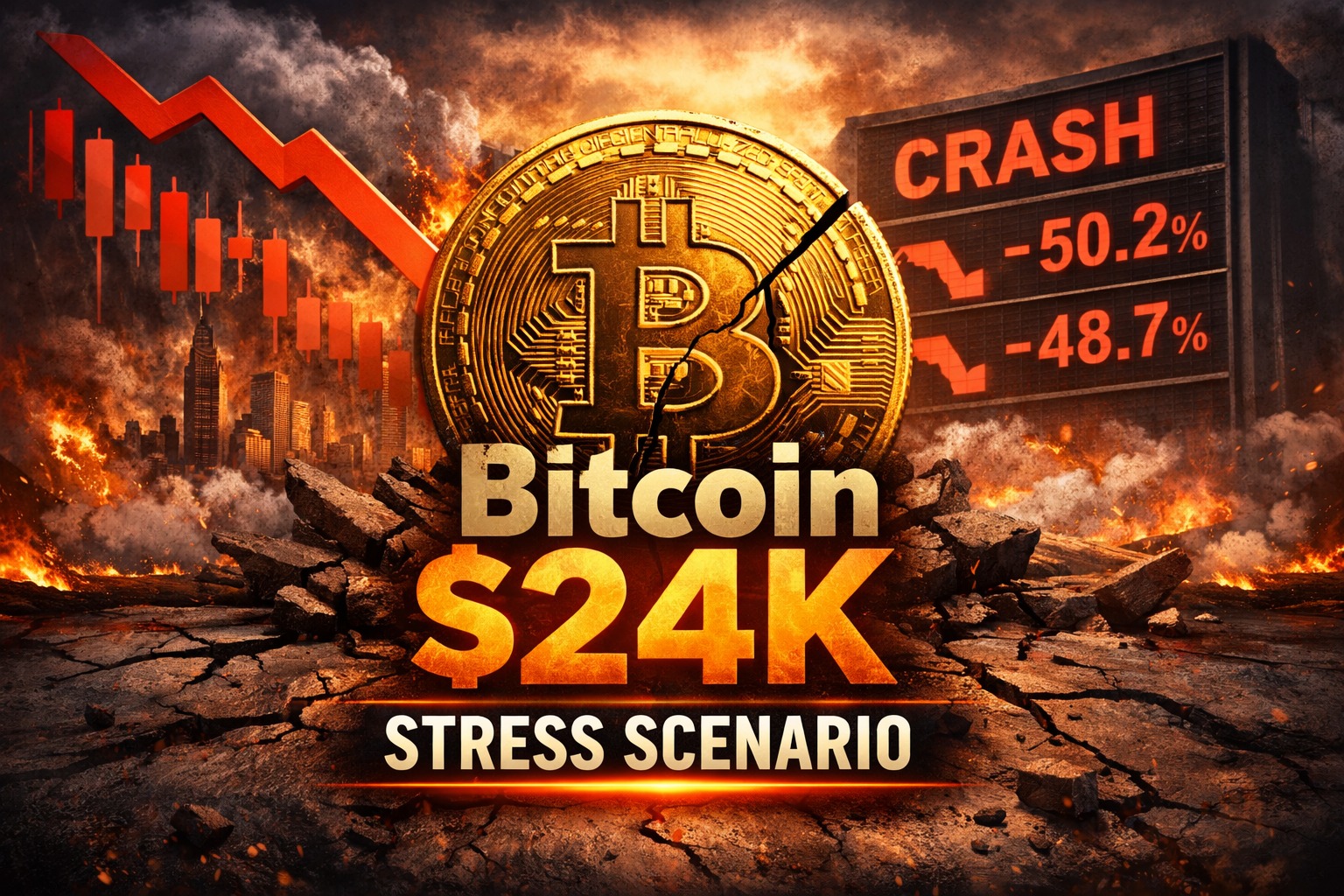
Bitcoin Faces $24K Stress Scenario If US Stocks Enter Deep Crash
Bitcoin’s $24K downside target should not be read as a simple price forecast. It is better understood as a stress-test scenario for what could happen if US stocks enter a deep crash while institutional Bitcoin demand remains weak.
That distinction matters.
According to a technical analyst, Bitcoin could fall toward $23,980 in 2026 if the US stock market suffers a decline of more than 50%. The level was presented as a downside area based on a long-term volume-weighted support line, not as a near-term certainty.
Still, the warning is difficult to ignore because Bitcoin is already showing signs of demand fatigue. Recent ETF flow data has shown heavy outflows since May, while US demand indicators have remained weak. That does not mean Bitcoin must revisit the $24K area. It means the market may have less protection if a wider risk-off move begins.
The real question is not whether Bitcoin is destined for $24K.
The real question is whether Bitcoin has enough fresh demand to absorb a deeper equity-market shock. That concern has already appeared in the broader Bitcoin bull run demand lags analysis, where price strength looked less convincing without stronger follow-through from buyers.
Bitcoin $24K Target Is A Stress Scenario, Not A Base Case
The $23,980 level comes from a long-term anchored volume-weighted average price model. Traders use anchored VWAP to track the average price of an asset, weighted by volume, from a chosen starting point.
In this case, the support line appears to be anchored near Bitcoin’s 2022 bear-market bottom. That makes the level more of a long-cycle stress marker than a normal short-term support zone.
That is why the context matters more than the number itself.
Bitcoin does not fall to a level like $24K simply because a chart line exists. It would likely need a major liquidity shock, a collapse in risk appetite, or forced de-risking across assets. The analyst’s scenario depends on a severe US stock-market crash of more than 50%, which would be an extreme macro event rather than a routine correction.
In practical terms, the $24K level should be treated like a market stress test. It shows where Bitcoin could trade if risk assets break down together and buyers fail to defend higher levels.
Markets do not move when a downside level is visible. They move when that level becomes the first place where real demand is willing to act.
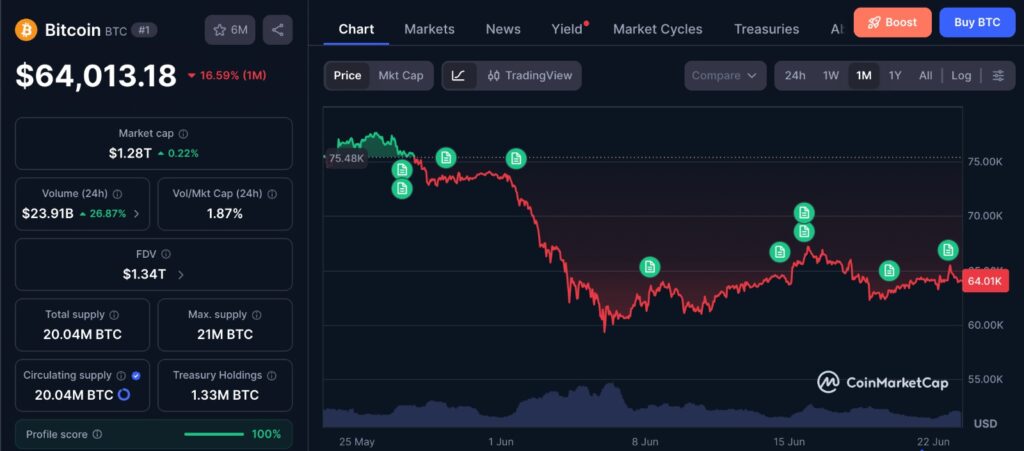
The 1-month Bitcoin chart shows why the $24K level should be viewed as a stress scenario rather than a direct price target. BTC’s recent price action reflects a market still trying to hold its range while ETF outflows and weaker US demand limit upside momentum. The important signal is not whether Bitcoin is already moving toward $24K, but whether buyers continue to absorb supply at current levels. If support weakens while broader risk appetite deteriorates, the stress-scenario discussion becomes more relevant.
Why A Stock Market Crash Would Matter For Bitcoin
Bitcoin is often described as a long-term hedge against currency debasement, but during market stress, it can still behave like a high-risk asset.
When stocks fall sharply, investors often reduce exposure across the risk curve. That relationship was also visible in the Bitcoin Nasdaq weakness BTC decoupling test, where Bitcoin’s ability to hold up against equity pressure became the main market signal. That can include tech stocks, speculative equities, crypto assets and leveraged positions. In those moments, investors are not always judging Bitcoin’s long-term future. They are often raising cash, cutting volatility or meeting risk limits.
This is where the $24K scenario becomes more relevant.
If a deep equity sell-off forces large investors to reduce risk, Bitcoin could face selling from several directions at once. Leveraged traders may be forced out. ETF holders may redeem exposure. Short-term funds may rotate into cash. Institutions may wait for confirmation before buying.
The structure matters because these sellers do not always wait for better prices. In a broad risk-off move, execution becomes more urgent. Funds that need to cut exposure may sell because they have to, not because they want to. That can turn normal weakness into faster repricing.
This is also where leverage can sharpen the move. When crowded positions move against traders, forced exits can add supply exactly when buyers are least willing to step in.
Liquidity is not continuous. Once nearby buy orders are absorbed, price has to move lower to find the next area where demand is willing to take the other side.
That is the mechanism behind the stress scenario: equity losses force risk reduction first, while Bitcoin only stabilizes if fresh buyers arrive quickly enough to absorb that forced supply.
Weak ETF Flows Leave Bitcoin More Exposed
The concern is not just the stock-market crash scenario. The concern is that Bitcoin’s support base looks thinner than it did during stronger phases of the cycle.
US spot Bitcoin ETFs have reportedly seen about $4.68 billion in net outflows since May. This continues a broader Bitcoin ETF outflows record demand test, where the key issue is whether institutional demand remains durable when momentum fades. That matters because ETFs have become one of the clearest channels for institutional Bitcoin exposure.
When ETF inflows are strong, they can help absorb selling and create a steady source of demand. When outflows persist, the same structure can become a pressure point. It does not automatically create panic, but it removes an important layer of support from the market.
ETF demand works differently from social-media conviction or retail dip buying. ETF flows represent allocated capital. When that capital comes in, it can support the market without traders needing to chase price. When it leaves, Bitcoin has to find replacement demand elsewhere.
If ETF investors are trimming exposure during normal volatility, the market has to ask how they might behave during a full risk-asset crash.
That is why the $24K discussion is less about one analyst’s chart and more about Bitcoin’s demand structure.
US Demand Has Not Confirmed A Strong Recovery
Another important signal is the Coinbase Premium Index, which tracks whether Bitcoin trades at a higher or lower price on Coinbase than on Binance.
A positive premium often points to stronger US buying pressure. A negative premium can suggest weaker professional demand or heavier selling from US-linked venues.
Market data has reportedly indicated that the Coinbase premium has remained largely negative so far in 2026. That weak premium also fits with earlier signs that Bitcoin Coinbase premium US demand cools as US-linked buyers become less aggressive during price weakness. That suggests US-linked demand has not returned with strong conviction.
This matters because Bitcoin needs more than passive interest to defend major levels. It needs active buyers willing to absorb supply when price weakens.
Recent sessions have shown Bitcoin reacting less like an isolated asset and more like a market tied to liquidity, ETF flows and broader risk appetite. That makes the current setup more fragile than a simple support line may suggest.
The Real Risk Is A Demand Gap During Panic
Bitcoin’s downside risk is not just about where support sits. It is about who is willing to buy when the market is under pressure.
Retail traders may buy dips, but institutional investors often operate differently. Many funds are governed by risk controls, drawdown limits and performance mandates. They may not buy simply because price is lower. They may wait for stability, confirmation or a change in flows.
That creates a timing problem.
If selling accelerates before institutional demand returns, Bitcoin can fall further than fundamentals-focused investors expect. The reason this happens is simple: supply can hit the market immediately, while larger buyers often need confirmation before committing capital.
That is the key mechanism behind the $24K stress scenario.
Bitcoin may not need to fall anywhere near that level. But if equities suffer a historic decline and ETF demand remains weak, the market could be forced to test how much real demand exists below current prices.
In a calm market, buyers can be patient. In a stressed market, patience can become a liquidity gap.
Bitcoin Bulls Need Flow Confirmation
For Bitcoin bulls, the answer is not to dismiss the $24K warning outright. The better response is to watch whether the conditions behind that warning begin to change.
The first signal would be ETF stabilization. If outflows slow or turn into sustained inflows, it would suggest that institutional investors are using weakness to rebuild exposure.
The second signal would be a stronger Coinbase premium. A move back into positive territory would show that US demand is improving.
The third signal would be Bitcoin holding up better than equities during risk-off sessions. That would suggest the market is developing a stronger independent bid.
Without those signals, Bitcoin may remain vulnerable to macro pressure even if the long-term story remains intact.
This does not mean Bitcoin needs perfect conditions to recover. It means the market needs evidence that buyers are not just interested at lower prices, but willing to provide liquidity while conditions are still uncomfortable.
Editor’s View: Bitcoin’s $24K Level Is A Warning About Liquidity
The $24K downside target is dramatic, but the more important message is simpler: Bitcoin’s risk depends on liquidity.
If US stocks avoid a deep crash, ETF flows stabilize and US demand improves, the $24K scenario may remain only a bearish stress test. But if equities break sharply and institutional buyers continue to step back, Bitcoin could face a harsher demand test.
Over the past month, Bitcoin’s weakness has not been about one headline alone. It has been about fading momentum, cautious ETF buyers and weaker US demand.
That combination does not guarantee a crash. It means Bitcoin needs stronger flow support before the market can fully dismiss extreme downside scenarios.
The market does not need every buyer to become bullish again. It needs enough buyers to show up before forced sellers take control.
For now, the $24K target is not the forecast.
It is the stress line that shows how far Bitcoin could be tested if forced selling arrives before real demand returns.
Disclaimer: This content is for informational purposes only and does not constitute financial advice.
Keep yourself updated with the latest crypto news with FYI Gazette
 Bitcoin
  Ethereum
  Tether
  BNB
BNB  XRP
XRP  Solana
  TRON
TRON  Dogecoin
  Litecoin
  Pepe
Pepe