

Bitcoin Whale Short Raises Concern, But One Trade Is Not The Whole Market
A Bitcoin whale short is attracting attention after a large trader opened bearish positions across crypto and tech-linked markets, but the move should not be treated as a full market signal on its own.
The position is large enough to affect sentiment. It also came while Bitcoin was struggling to hold the $80,000 area, which makes the timing more noticeable. When a whale with a strong trading record flips bearish, traders naturally ask whether the move reflects something deeper. That timing matters because Bitcoin’s latest weekly close near the $80K resistance area has already made traders more sensitive to any sign of weakening demand.
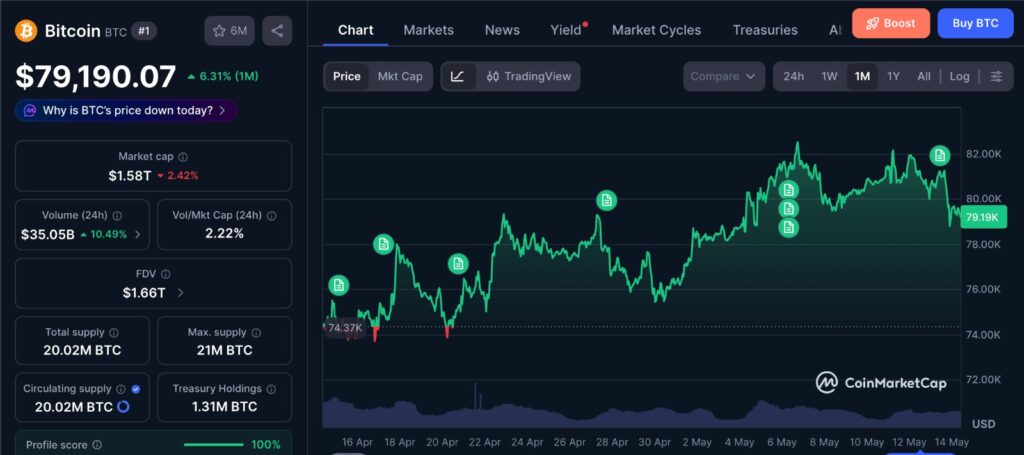
The one-month BTC chart adds useful context to the whale short because it shows how Bitcoin has been trading around a sensitive range rather than reacting to one event in isolation. The key point is not only where BTC is priced today, but whether buyers continue to absorb pressure after repeated tests of nearby levels. If the chart shows hesitation, it supports the idea that traders are watching liquidity and demand closely. If it shows stability, it reinforces why one large short still needs broader market confirmation.
That is where the market needs more context.
A large short can show caution. It can reveal pressure in derivatives. It can influence short-term behavior if other traders follow it. Still, it does not automatically mean that Bitcoin is entering a broader breakdown.
The safer reading is more balanced: this trade matters, but only if it lines up with weaker liquidity, stretched funding, and fading spot demand.
Recent sessions have shown Bitcoin reacting less to single headlines and more to whether buyers can absorb pressure near important levels.
Why The Bitcoin Whale Short Is Getting Attention
The whale reportedly opened around $70 million in bearish exposure across crypto and tech-related assets. The positions included a large short on HYPE, a Bitcoin short, and synthetic exposure tied to technology markets.
That mix matters because it does not look like a simple “Bitcoin-only” bet.
Instead, it looks more like a broader risk-positioning trade. The whale appears to be reducing exposure to assets that usually perform better when risk appetite is strong. Bitcoin, crypto tokens, and tech-linked instruments often react to similar shifts in liquidity, leverage, and macro expectations.
That does not mean they move together perfectly. But when a trader shorts several risk-linked assets at the same time, the market reads it as a sign of caution.
The risk is that traders turn one large position into a full market narrative.
That can be misleading.
A whale short tells us what one large trader is positioned for. It does not tell us whether spot buyers are gone, whether liquidity has weakened, or whether broader demand has broken down.
Markets do not move when one whale leans bearish. They move when that position meets weak liquidity and other traders are forced to adjust.
This Looks More Like A Tactical Trade Than A Market Collapse Signal
The most important detail is not only the size of the short. It is the likely style of the trade.
Reports around the position suggest the whale has a history of active trading and shorter holding periods. That changes how the market should interpret the move.
If the position is tactical, it may be designed to capture a short-term pullback, volatility spike, or liquidity sweep. That is very different from a long-term bearish call on Bitcoin.
Large traders often take short positions for several reasons. They may be hedging previous gains, trading against weak momentum, targeting crowded leverage, or positioning around macro uncertainty for a few sessions.
None of those reasons automatically mean that Bitcoin’s larger structure has failed.
This is why the trade should be watched, but not overvalued.
The key question is not, “Is the whale short?”
The better question is, “Is the rest of the market confirming the whale’s view?”
Right now, that confirmation matters more than the position itself.
Liquidity Is The Real Signal To Watch
A large Bitcoin whale short becomes more important when liquidity is thin.
If order books are weak and buyers are not absorbing sell pressure, even moderate selling can move price quickly. In that environment, a large short can add pressure because other traders may reduce risk at the same time.
But if liquidity remains firm, the same short can lose influence.
This is where market structure matters. Large positions do not create sustained moves by themselves. They become powerful when they expose a lack of buyers on the other side.
Liquidity is not continuous. Once nearby orders are absorbed, price must move to find the next available interest, which is why thin markets can turn a controlled move into a faster repricing.
This matters because thin liquidity changes how traders behave. When exits become harder, participants reduce risk faster, and that can turn caution into broader pressure.
If bids are shallow, sellers need less size to push price lower. If bids are strong, bearish pressure can be absorbed without creating a deeper breakdown. That is why the reaction around key levels matters more than the headline size of the short.
Bitcoin has often seen large directional bets fail when spot demand remains strong enough to absorb pressure. This is why whale positioning alone is not enough. The market needs to see whether buyers remain active near important levels.
A whale can start the conversation, but liquidity decides whether the market listens.
Funding Rates Matter Because Leverage Can Make The Move Bigger
Funding rates are another key part of this setup. That is why the recent shift in Bitcoin funding rates and cautious leverage is important when judging whether the whale short has real market support.
If Bitcoin funding is already overheated, a large short can become more meaningful because it may be targeting crowded long positions. When too many traders are leaning bullish with leverage, price does not need to fall much to trigger liquidations.
In that setup, the short does not need to create the move by itself. It only needs to push price far enough to force crowded longs to start exiting. That risk becomes more important when leverage is already fragile, as seen in the recent crypto liquidations surge that hit Bitcoin near $78K.
That can turn a normal pullback into a sharper move.
But if funding is only mildly positive or neutral, the risk is different. It may show that the market is cautious rather than extremely crowded. In that case, the whale short may still pressure sentiment, but it may not have the same liquidation fuel behind it.
This is why the current setup should not be simplified into a bearish headline.
A large short is only dangerous when leverage is crowded, liquidity is weak, and spot buyers step back at the same time.
Without that combination, the trade may remain tactical.
Spot Demand Is Still The Final Test
The biggest confirmation must come from spot demand. This is also why recent Bitcoin ETF outflows while BTC stalled near $80K matter, because ETF flows can help show whether real demand is supporting price or fading.
Derivatives can move price quickly, but spot demand decides whether a move has staying power. If real buyers continue to absorb supply, bearish leverage can get trapped. If buyers disappear, the short side gains more control.
That is why Bitcoin’s reaction around key price zones matters more than the whale position itself.
If Bitcoin keeps failing to reclaim important levels and spot demand weakens, the whale short will look more relevant. It would suggest that larger traders are positioning ahead of a broader risk reset.
But if Bitcoin stabilizes and buyers continue to step in, the trade may end up being a short-term positioning move rather than a major warning sign.
The market should not ignore the whale, but it should not follow the whale blindly either.
Price matters, but absorption matters more. A market that absorbs selling is very different from a market that simply has not fallen yet.
Why This Is Different From A Liquidation Event
This setup is different from a market-wide liquidation event.
A liquidation event usually shows forced selling after leverage breaks. It is the result of pressure already spreading across the market. A whale short, by contrast, is a position taken before the outcome is confirmed.
That makes it more of a warning signal than a completed event.
It shows that a large trader sees downside opportunity. But it does not prove that the market is already breaking.
This distinction matters because traders often react too late to liquidation data and too early to whale positioning. The better approach is to connect both signals.
If whale shorts rise and liquidations start increasing, that would show pressure is spreading. If whale shorts rise but liquidations stay contained, the market may simply be dealing with short-term caution.
That is why this story should be framed around confirmation, not fear.
What Bitcoin Traders Should Watch Next
The next signal is not the whale’s position alone. The next signal is how Bitcoin behaves around liquidity zones.
If Bitcoin loses support with rising volume, weaker bids, and negative spot flow, the short becomes more important. If price holds firm and funding cools without major forced selling, the bearish position may lose impact.
Traders should also watch whether the short expands or gets reduced quickly. A fast reduction would support the idea that this is a tactical trade. A larger build-up, especially alongside weaker market depth, would deserve more attention.
For now, the setup is cautious but not conclusive.
A whale short can shake confidence, but it cannot replace broader market evidence.
Editor’s View
This Bitcoin whale short matters because it reflects caution from a large and active trader. But it should not be treated as a complete market signal unless other parts of the market confirm the same weakness.
The strongest bearish case would require three things to line up: weaker liquidity, more stressed funding, and softer spot demand.
Without those signals, the trade may simply show that one large player is betting on a short-term pullback.
That makes this a useful warning, not a final verdict.
The real signal appears when liquidity thins, buyers step back, and the whale’s trade starts matching the market’s direction.
.
Disclaimer: This content is for informational purposes only and does not constitute financial advice.
Keep yourself updated with the latest crypto news with FYI Gazette
 Bitcoin
  Ethereum
  Tether
  BNB
BNB  XRP
XRP  Solana
  TRON
TRON  Dogecoin
  Litecoin
  Pepe
Pepe