
XRP ETF Inflows Rise, But Price Still Needs Spot Confirmation
XRP ETF inflows are improving, but XRP price action has not yet confirmed a stronger shift in spot-market demand.
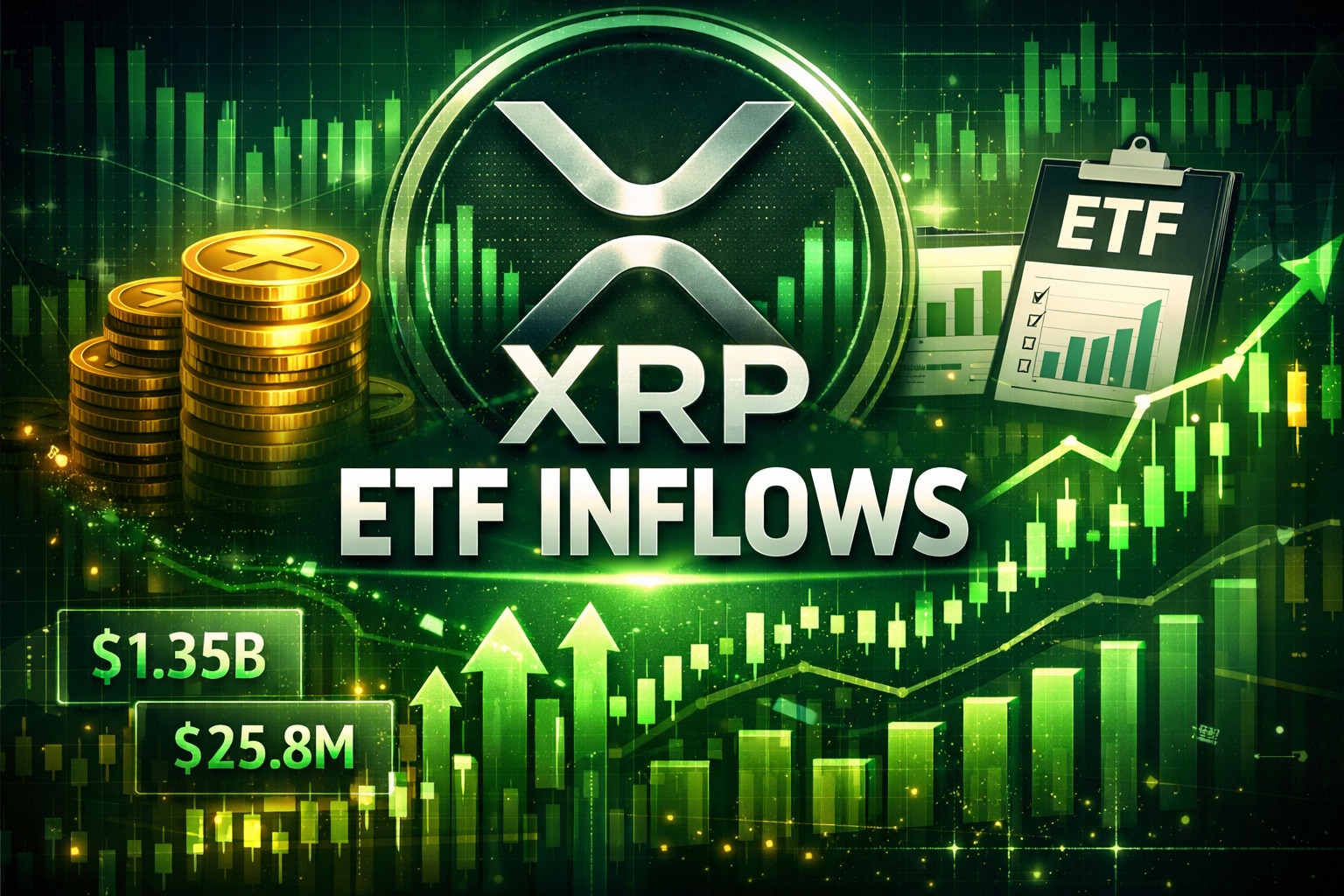
The latest data shows that spot XRP ETFs recorded about $25.8 million in net inflows on Monday, marking their strongest daily inflow since January. Cumulative net inflows reached around $1.35 billion, while total net assets stood near $1.18 billion. XRP exchange-traded products also saw nearly $40 million in weekly inflows for the week ending May 8.
That is a clear improvement in demand, but the market reaction remains measured.
The key question is not whether capital is entering XRP products. It is whether that demand is strong enough to change XRP’s behavior on exchanges, where price still has to deal with sellers, resistance, and real-time liquidity conditions.
So far, price has not delivered a clean confirmation.
XRP has attracted fresh institutional attention, but it has not yet shown the kind of sustained expansion that would confirm broad spot-market strength. That makes this setup more useful than a simple bullish headline. XRP ETF inflows are improving, but the next signal has to come from buyer absorption, liquidity depth, and sustained bid support above key price areas.
This follows a similar pattern seen in XRP’s earlier support-zone setup, where ETF inflows improved but price still needed stronger confirmation from buyers.
XRP ETF Inflows Show Institutional Demand Is Returning
The strongest part of the current XRP setup is the flow data.
Spot XRP ETFs saw five straight days of net inflows, with Monday’s $25.8 million inflow standing out as the largest daily figure since January. Cumulative net inflows also reached around $1.35 billion, showing that demand for XRP-linked ETF exposure has continued to build while price action has stayed controlled.
This matters because ETF flows can reveal a different type of demand than short-term exchange trading.
When traders buy XRP directly on exchanges, demand often reacts quickly to price movement, sentiment, and leverage conditions. ETF flows are usually slower and more structured. They can reflect allocation decisions rather than short-term speculation.
That does not mean ETF inflows automatically push price higher.
It means XRP is receiving more consistent attention from capital that may not behave like normal retail flow. For a market that has often moved on sentiment, legal headlines, and technical setups, this creates a different kind of signal.
The signal is not explosive yet.
It is more about steady demand building in the background while price remains close to important market levels. In that kind of setup, price may not react immediately because new demand can be matched by existing supply from short-term holders, profit takers, and traders waiting near resistance.
ETF inflows show demand is entering the system. Price confirms whether that demand is strong enough to change the structure.
Why XRP ETF Inflows Alone May Not Be Enough
ETF demand is important, but it is only one layer of the market.
For XRP to turn stronger ETF flows into a more convincing price move, spot buyers still need to absorb supply at higher levels. Without that, inflows can improve the demand story while price continues to move slowly.
That is the difference between demand showing up in products and demand showing up in price.
ETF inflows show interest.
Spot confirmation shows execution.
If XRP buyers are strong enough, price should begin to hold higher levels with less hesitation. Pullbacks should become shallower, resistance should weaken, and volume should support the move instead of fading after short rallies.
At the moment, the reaction remains controlled. XRP was recently trading below its short-term high near $1.50, even as inflows improved. That shows the market is not ignoring the data, but it is also not repricing XRP around it yet. That resistance behavior is similar to XRP’s recent sentiment setup, where improving market interest still failed to produce a clean price breakout.
Recent sessions have shown the same pattern clearly: demand is improving, but price still needs to prove that buyers can stay active when XRP moves into heavier selling zones.
That is why this setup should be viewed as a confirmation phase, not a completed breakout.
Markets do not move when demand appears in one corner of the market. They move when that demand absorbs the supply waiting in front of it.
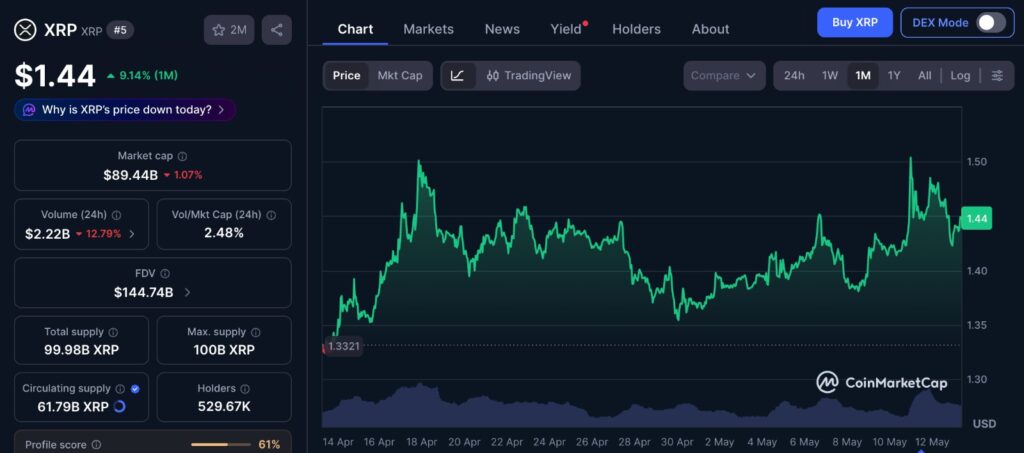
The one-month XRP chart helps explain why the latest inflow data still needs price confirmation. While ETF demand has improved, XRP’s price action over the past month has remained controlled rather than explosive. That suggests buyers are present, but they have not yet overwhelmed the supply sitting near resistance. For the inflow story to become stronger, the chart needs to show sustained bid support, cleaner resistance absorption, and less hesitation when sellers return.
XRP Price Reaction Remains Measured
A measured price reaction is not automatically bearish.
For XRP, it simply means the market still needs proof. Stronger inflows have improved the background story, but price has not yet shown that buyers can control higher levels once sellers return.
That matters because recent attention has come from several directions at once. ETF inflows are improving, open interest has risen, and analysts have pointed to stronger technical structures. The source data also showed XRP futures open interest rising in May while XRP traded modestly higher during the month.
That mix can support a stronger structure if spot buyers remain active.
But it can also create risk if too much of the move depends on derivatives positioning. When futures interest rises faster than exchange demand, the market can become more vulnerable to sharp pullbacks. That is why spot confirmation matters more than the headline inflow number.
A stronger XRP move would need more than improving sentiment.
It would need visible demand that keeps showing up after price tests resistance. Buyers should not only chase strength, but also defend higher levels when sellers return. Without that behavior, the market can look positive on the surface while still lacking the depth needed for real follow-through.
The Real Test Is Liquidity, Not Just Sentiment
XRP’s current setup is less about whether traders are becoming bullish and more about whether liquidity is shifting in favor of buyers.
ETF inflows can help reduce available supply pressure if they continue. But price still has to move through exchange liquidity, sell walls, short-term profit-taking, and traders waiting near resistance zones. That same exchange-liquidity issue was visible when XRP exchange outflows raised questions about whether reduced supply could translate into actual price follow-through.
That is where many crypto rallies either confirm or fail.
A market can have a positive story and still stall if sellers remain active at every higher level. On the other hand, if buyers continue to absorb supply without allowing deeper pullbacks, the structure starts to change.
This is why XRP’s reaction around the $1.50 area matters.
A clean move above that region, followed by stability rather than immediate rejection, would say more than the inflow number alone. It would show that ETF demand is starting to connect with actual spot-market strength.
Until then, the inflows are constructive, but not conclusive.
Liquidity is not continuous. Once nearby orders are absorbed, price has to move toward the next area where buyers or sellers are willing to act. This is why execution matters. Larger buyers often cannot enter all at once without moving price against themselves, so real accumulation can appear slow before it becomes visible in the chart.
What Traders Should Watch Next
The next phase for XRP depends on whether ETF demand continues and whether the spot market confirms it.
The first thing to watch is whether inflows remain consistent after the latest record. One strong day can attract attention, but repeated inflows show that allocation demand is becoming more durable.
The second thing is price behavior near resistance. If XRP keeps failing near the same upper range, it would suggest that sellers are still using strength to exit positions. If price begins to hold above recent levels, the market structure would look stronger.
The third thing is the balance between spot demand and leverage. Rising open interest can support momentum, but it can also make the move more fragile if traders become too crowded on one side.
This is where XRP’s setup becomes more nuanced.
ETF inflows are improving the background structure, but spot confirmation is still the deciding factor.
Editor’s View
The most important part of this XRP move is not the inflow record itself. It is the gap between improving institutional demand and a price reaction that remains controlled.
That gap says something important. The market is not ignoring the inflows, but it is not yet repricing XRP around them either.
For XRP, that may be healthier than a sudden hype-driven move. Stronger trends often begin when demand improves quietly before price fully reflects it. But that only matters if buyers keep showing up when the market tests them.
The next real signal will not come from the inflow headline alone. It will come from how XRP behaves when price meets resistance and sellers try to take control again.
Final Thoughts
XRP ETF inflows are becoming harder to ignore, especially after cumulative net inflows reached around $1.35 billion and weekly XRP exchange-traded product inflows improved. That gives XRP a stronger institutional demand story than it had earlier in the year.
But price still needs to confirm the signal.
Until XRP shows stronger spot demand, cleaner resistance absorption, and more stable higher-level trading, the inflow story remains a developing setup rather than a completed breakout.
The real confirmation is not the size of the inflow. It is whether sellers can test the market and still fail to push XRP lower.
Disclaimer: This content is for informational purposes only and does not constitute financial advice.
Read more about Memecoins with FYI Gazette
Keep yourself updated with the latest Altcoin News with FYI Gazette
 Bitcoin
  Ethereum
  Tether
  BNB
BNB  XRP
XRP  Solana
  TRON
TRON  Dogecoin
  Litecoin
  Pepe
Pepe