
XRP Support Zone Holds as ETF Inflows Keep Rebound Setup in Focus
XRP support zone around $1.30 to $1.40 remains one of the most important areas on the chart, as traders watch whether XRP is building a stronger market base or simply holding above support before another test lower.
The setup has gained attention because XRP is trading near a long-term support area that has shaped its broader market structure for several months. This zone matters not only because of where price is sitting, but because sellers have not yet been able to force a clean breakdown below it.
That does not confirm a major rally.
However, it does show that the downside has not taken full control. In crypto, that kind of behavior matters. A market does not need to look strong every day to be forming a base. Sometimes the first sign of improvement is simply that price stops making meaningful downside progress.
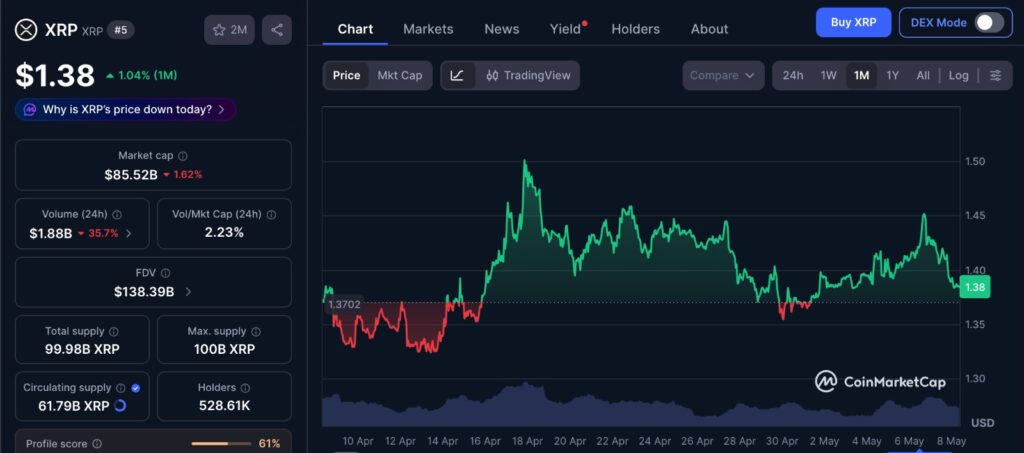
Over the past month, XRP’s CoinMarketCap chart shows why the current support area remains important. Price action has stayed focused around a narrow recovery range rather than showing a clean expansion, which suggests traders are still waiting for stronger confirmation. The chart helps show that XRP is not only reacting to short-term volatility, but also testing whether buyers can continue defending the broader support base near the $1.30 to $1.40 zone. For now, the key signal is not one sharp move higher, but whether XRP can keep holding support while demand gradually improves.
XRP Support Zone Retests a Long-Term Market Area
XRP has been trading near the lower side of a long-term rising channel that has shaped its broader price action for several years. Analysts are watching this area because previous moves near the lower boundary have appeared close to major rebound phases.
One analyst has suggested that XRP could eventually move toward $12 if this support structure holds. Another chart-based view points to a possible target zone between $8 and $14 if XRP continues to defend its breakout area and turns higher from current levels.
Those levels should be treated as technical projection zones, not expectations or confirmed outcomes. They only become relevant if XRP first proves that the current support base is real.
The more important question is not whether XRP can reach those upside targets. The real question is whether buyers are strong enough to protect the XRP support zone that keeps the broader setup intact.
Recent sessions have shown XRP recovering from its February lows near $1.11, with price up roughly 30% from that area. That rebound suggests buyers are still active, but the structure remains unfinished. XRP needs more than one reaction from a low. It needs sustained demand, stronger follow-through, and continued defense of the same support cluster. That same structure has also kept attention on the broader XRP consolidation breakout setup, where the $1.40 area remains important for confirming whether buyers can build momentum beyond support.
A rebound can attract attention, but a durable recovery needs repeated confirmation. Buyers must keep absorbing supply each time price returns to the same area, rather than relying on one sharp bounce from oversold conditions.
Why the XRP Support Zone Matters
The $1.30 to $1.40 area matters because it sits near both chart support and longer-term moving average support. That gives the zone more weight than a random short-term level.
When price holds a level like this for months, it creates a clear battle between buyers and sellers. Buyers see the area as a possible accumulation zone. Sellers see it as the level that must break before a deeper decline can begin. This also connects with the XRP holders profit setup, because holder behavior can influence how much supply reaches the market when price returns to key support or resistance areas.
This is why the current XRP setup is more about behavior than prediction.
If buyers keep stepping in near support, it suggests the market is absorbing supply. If each rebound becomes weaker, it suggests demand is not strong enough yet. The same level can look constructive or fragile depending on how price reacts around it over time.
Markets do not reverse when a support line looks important. They reverse when sellers stop making progress and buyers begin controlling the reaction.
The longer price stays near a major support zone without breaking it, the more important execution becomes. Traders are watching whether bids appear when price dips, whether sellers lose momentum, and whether buyers can push XRP away from the zone instead of only defending it at the last moment.
This matters because larger participants often need both time and liquidity to build or reduce positions. When price sits near support, every dip tests whether enough demand is available to absorb sellers without forcing a deeper breakdown.
When price keeps returning to the same support area, the market is testing bid depth. If that depth weakens, the level can fail quickly because sellers no longer meet the same resistance.
ETF Inflows Add Support to the XRP Setup
The technical setup is also being supported by improving market-specific demand. XRP-related investment products saw $81.6 million in April inflows, marking their strongest monthly total of 2026. In the first week of May, XRP ETFs reportedly added another $28.17 million in inflows.
This matters because capital is entering while XRP is still trading near support. That can improve the quality of the base if demand remains steady, especially during a period when price has not yet confirmed a larger breakout. The same supply-side issue was also visible in recent XRP exchange outflows, where reduced available supply helped explain why liquidity conditions can matter as much as headline price moves.
Still, ETF inflows are not enough by themselves. They can support sentiment and show rising interest, but price still has to confirm that demand through stronger structure. If capital enters while price holds support and begins moving away from it, the setup becomes more constructive. If inflows continue but XRP remains pinned near the same zone, traders may stay cautious.
For XRP, this difference is important. A support zone alone is not enough. The market needs evidence that buyers are not only reacting to dips, but are willing to keep adding exposure as price attempts to build higher levels.
That is why ETF inflows strengthen the story, but they do not complete it.
XRP Still Needs Stronger Confirmation
Even with improving inflows and a defended support zone, XRP has not confirmed a larger breakout. The bullish case still depends on price holding the current structure and turning higher with stronger follow-through.
A clean move above nearby resistance would strengthen the argument that buyers are regaining control. Until then, XRP remains in a testing phase.
This is where many traders misread the setup. A support hold is not the same as a confirmed trend reversal. It only means the downside has not taken control yet.
For XRP to build a more convincing structure, buyers need to do more than defend the lower range. They need to push price away from support and keep it there. That would show that demand is not only reactive, but strong enough to shift market direction.
A market base is not built by hope. It is built when buyers repeatedly step in before sellers can force a new low.
That is why follow-through matters. If XRP rises from support but quickly falls back into the same zone, sellers are still finding liquidity to exit or press shorts. If price begins holding higher levels after each rebound, it would suggest the balance between buyers and sellers is slowly shifting.
Over the past week, XRP’s behavior has remained more defensive than aggressive, with traders focused less on sudden upside and more on whether price can stay above the same support area without weakening. That kind of price action often reflects a market waiting for clearer confirmation before larger participants become more active.
The Downside Risk Is Still Clear
The XRP setup would weaken if price loses the current support cluster. The key area to watch is around the lower channel support and the 50-month exponential moving average near $1.33.
If XRP breaks below this zone with momentum, the market could shift toward deeper downside levels. Analysts have pointed to the 100-month EMA near $0.93 as a possible area of focus if the current structure fails. That would represent a significant drop from present levels and would damage the current rebound argument.
This is why the XRP support zone remains important. XRP does not need to rally immediately for the broader setup to survive, but it does need to avoid a decisive breakdown.
A slow market can still be constructive. A broken structure is different.
The risk is not just that price falls below a line on the chart. The bigger risk is that a failed support zone can change participant behavior. Buyers who were defending the area may step back, while sellers may become more aggressive once the market proves that the level no longer holds.
What XRP Traders Should Watch Next
The next phase for XRP depends on whether buyers can keep defending the current support area while building stronger momentum above it. Continued ETF inflows, improving risk appetite, and stronger price follow-through would all help support the rebound case.
However, traders should be careful with large upside targets. The $12 level and the $8 to $14 zone are technical projections, not confirmed outcomes. They only matter if XRP first proves that the current support base can hold.
For now, XRP remains in a high-interest area because the market is sitting near a level that could decide its next larger move.
If support holds, XRP may continue building a broader recovery structure. If support fails, the market could quickly shift from rebound talk to downside protection.
The next meaningful signal is not the size of the target, but the quality of the reaction near the XRP support zone. XRP does not move higher because a chart points to a large number. It moves when buyers absorb enough supply for sellers to lose control.
Disclaimer: This content is for informational purposes only and does not constitute financial advice.
Read more about Memecoins with FYI Gazette
Keep yourself updated with the latest Altcoin News with FYI Gazette
 Bitcoin
  Ethereum
  Tether
  BNB
BNB  XRP
XRP  Solana
  TRON
TRON  Dogecoin
  Litecoin
  Pepe
Pepe