
Ethereum Whales Accumulate as ETH Falls Below 3000
Ethereum whales are showing strong confidence in the market even as ETH slips below the critical 3000 price level. While many smaller investors react emotionally to falling prices, large holders appear to be taking advantage of the dip. Their quiet accumulation suggests a long term strategy rather than short term fear, offering insight into how experienced market participants view the current situation.
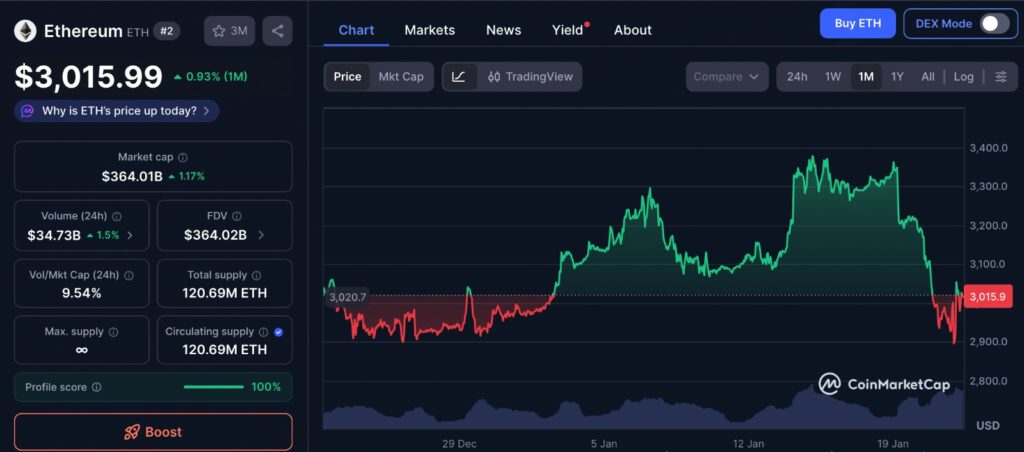
Viewed over the past month, the ETH price chart shows a market that has been trending lower without sharp capitulation. The decline appears controlled rather than disorderly, with pauses that suggest hesitation on both sides rather than panic. This kind of price behavior often reflects a standoff between sellers losing momentum and buyers waiting for clearer confirmation. It is the type of environment where positioning happens quietly, rather than through aggressive moves that stand out on short-term charts.
Ethereum Whales Buying During Market Weakness
Ethereum whales are known for making calculated moves during periods of uncertainty. Recent on chain data shows that several large wallets increased their ETH holdings after the price dropped below 3000. Instead of selling into weakness, these holders chose to accumulate, indicating that they view the decline as a buying opportunity rather than a sign of deeper trouble.
One major reason behind this behavior is valuation. Large investors often focus on long term fundamentals rather than short term price swings. When ETH trades below key psychological levels, it becomes more attractive to buyers with patience and capital. This mindset separates whales from retail traders, who often sell during fear driven corrections.
Institutional Scale Accumulation by Ethereum Whales
Ethereum whales are not buying small amounts. Some large entities acquired tens of thousands of ETH in a short period. These purchases were made through methods that do not immediately impact exchange prices, such as private deals or borrowing stablecoins to fund acquisitions. This approach allows whales to build positions quietly without creating sudden price spikes.
The use of borrowed funds also highlights confidence, though it adds risk. Whales typically manage leverage carefully, but if prices fall further, leveraged positions could face pressure. Still, the willingness to borrow to buy ETH suggests strong belief in future recovery.
Market Conditions Behind Ethereum Whales Accumulation
Broader Crypto Market Sentiment
Ethereum’s decline below 3000 occurred alongside broader weakness in the crypto market. Overall market capitalization dropped, and investor sentiment turned cautious. Many traders moved into defensive positions, waiting for clearer signals before reentering the market.
Despite this uncertainty, Ethereum whales appear unfazed. Their actions suggest that they see the current pullback as temporary. Historically, whales tend to accumulate during periods of fear and reduce exposure during periods of extreme optimism.
Ethereum Network Activity Signals
Ethereum network activity increased during this period, with more addresses and transactions recorded. While this may appear bullish, not all activity reflects real economic demand. Some of the growth may come from technical behavior rather than increased user adoption.
Even so, whales often combine multiple data points when making decisions. Network resilience, long term development, and Ethereum’s role in decentralized finance continue to support confidence among large holders.
How Ethereum Whales Influence Supply and Price
When Ethereum whales accumulate, they often move ETH off exchanges into private wallets or long term holdings. This reduces the amount of ETH available for trading, tightening supply. When supply decreases while demand remains stable or increases, price pressure can build upward.
This supply reduction does not always produce immediate results. Instead, it lays the foundation for future price movement. Once selling pressure weakens and demand returns, reduced supply can amplify price increases.
Reduced Volatility Over Time
As more ETH moves into long term holdings, short term volatility can decrease. Fewer coins are available for quick trades, which can stabilize price action. This environment tends to favor gradual recovery rather than sharp rebounds, aligning with whale investment strategies.
Risks Associated With Ethereum Whales Strategies
While whale accumulation is often seen as bullish, it is not without risks. Some large purchases are funded with borrowed capital. If ETH continues to decline toward lower support levels, leveraged positions may be forced to sell, adding temporary downward pressure.
Additionally, whale behavior does not guarantee immediate price recovery. Markets can remain irrational longer than expected, and macroeconomic factors can override on chain signals. Retail investors should avoid blindly following whale activity without considering broader conditions.
What Ethereum Whales Behavior Means for Investors
For everyday investors, the actions of Ethereum whales provide useful context. Large holders accumulating during price weakness often reflects confidence in long term value. However, this does not mean prices will rise immediately.
Investors should view whale activity as a long term signal rather than a short term trading cue. Combining whale data with technical analysis, market sentiment, and personal risk tolerance is essential for informed decision making.
Long Term Outlook Shaped by Ethereum Whales
Ethereum whales play a key role in shaping market structure. Their accumulation during downturns helps establish support zones and can signal the end of panic selling phases. Over time, this behavior contributes to healthier market cycles.
As ETH continues to evolve and maintain its position within the crypto ecosystem, whale confidence remains an important indicator. While uncertainty persists, the steady accumulation by large holders suggests belief in Ethereum’s long term potential.
Editor’s View: Why Quiet Accumulation Often Goes Unnoticed
What stands out in moments like this is not the size of the buying, but the lack of urgency around it. Experienced participants rarely rush to signal conviction when prices fall; instead, they prefer patience and discretion. Accumulation during uncertainty is often less about calling a bottom and more about accepting imperfect timing in exchange for long-term exposure. This behavior reflects comfort with ambiguity, something charts and indicators rarely capture but which consistently separates reactive traders from strategic investors.
Final Thoughts on Ethereum Whales Accumulating the Dip
Ethereum whales accumulating below 3000 highlights a clear divide between emotional selling and strategic buying. While short term price action remains uncertain, large holders appear focused on future value rather than immediate returns.
Their quiet accumulation reduces circulating supply and sets the stage for potential recovery when market sentiment improves. Although risks remain, whale behavior suggests that Ethereum’s current price levels are viewed as an opportunity rather than a threat.
Disclaimer: This content is for informational purposes only and does not constitute financial advice.
Keep yourself updated with the latest crypto news with FYI Gazette
Read more about Memecoins with FYI Gazette
Keep yourself updated with the latest Altcoin News with FYI Gazette
 Bitcoin
  Ethereum
  Tether
  XRP
XRP  BNB
BNB  Solana
  TRON
TRON  Dogecoin
  Litecoin
  Pepe
Pepe