
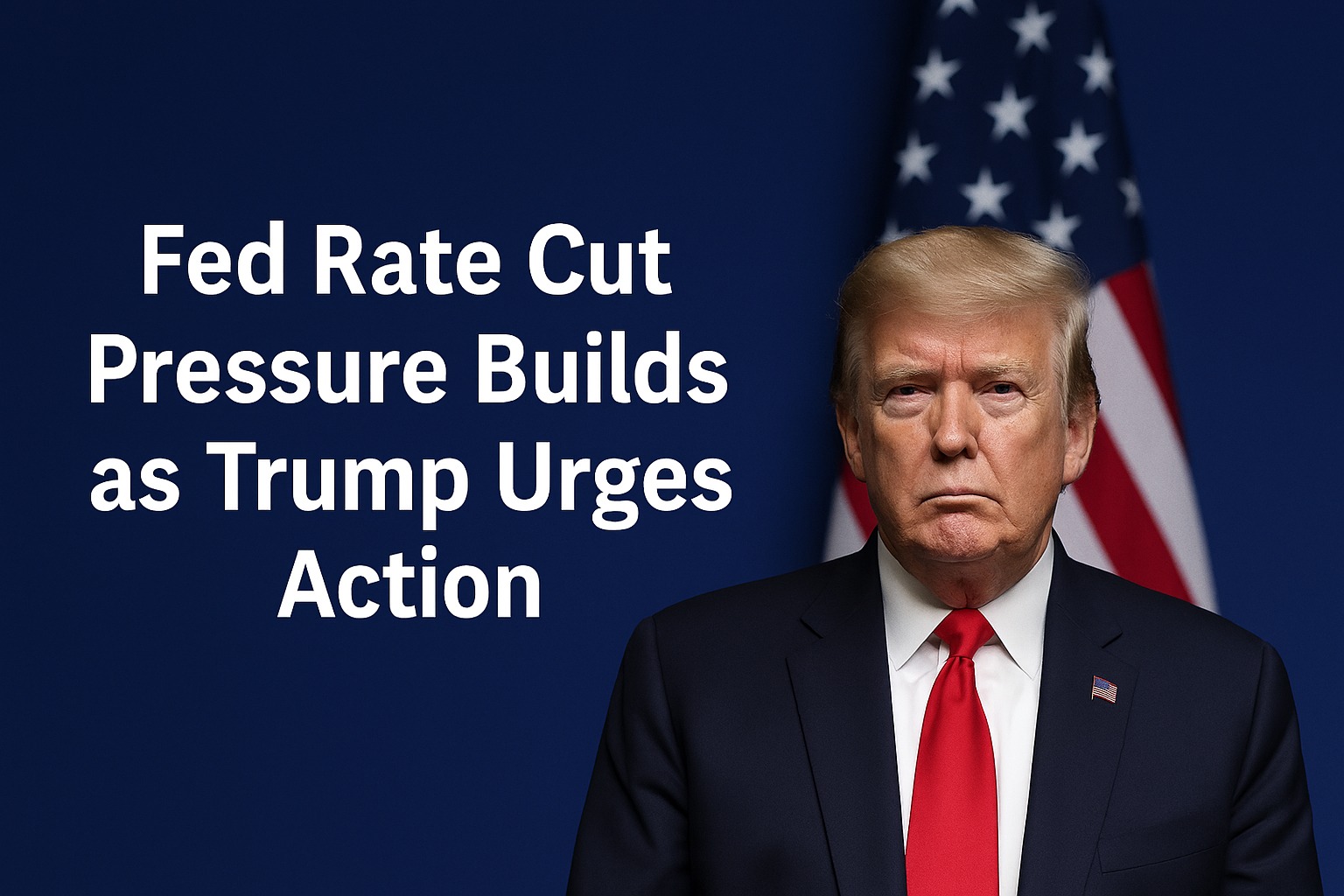
Fed Rate Cut Pressure Builds as Trump Urges Action
Fed Rate Cut pressure has intensified after US President Donald Trump once again urged the Federal Reserve to immediately lower interest rates, even suggesting that policymakers should hold a special emergency meeting to act without delay.
Trump renews Fed Rate Cut demands
This clip highlights the tone and urgency behind Trump’s repeated calls for a Fed Rate Cut, offering a clearer sense of how the message is being communicated publicly. Beyond the wording itself, the delivery reflects growing frustration with the current pace of monetary policy decisions. For market participants, such moments often carry weight not because they change policy immediately, but because they can influence sentiment and expectations in the short term.
Speaking at a White House meeting, Trump questioned why the central bank has not moved sooner, arguing that current conditions already justify a rate reduction. He remarked that even a basic understanding of economics would point toward cutting rates now, reinforcing his frustration with the Federal Reserve’s pace of decision-making. These comments were widely circulated on social media, adding to the ongoing debate around monetary policy.
Trump has repeatedly pushed for lower interest rates in recent months. In a post shared on Truth Social, he stated that the Federal Reserve chair should be dropping rates immediately, emphasizing that delays could have negative consequences for the economy. His criticism has been consistent, often targeting the Federal Reserve’s cautious approach.
Earlier this year, Trump argued that the United States should have significantly lower interest rates, even suggesting they should be among the lowest globally. He has labeled Federal Reserve Chair Jerome Powell as being too slow in responding to economic conditions and warned that maintaining higher rates could hurt the country’s economic position and broader stability.
Economic reasoning behind Fed Rate Cut push
At the center of Trump’s argument is the growing cost of servicing US national debt, which has reached approximately 39 trillion dollars. Higher interest rates increase borrowing costs for the government, making debt management more expensive. Trump has framed a Fed Rate Cut as a way to ease this burden while also supporting growth across multiple sectors.
Lower interest rates generally reduce borrowing costs for businesses and consumers. This can encourage spending, investment, and expansion, which in turn can stimulate economic activity. Trump has pointed to potential benefits in areas such as housing, where mortgage rates directly affect affordability, and in equity markets, where lower rates often support valuations.
Liquidity and risk assets
Another key effect of a Fed Rate Cut is increased liquidity in financial markets. When borrowing becomes cheaper, more capital flows through the system, often finding its way into higher-risk assets. This includes stocks and cryptocurrencies, which tend to perform well in environments where liquidity is abundant and returns on safer assets are lower.
No Fed Rate Cut expected this week
Despite these arguments, market expectations suggest that the Federal Reserve is unlikely to make any immediate changes. The central bank’s March meeting, scheduled as a two-day event, is expected to conclude without a rate adjustment.
Data from futures markets indicates a 99 percent probability that interest rates will remain within the current range of 3.50 percent to 3.75 percent during this meeting. This reflects a strong consensus among traders that policymakers will maintain their current stance for now.
Looking ahead, expectations remain similar for the next meeting scheduled for April 29. Market pricing shows a 97 percent probability that rates will stay unchanged, suggesting that any shift in policy is not expected in the near term.
Leadership changes and Fed Rate Cut outlook
There is also growing attention on future leadership at the Federal Reserve. Trump’s preferred candidate to replace Jerome Powell, Kevin Warsh, is expected to take over in mid-May when Powell’s term ends. Warsh is seen by some as being more open to rate cuts, which could influence the direction of monetary policy later in the year.
However, until that transition occurs, the Federal Reserve is likely to continue operating under its current framework. This means that decisions will remain focused on economic data rather than political pressure, maintaining the institution’s independence.
Inflation risks complicate Fed Rate Cut decisions
Inflation remains one of the key factors influencing the Fed’s decision-making process. While the inflation rate stood at 2.4 percent in February, expectations suggest that it may increase in March. This creates additional uncertainty around whether rate cuts would be appropriate at this stage.
A significant factor contributing to inflation concerns is the recent surge in oil prices, driven in part by geopolitical tensions involving Iran. Higher oil prices increase fuel costs, which can raise transportation expenses and push up the prices of goods and food. This creates upward pressure on inflation, complicating the case for lowering interest rates.
If inflation continues to rise, the Federal Reserve may face pressure to maintain or even increase rates rather than cut them. This highlights the challenge of balancing economic growth with price stability, especially in an uncertain global environment.
Fed likely to maintain cautious stance
Market participants largely expect the Federal Reserve to take a cautious approach. Traders have already priced in the possibility that there may be no rate cuts this year, reflecting uncertainty around how inflation and external factors will evolve.
A wait-and-see strategy allows policymakers to assess incoming data before making any major decisions. This approach reduces the risk of acting too early or too aggressively, particularly when the economic outlook remains unclear.
Fed Rate Cut impact on crypto markets
For cryptocurrency markets, the Fed Rate Cut debate carries important implications. Lower interest rates typically increase liquidity, which can support demand for digital assets. However, if markets have already adjusted to the expectation of no cuts, the impact on crypto prices may be more limited.
At the same time, the relationship between inflation, oil prices, and monetary policy adds complexity. If inflation rises significantly, it could restrict the Federal Reserve’s ability to ease policy, which would affect liquidity conditions across all asset classes.
Editor’s View:
What stands out here is not just the push for a Fed Rate Cut, but the timing and tone of the pressure. When political figures begin calling for immediate policy action, it often reflects broader concern about how current conditions are being perceived rather than what the data strictly shows. Markets tend to react to these signals even if policy itself remains unchanged, as narratives can shape positioning ahead of official decisions. In this case, the discussion around rate cuts may matter as much for sentiment as the actual outcome.
Conclusion
The ongoing discussion around a Fed Rate Cut highlights the tension between political pressure and central bank independence. While Trump continues to advocate for immediate action, current market expectations and economic conditions suggest that the Federal Reserve is unlikely to act in the short term.
As new data emerges and leadership changes approach, the direction of US interest rates will remain a key focus for investors. The outcome will play a critical role in shaping both traditional financial markets and the broader cryptocurrency landscape.
Disclaimer: This content is for informational purposes only and does not constitute financial advice.
Keep yourself updated with the latest crypto news with FYI Gazette
Read more about Memecoins with FYI Gazette
Keep yourself updated with the latest Altcoin News with FYI Gazette
 Bitcoin
  Ethereum
  Tether
  XRP
XRP  BNB
BNB  Solana
  TRON
TRON  Dogecoin
  Litecoin
  Pepe
Pepe