
Fusaka Upgrade Pushes Ethereum Toward Instant-Feel UX
Fusaka Upgrade marks a pivotal moment for Ethereum, officially going live on the mainnet and moving the network closer to delivering a true instant-feel user experience. With improvements centered on data capacity, transaction efficiency, and usability, the Fusaka Upgrade represents Ethereum’s second major development milestone of the year. Its activation introduces a series of enhancements designed to benefit users, developers, Layer-2 networks, node operators, and enterprises that rely on Ethereum’s infrastructure.
The upgrade went live at 9:49 pm UTC at Epoch 411392, signaling the network’s transition into a new phase of scalability. The most important addition is peer data availability sampling, commonly referred to as PeerDAS. This mechanism tackles one of Ethereum’s biggest bottlenecks: the efficient handling of large amounts of data required by Layer-2 rollups and other scaling solutions. By unlocking a more optimized approach to how data travels through the network, the Fusaka Upgrade lays the groundwork for faster interactions and lower operational costs.
How the Fusaka Upgrade enhances Ethereum’s foundation
The introduction of PeerDAS provides significant scaling advantages. Ethereum’s developers highlighted how the system breaks down entire blobs of rollup data into smaller, more manageable cells. Instead of requiring nodes to download and upload complete blobs, PeerDAS allows them to work with only fragments, reducing the amount of data they process. This results in faster node performance and a more streamlined flow of information throughout the network.
In its explanation, the Ethereum Foundation emphasized that this approach allows Layer-2 networks to interact with Ethereum much more efficiently. As these networks depend heavily on data posting to secure their transaction batches, reducing the burden on nodes translates directly to improved throughput. According to the Foundation, Fusaka can unlock up to eight times more data capacity through PeerDAS, dramatically increasing the network’s ability to handle rollup activity.
The upgrade also supports Ethereum’s long-term goal of reducing user fees. Because rollups can post data more efficiently and with less overhead, the associated blob fees become cheaper. Lower fees open the door for broader adoption and create a more cost-effective environment for decentralized applications. This is a key advantage for both users and developers seeking reliable, predictable, and affordable on-chain interactions.
Why the Fusaka Upgrade improves user experience
Instant-feel UX driven by reduced latency
A major highlight of the Fusaka Upgrade is its push toward near-instant user experiences. The Ethereum Foundation described how the upgrade introduces the base conditions for significantly reduced transaction latency. With preconfirmations operating more efficiently, the system can shift from interactions measured in minutes to reactions measured in milliseconds.
This improvement does not replace finality, but it does change how users perceive responsiveness. Whether interacting with a decentralized exchange, a Web3 game, or a simple token transfer, actions can now feel almost instantaneous. The combination of reduced latency and lower costs signals a turning point for usability across the Ethereum ecosystem.
Seamless scalability for Layer-2s and rollups
The Fusaka Upgrade does not only benefit the base layer. Layer-2 networks and rollups stand to gain the most from PeerDAS due to their heavy reliance on data availability. With faster data handling and greater throughput, these networks can expand capacity, lower fees, and support more users simultaneously.
The Ethereum Foundation noted that rollups will enjoy both cheaper blob fees and additional room for growth, all while maintaining decentralization. These improvements reinforce Ethereum’s modular scaling vision, where the base layer remains secure and stable, and Layer-2s handle execution at high volume and speed.
Market reaction and analyst expectations
The Fusaka Upgrade has also drawn attention from market commentators who are evaluating its potential influence on the price of Ether. While the upgrade itself focuses on usability and infrastructure rather than token economics, many observers believe that the technical improvements could play a role in shaping future sentiment.
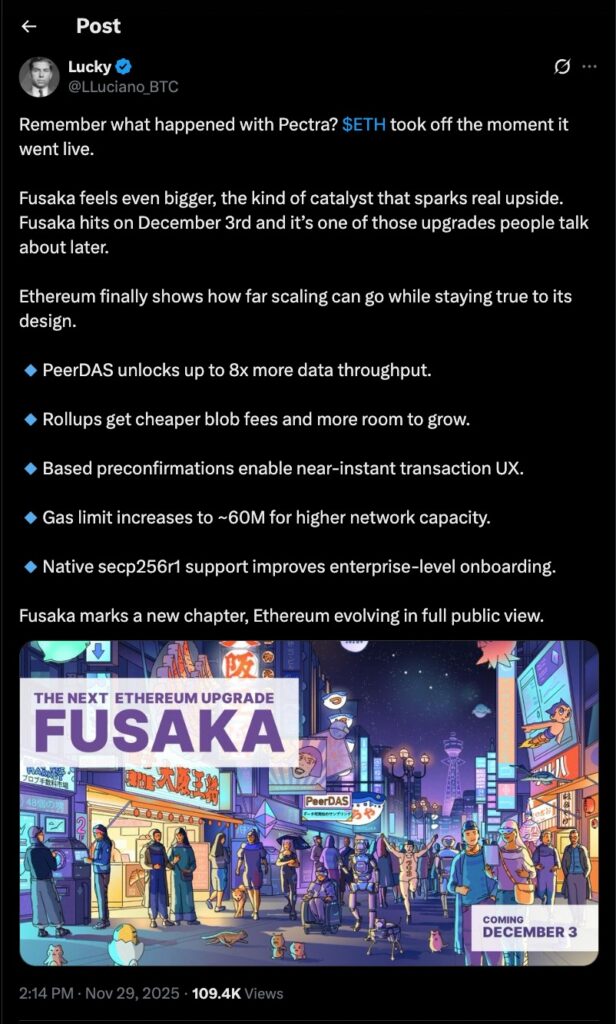
The post highlights how some traders view the Fusaka Upgrade as a potentially powerful catalyst for Ethereum, echoing the broader market speculation surrounding the network’s new capabilities. By emphasizing improvements such as increased data throughput, cheaper blob fees for rollups, and the foundation for near-instant transaction experiences, the commentary reflects growing optimism that Fusaka could enhance usability while strengthening long-term network fundamentals. This aligns with other analysts who believe the upgrade may contribute to renewed momentum for Ether as the ecosystem adapts to the newly expanded capacity and performance upgrades.
Some analysts highlighted the impact of Ethereum’s previous upgrade, Pectra, which coincided with a notable increase in Ether’s price. This led to speculation that Fusaka, offering even more substantial enhancements, could contribute to renewed momentum. They emphasized that fundamental network improvements often drive long-term value, and Fusaka may deepen investor confidence.
Others echoed the belief that Fusaka could serve as a major catalyst, describing it as the type of progress that illustrates just how far Ethereum can scale while staying committed to its foundational design principles. These perspectives reflect growing optimism about Ethereum’s trajectory as it becomes more capable, efficient, and user-friendly.
What Fusaka Upgrade means for Ethereum’s future
The Fusaka Upgrade is more than a standalone improvement; it represents a meaningful step in Ethereum’s broader evolution. By improving data capacity, slashing blob fees, reducing latency, and enabling instant-feel interactions, the upgrade strengthens the foundation upon which the network’s next era of growth will be built.
Its benefits extend across multiple layers of the blockchain ecosystem. Users gain faster and smoother experiences. Developers gain a more flexible environment for building scalable applications. Rollups gain room to expand without overwhelming the base layer. Node operators benefit from handling less data while contributing to network security.
In many ways, Fusaka signals Ethereum’s readiness for mass-scale usage. Although more upgrades will follow, the network’s progress toward accessible, high-speed, and low-cost interactions takes a major leap forward with this release.
Conclusion
The Fusaka Upgrade positions Ethereum closer to delivering the seamless, instant-feel performance that developers and users have long anticipated. Through PeerDAS, expanded data efficiency, lower costs, and enhanced responsiveness, the upgrade strengthens Ethereum’s scalability and usability across the entire ecosystem. As adoption grows and Layer-2 networks continue to build on these improvements, the Fusaka Upgrade stands as a defining milestone in Ethereum’s journey toward a more powerful and accessible decentralized future.
Keep yourself updated with the latest crypto news with FYI Gazette
Read more about Memecoins with FYI Gazette
Keep yourself updated with the latest Altcoin News with FYI Gazette
 Bitcoin
  Ethereum
  Tether
  XRP
XRP  BNB
BNB  Solana
  TRON
TRON  Dogecoin
  Litecoin
  Pepe
Pepe