Kevin Warsh Nomination Sent to Senate by Trump
Kevin Warsh Nomination has officially moved to the United States Senate after President Donald Trump selected the former Federal Reserve governor to lead the central bank. The White House confirmed that Trump nominated Warsh to serve as chair of the Federal Reserve’s Board of Governors, beginning the confirmation process that will determine whether he replaces current chair Jerome Powell. Powell’s term as chair is scheduled to end in May, but he may remain on the Board of Governors until January 31, 2028. The nomination gives Warsh a four year term as chair and a fourteen year term as a member of the Federal Reserve Board if the Senate confirms him.
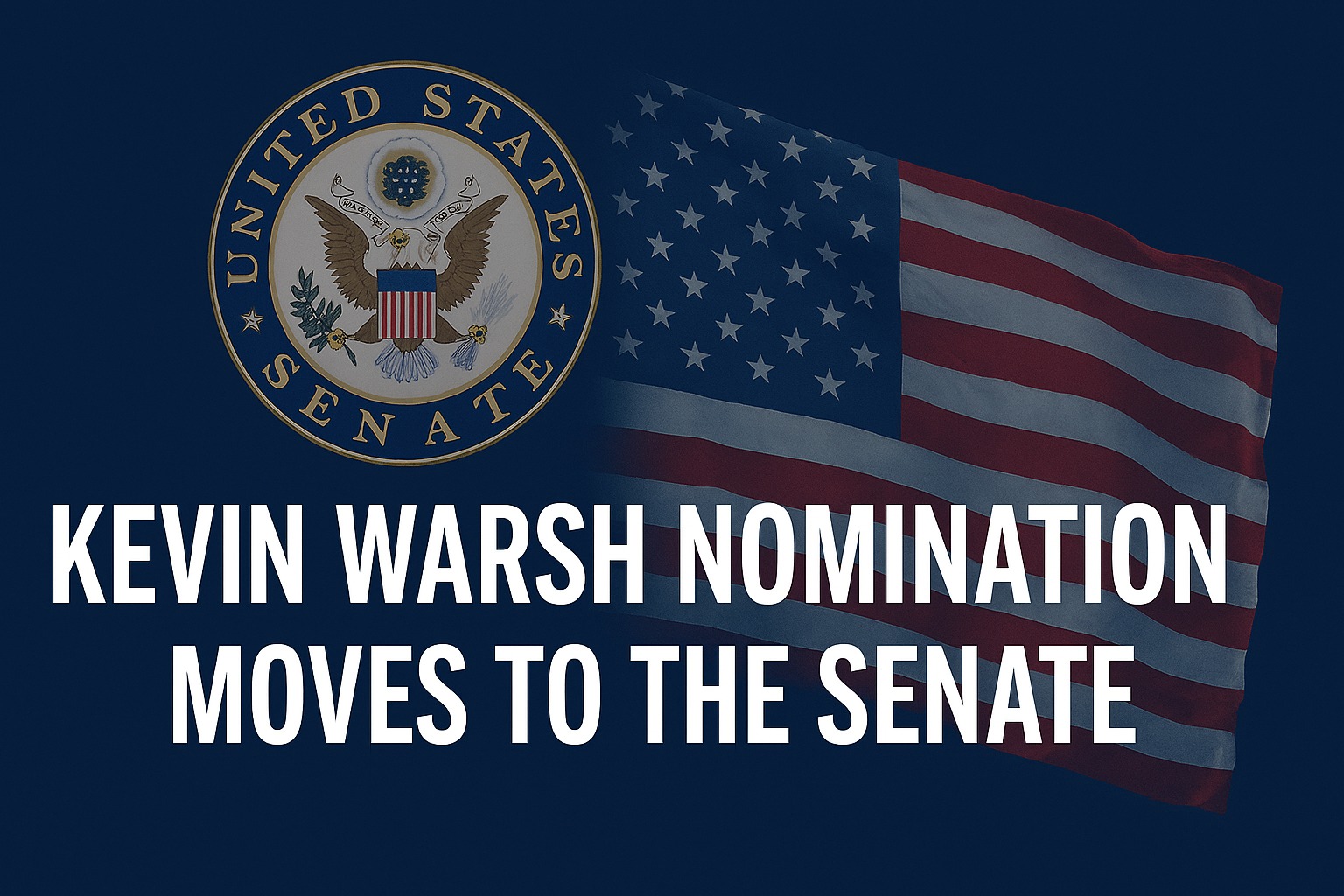
Kevin Warsh Nomination moves to the Senate
The Kevin Warsh Nomination now moves to the Senate, where lawmakers will review the appointment through hearings and a confirmation vote. During this process senators typically question nominees about monetary policy, financial regulation, and the independence of the Federal Reserve.
The central bank plays a critical role in shaping interest rates and guiding the direction of the US economy. Warsh would assume leadership of the institution at a time when markets closely monitor inflation, economic growth and policy signals from the Fed. Because the Federal Reserve influences borrowing costs and liquidity across the financial system, the choice of chair often draws intense political and market attention.
Background of Kevin Warsh
Kevin Warsh previously served as a governor at the Federal Reserve from 2006 to 2011. He was appointed during the administration of President George W. Bush and continued serving during the presidency of Barack Obama.
During that period the United States experienced the global financial crisis, when the Federal Reserve introduced extraordinary measures to stabilize financial markets and support the broader economy. After leaving the central bank, Warsh remained active in economic policy discussions and financial research.
He later became the Shepard Family Distinguished Visiting Fellow in Economics at the Hoover Institution at Stanford University, where he studies financial markets, policy frameworks and economic growth in the United States.
Kevin Warsh Nomination draws attention to Bitcoin views
The Kevin Warsh Nomination has also attracted attention from the cryptocurrency industry because of his past comments about Bitcoin. Warsh has repeatedly suggested that the digital asset represents a changing attitude toward stores of value among younger investors.
In a January 2021 interview on CNBC’s Squawk Box, Warsh said that if Bitcoin never existed gold would likely be rising even more strongly. However he noted that for people under forty, Bitcoin may serve as their modern equivalent of gold as a store of value.
The interview clip highlights how Warsh framed Bitcoin within a broader shift in investor preferences. Rather than treating it purely as a speculative asset, he described it as competing with traditional stores of value like gold. His comments reflected an observation that younger investors increasingly view digital assets as part of the financial landscape. That perspective helps explain why discussions about Bitcoin sometimes surface even in conversations about monetary policy and central banking.
He explained that the growth of digital assets reflects how investors respond to economic conditions and monetary policy signals from governments and central banks.
Warsh’s perspective on Bitcoin
Warsh has continued discussing Bitcoin in later interviews as well. In a 2025 conversation hosted by the Hoover Institution, he suggested that Bitcoin could provide a form of market discipline for policymakers.
According to Warsh, the performance of the cryptocurrency might reveal how much confidence markets have in economic management and financial stability. If investors lose trust in policy decisions, assets like Bitcoin could rise as people search for alternatives to traditional stores of value.
Warsh added that Bitcoin itself does not make him nervous. Instead he sees the asset as a signal that can help policymakers understand whether their decisions strengthen or weaken confidence in the financial system.
Editor’s View: Market interpretation often extends beyond policy
When central bank leadership changes enter public discussion, markets often pay attention not just to policy but to personality and communication style. Investors tend to interpret remarks from potential policymakers through the lens of past statements, even when those remarks were made years earlier in different contexts. In that sense, Warsh’s previous comments on Bitcoin may attract attention simply because they offer a rare glimpse into how a traditional monetary policymaker thinks about emerging financial assets. Sometimes the market reaction reflects this human tendency to look for signals of mindset rather than immediate policy direction.
Political reaction to the Kevin Warsh Nomination
The Kevin Warsh Nomination could face resistance from some lawmakers in Washington. Several Democratic leaders have already raised concerns about whether the Federal Reserve would remain fully independent from political influence.
Senate Minority Leader Chuck Schumer previously warned that lawmakers should not move Warsh nomination forward without clear assurances about central bank independence. According to Schumer, the Federal Reserve must remain free from pressure from any presidential administration.
He argued that Warsh would need to demonstrate that he could protect the institution from political interference. If that commitment is not clear, Schumer said the Senate should refuse to confirm him as chair of the Federal Reserve.
Regulatory leadership beyond the Kevin Warsh Nomination
While the Kevin Warsh Nomination moves through the Senate, another financial regulator in the United States is still waiting for additional leadership appointments.
The Commodity Futures Trading Commission currently operates with only one confirmed leader, its chair Michael Selig, who was confirmed in December. The agency normally includes five commissioners who oversee derivatives markets and certain areas of financial regulation.
However no additional nominations had been sent to the Senate to fill the remaining seats. This leadership gap could become more important if lawmakers pass legislation that expands oversight of digital assets and cryptocurrency markets.
A market structure bill moving through the Senate could grant the regulator greater authority over parts of the crypto industry if it becomes law.
Disclaimer: This content is for informational purposes only and does not constitute financial advice.
Keep yourself updated with the latest crypto news with FYI Gazette
Read more about Memecoins with FYI Gazette
Keep yourself updated with the latest Altcoin News with FYI Gazette
 Bitcoin
  Ethereum
  Tether
  BNB
BNB  XRP
XRP  Solana
  TRON
TRON  Dogecoin
  Litecoin
  Pepe
Pepe