
Paxful $4M Fine Reveals Serious Compliance Failures
Paxful $4M Fine highlights a major enforcement action that demonstrates how cryptocurrency platforms are increasingly being held accountable for compliance failures, particularly when weak controls allow illicit financial activity to flow through their systems.
Understanding the Paxful $4M Fine
The Paxful $4M Fine originates from a federal court judgment following the cryptocurrency platform’s guilty plea to criminal charges brought by United States authorities. Prosecutors accused the company of operating with insufficient anti money laundering safeguards while facilitating transactions connected to unlawful activities, including fraud and illegal prostitution related offenses.
Authorities argued that the platform’s compliance deficiencies were not minor oversights. Instead, investigators concluded that the exchange’s structure and policies created an environment where illicit actors could move funds with limited resistance. This case represents another example of regulators targeting crypto businesses that fail to implement financial crime prevention measures.
Background of Paxful’s Business Model
Paxful operated as a peer to peer cryptocurrency marketplace that enabled users to trade digital assets directly. Unlike traditional centralized exchanges, peer to peer platforms connect buyers and sellers, often allowing a variety of payment methods. This flexibility contributed to Paxful’s rapid growth and global user base.
However, the same characteristics that supported adoption also introduced regulatory concerns. Peer to peer systems can carry elevated risks when identity verification and transaction monitoring mechanisms are limited or inconsistently applied. Regulators later determined that Paxful’s compliance systems did not adequately address these vulnerabilities.
Compliance Issues Behind the Paxful $4M Fine
Central to the Paxful $4M Fine were allegations that the platform failed to maintain effective anti money laundering controls as required under United States regulations. Financial platforms that handle money transfers must implement safeguards designed to detect suspicious activity, verify customer identities, and restrict misuse.
Investigators concluded that Paxful’s compliance framework fell short of these standards. The platform was accused of allowing transactions that should have triggered deeper scrutiny or intervention. These deficiencies formed the backbone of the government’s legal case.
Links to Criminal Activity
Prosecutors stated that transactions processed through the platform were associated with unlawful conduct. Authorities emphasized that financial intermediaries bear responsibility for preventing systems from being exploited by actors engaged in fraud and other illegal activities.
Regulators argued that insufficient safeguards created conditions that enabled prohibited transactions to occur. This formed a critical element in establishing the seriousness of the violations and the justification for enforcement.
Legal Proceedings and Guilty Plea
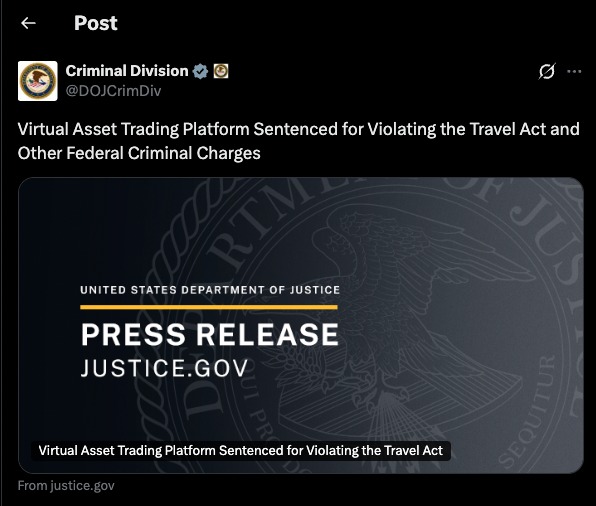
The Justice Department’s public statement adds an important layer of context to the case, as regulatory actions often move through legal channels long before broader market audiences take notice. Official communications like this typically signal that investigators view the matter as more than a routine compliance lapse. In enforcement narratives, language choice and framing can offer subtle clues about how authorities categorize misconduct. For industry observers, such statements frequently serve as reference points when assessing how similar cases may be interpreted in the future.
The Paxful $4M Fine followed the company’s guilty plea to charges including violations related to operating an unlicensed money transmitting business and failing to meet compliance obligations. A guilty plea generally reflects the presence of evidence sufficient to support prosecution.
By resolving the case through legal agreements, the company accepted financial penalties and accountability. This outcome aligns with broader enforcement patterns affecting cryptocurrency businesses.
Financial Penalties and Reduction
Reports indicated that authorities initially considered significantly larger penalties. The final Paxful $4M Fine was reportedly influenced by the company’s financial circumstances and its capacity to satisfy monetary sanctions.
Such adjustments are not uncommon in regulatory proceedings. Courts and prosecutors may scale penalties while preserving the deterrent effect of enforcement actions.
Regulatory Implications of the Paxful $4M Fine
The Paxful $4M Fine reinforces the expectation that cryptocurrency platforms must operate within established compliance frameworks. Digital asset businesses are increasingly subject to financial regulations governing anti money laundering and risk management practices.
Regulators have consistently signaled that technological innovation does not remove legal responsibilities. Platforms facilitating digital transactions must maintain controls comparable to traditional financial institutions.
Editor’s View: Interpreting Market Behavior
Compliance failures in cryptocurrency markets often reveal less about technology and more about incentives. Platforms rarely set out to facilitate illicit activity, yet growth pressures and competitive positioning can gradually distort risk decisions. When user acquisition and transaction volume become primary success metrics, safeguards may be viewed internally as friction rather than protection. Over time, this tension can reshape operational priorities in subtle but consequential ways. Cases like this illustrate how regulatory actions frequently trace back to governance choices rather than isolated technical weaknesses.
Lessons for Cryptocurrency Platforms
One key takeaway from the Paxful $4M Fine involves the necessity of robust compliance infrastructure. Platforms must invest in identity verification procedures, transaction monitoring systems, and internal oversight mechanisms capable of detecting suspicious behavior.
Failure to maintain these controls can expose firms to legal liability and reputational harm. Regulatory expectations surrounding financial crime prevention continue to expand across jurisdictions.
Industry Wide Consequences
Enforcement actions such as the Paxful $4M Fine contribute to evolving standards within the cryptocurrency sector. Regulatory decisions influence how platforms design policies, allocate resources, and manage operational risks.
As oversight intensifies, companies that previously relied on minimal compliance approaches may face increasing pressure to strengthen internal controls. These shifts reflect broader institutionalization within the digital asset industry.
The Future of Crypto Compliance
The Paxful $4M Fine underscores a consistent theme in cryptocurrency regulation. While the industry continues to develop, companies are expected to operate within legal frameworks designed to protect financial systems and market participants.
Regulators are likely to maintain scrutiny of platforms handling digital asset transactions. Firms that integrate compliance into core operations may be better positioned to navigate this environment.
Disclaimer: This content is for informational purposes only and does not constitute financial advice.
Keep yourself updated with the latest crypto news with FYI Gazette
Read more about Memecoins with FYI Gazette
Keep yourself updated with the latest Altcoin News with FYI Gazette
 Bitcoin
  Ethereum
  Tether
  XRP
XRP  BNB
BNB  Solana
  TRON
TRON  Dogecoin
  Litecoin
  Pepe
Pepe