
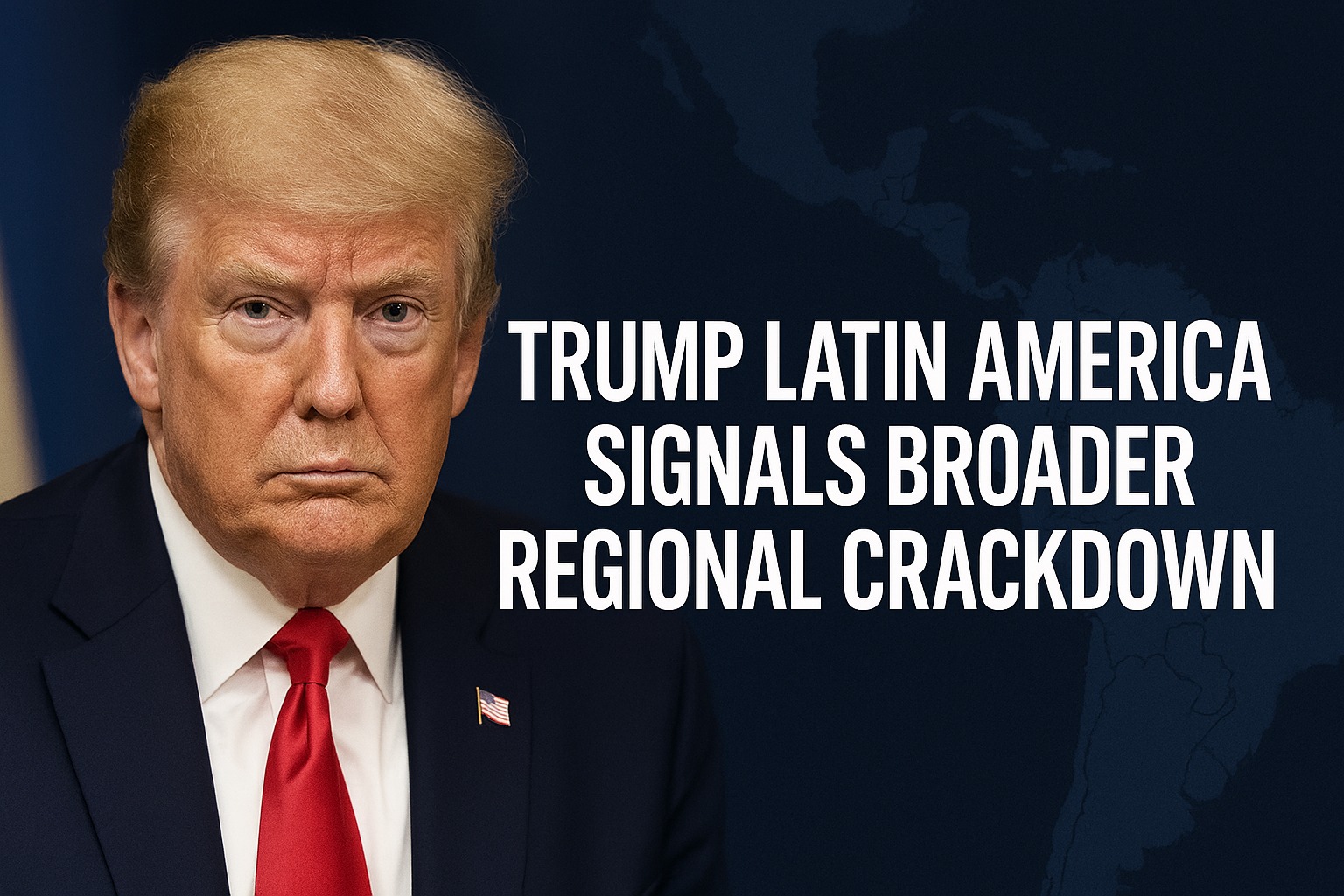
Trump Latin America Signals Broader Regional Crackdown
Trump Latin America policy became a major global talking point after former U.S. President Donald Trump suggested that Colombia and Mexico could be next following the dramatic capture of Venezuelan President Nicolás Maduro. His comments signaled a sharp escalation in rhetoric toward the region and raised concerns about future U.S. involvement beyond Venezuela. The statements came shortly after U.S. forces carried out an operation that resulted in Maduro’s arrest, an event that shocked governments across Latin America and beyond.
Trump Latin America and the Maduro Operation
The capture of Nicolás Maduro marked one of the most aggressive U.S. actions in Latin America in recent history. The operation demonstrated Washington’s willingness to directly confront leaders accused of corruption, drug trafficking, and authoritarian governance. Trump framed the event as a victory for justice and regional stability, emphasizing that Maduro’s removal was necessary to combat criminal networks operating out of Venezuela.
Following the operation, Trump expanded his remarks to include other countries in the region. Rather than limiting the discussion to Venezuela, he made clear that the United States was closely watching neighboring nations that he believes are contributing to drug trafficking and organized crime affecting the U.S.
Trump Latin America Focus Turns to Colombia
Colombia quickly emerged as a focal point in Trump’s comments. He criticized the country’s leadership, accusing it of allowing large-scale cocaine production and export into the United States. Trump described Colombia as being run by a deeply flawed system and suggested that stronger action may be required to stop the flow of drugs.
When asked directly whether Colombia could face similar action to Venezuela, Trump responded positively to the idea, signaling openness to intervention. While no formal policy or plan was announced, the language used marked a significant departure from traditional diplomatic norms between the two countries.
Historically, Colombia has been one of the United States’ closest allies in Latin America, particularly in counter-narcotics efforts. Trump’s remarks suggest frustration with the perceived lack of progress and hint at a more aggressive stance if drug production continues at current levels.
Trump Latin America and Pressure on Mexico
Mexico was also mentioned in Trump’s remarks, though the tone differed slightly. Trump acknowledged cooperation with Mexican leadership but criticized the country’s inability to control powerful drug cartels. He stated that something would eventually have to be done to address cartel violence and drug trafficking.
Trump reportedly offered assistance in dealing with cartels, an offer that was declined by Mexico’s president. Despite this rejection, Trump continued to suggest that U.S. patience was limited. His comments implied that continued cartel activity could push the United States toward stronger involvement.
The mention of Mexico carries serious implications given the deep economic, political, and social ties between the two countries. Any escalation would have far-reaching consequences for trade, border security, and regional stability.
Trump Latin America and Regional Tensions
Trump’s statements triggered concern across Latin America. Many governments viewed the capture of Maduro and subsequent comments as signals that the United States may be returning to a more interventionist foreign policy approach in the region. Leaders and analysts worry that public threats could undermine sovereignty and destabilize diplomatic relationships.
At the same time, some voices within and outside the region argue that tough measures are necessary to combat drug trafficking, corruption, and criminal organizations that operate across borders. Trump’s framing positions the U.S. as a force willing to take decisive action when regional governments are seen as ineffective.
Trump Latin America and Economic Reactions
The political developments also had economic ripple effects. Market uncertainty increased following the news, and alternative assets such as Bitcoin saw notable price movement. Investors often react to geopolitical instability by seeking assets perceived as hedges against traditional financial systems.
While the long-term economic impact remains unclear, the immediate response highlights how closely financial markets track major geopolitical events, particularly those involving the United States and strategic regions like Latin America.
Trump Latin America Strategy Implications
Trump’s remarks raise important questions about the future direction of U.S. foreign policy in the Western Hemisphere. By openly suggesting that Colombia or Mexico could be next, he introduced uncertainty into relationships that have traditionally relied on cooperation rather than confrontation.
If such rhetoric were to translate into policy, it could reshape alliances, security agreements, and regional power dynamics. It could also invite responses from other global powers with interests in Latin America, further complicating the geopolitical landscape.
Editor’s View: Why Markets React Before Policy Does
Political statements often move markets not because of what will happen, but because of how uncertainty changes behavior. Traders and investors tend to react first to shifts in tone, especially when those shifts come from figures known for unpredictable decision-making. In moments like this, the market response reflects caution rather than conviction, as participants adjust risk exposure ahead of any concrete policy. This dynamic explains why even early or ambiguous signals can have outsized short-term effects, particularly in assets sensitive to global instability.
Looking Ahead for Trump Latin America Policy
For now, Trump’s comments remain statements rather than confirmed plans. However, they signal a willingness to use strong language and possibly strong action to address issues such as drug trafficking and organized crime. Whether this approach results in diplomatic pressure, economic measures, or military involvement remains to be seen.
What is clear is that Trump Latin America policy has entered a more confrontational phase. The capture of Maduro and the warnings directed at Colombia and Mexico have intensified debate over sovereignty, security, and the appropriate role of the United States in the region.
As the situation develops, governments, markets, and citizens across Latin America will be watching closely. The direction taken could define regional relations for years to come.
Disclaimer: This content is for informational purposes only and does not constitute financial advice.
Keep yourself updated with the latest crypto news with FYI Gazette
Read more about Memecoins with FYI Gazette
Keep yourself updated with the latest Altcoin News with FYI Gazette
 Bitcoin
  Ethereum
  Tether
  XRP
XRP  BNB
BNB  Solana
  TRON
TRON  Dogecoin
  Litecoin
  Pepe
Pepe