Blockchain Trilemma Solved Through Ethereum Innovation
Blockchain Trilemma Solved is a statement that challenges one of the longest-standing ideas in blockchain technology. For many years, developers believed that a blockchain could only achieve two of three key qualities at the same time: decentralization, security, and scalability. According to Ethereum co-founder Vitalik Buterin, recent Ethereum upgrades show that this limitation may finally be overcome.
The blockchain trilemma explains why many networks struggle as they grow. When transaction demand increases, blockchains often become slower or more expensive. Some networks solve this by becoming more centralized, while others remain decentralized but inefficient. Ethereum’s latest technical developments aim to remove this tradeoff instead of choosing between compromises.
Blockchain Trilemma Solved and What It Means
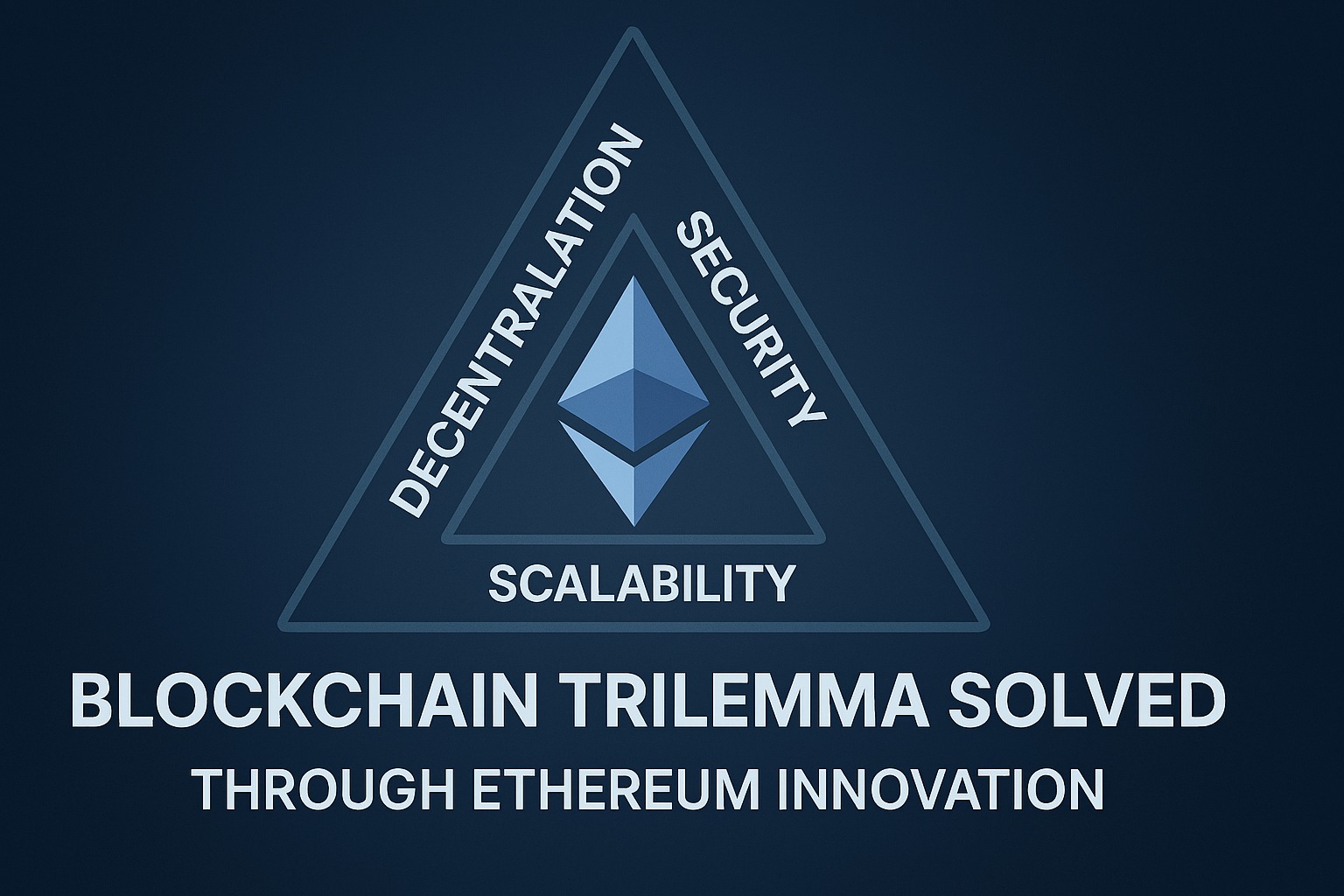
The blockchain trilemma describes the difficulty of building a network that is decentralized, secure, and scalable at the same time. Decentralization means control is spread across many participants. Security ensures transactions and data cannot be manipulated. Scalability allows the network to handle large volumes of activity without high costs or delays.
Historically, improving one of these areas weakened another. Faster blockchains often relied on fewer validators, which reduced decentralization. Highly decentralized systems often processed transactions slowly. This challenge shaped blockchain design for more than a decade.
Vitalik Buterin believes Ethereum is now approaching a point where this balance can be achieved through layered upgrades that work together.
Why Blockchain Trilemma Solved Is Important
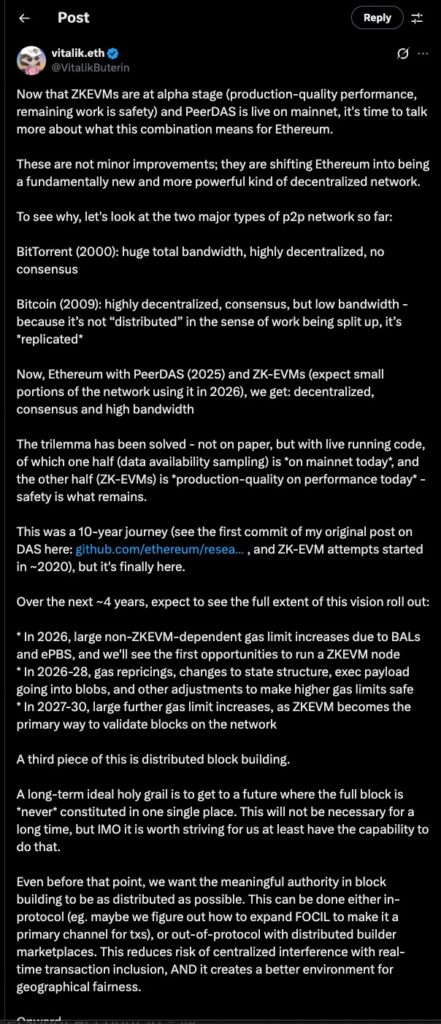
The tweet captures a shift in how Ethereum’s scaling discussion is framed. Rather than presenting these upgrades as isolated optimizations, the focus is on how multiple systems now operate together in live conditions. The emphasis on running code, rather than theoretical design, reflects a broader change in how progress is measured within the ecosystem. It also highlights that the remaining challenges are openly acknowledged, not dismissed, which adds context to why these developments are being taken seriously.
Solving the blockchain trilemma is essential for real-world adoption. A network that cannot scale becomes unusable during high demand. A network that sacrifices decentralization risks censorship or control by powerful actors. A network that weakens security loses user trust.
Ethereum supports decentralized finance platforms, digital assets, games, and applications used by millions of people. If Ethereum fails to scale safely, these systems cannot grow. This is why Ethereum focuses on long-term improvements rather than quick fixes.
Blockchain Trilemma Solved Through PeerDAS
One major upgrade contributing to the blockchain trilemma solved claim is peer data availability sampling, known as PeerDAS. This technology changes how blockchain data is checked and shared across the network.
In traditional systems, nodes must download all block data to verify that it exists. This limits scalability because it increases storage and bandwidth requirements. PeerDAS allows nodes to verify small portions of data instead of the full dataset.
By sampling data, the network can confirm availability without forcing every node to store everything. This increases data capacity while keeping node operation accessible to more users. As a result, decentralization is preserved while scalability improves.
PeerDAS is already active on Ethereum, making it a practical example of how scaling can happen without centralization.
Blockchain Trilemma Solved Using ZK-EVMs
Another key component is the development of zero-knowledge Ethereum Virtual Machines, or ZK-EVMs. These systems use cryptographic proofs to verify transactions efficiently without reprocessing every action.
ZK-EVMs allow Ethereum to group many transactions together and confirm them with a single proof. This reduces computational workload while maintaining security. Importantly, ZK-EVMs are compatible with existing Ethereum smart contracts, allowing developers to adopt them without rewriting applications.
While safety improvements are still ongoing, ZK-EVMs already demonstrate strong performance capabilities. Over time, they are expected to play a major role in Ethereum’s transaction validation process.
Ethereum’s Roadmap Toward Blockchain Trilemma Solved
Ethereum’s strategy focuses on gradual improvements rather than dramatic changes. PeerDAS improves data availability. ZK-EVMs improve transaction verification. Additional upgrades such as gas limit increases and state optimizations further expand capacity.
Together, these technologies support scalability while protecting decentralization and security. Vitalik Buterin emphasizes that no single upgrade solves the trilemma alone. Instead, the combined effect of these systems creates balance across all three areas.
This approach allows Ethereum to scale sustainably while reducing risk.
What Blockchain Trilemma Solved Means for the Future
If Ethereum succeeds, the impact goes beyond one network. Other blockchain projects may adopt similar data availability and zero-knowledge solutions. Developers gain confidence building applications that can scale without sacrificing core principles.
A scalable and decentralized Ethereum could support global financial systems, digital identity tools, gaming platforms, and enterprise applications. This moves blockchain technology closer to mainstream infrastructure while preserving openness and trust.
Editor’s View: Why This Debate Persists
One reason the blockchain trilemma has endured is that many users judge networks based on moments of stress rather than normal operation. Congestion, high fees, or outages leave a stronger impression than gradual improvements that happen quietly in the background. This creates a gap between how engineers measure progress and how participants experience it day to day. Understanding that gap helps explain why claims of improvement are often met with skepticism, even when the underlying technology has genuinely evolved.
Conclusion
Blockchain Trilemma Solved is no longer just a theoretical concept. With PeerDAS already active and ZK-EVMs nearing wider adoption, Ethereum shows a clear path toward balancing decentralization, security, and scalability.
While development continues, the foundation is already in place. Ethereum’s layered approach demonstrates that long-standing blockchain limitations can be addressed through careful design. The coming years will determine how fully this vision is realized, but the progress so far signals a major shift in blockchain technology.
Disclaimer: This content is for informational purposes only and does not constitute financial advice.
Keep yourself updated with the latest crypto news with FYI Gazette
Read more about Memecoins with FYI Gazette
Keep yourself updated with the latest Altcoin News with FYI Gazette
 Bitcoin
  Ethereum
  Tether
  BNB
BNB  XRP
XRP  Solana
  TRON
TRON  Dogecoin
  Litecoin
  Pepe
Pepe