
Bitcoin Bailout Authority Explained by US Treasury
Bitcoin Bailout Authority became a major topic of discussion in the United States after Treasury Secretary Scott Bessent addressed questions about whether the government could rescue Bitcoin during a market crisis. Speaking before lawmakers, Bessent made it clear that the US government does not have the power to bail out Bitcoin or require banks to buy it. His statement highlights how limited the government’s role is when it comes to supporting cryptocurrencies, even as Bitcoin becomes more important in global finance.
The comments came during a congressional hearing where lawmakers questioned the Treasury Department’s stance on digital assets. Some members of Congress have long expressed concerns about Bitcoin’s volatility and potential risks to financial stability. Others see Bitcoin as a strategic asset that could strengthen the US position in the global financial system. Bessent’s response focused on legal authority rather than ideology, stressing that existing laws do not allow for a Bitcoin bailout.
Bitcoin Bailout Authority and Treasury Limits
The idea of Bitcoin Bailout Authority often assumes that the government could step in the same way it has rescued banks or large corporations in the past. According to Bessent, that assumption is incorrect. He explained that neither the Treasury Department nor the Financial Stability Oversight Council has the authority to use taxpayer money to support Bitcoin prices or to direct private banks to purchase Bitcoin.
This distinction is important because Bitcoin operates outside the traditional financial system. Unlike banks, it is not regulated as a central financial institution, and it does not have access to emergency government funding. Bessent emphasized that Bitcoin investors take on market risk voluntarily and should not expect government protection if prices fall sharply.
Why Bitcoin Bailout Authority Does Not Exist
Bessent’s explanation focused on the legal framework that governs federal financial agencies. These agencies are bound by laws passed by Congress, and those laws do not include provisions for rescuing cryptocurrencies. Even in extreme market conditions, the Treasury cannot create new powers on its own.
This position reassures critics who worry that taxpayers could be forced to absorb losses from speculative investments. It also reinforces the idea that Bitcoin remains a market driven asset rather than a government backed one.
Bitcoin Bailout Authority and Strategic Bitcoin Reserves
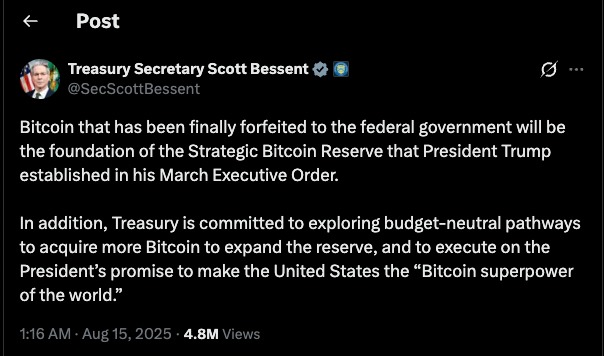
This statement from Treasury Secretary Scott Bessent helps clarify a common misunderstanding about the government’s role in Bitcoin markets. While the Strategic Bitcoin Reserve relies on Bitcoin already forfeited to the federal government, it does not represent a commitment to support prices or intervene during downturns. The emphasis on budget neutral pathways underscores that any expansion of holdings must avoid new taxpayer spending. In this context, the reserve functions more as an asset management decision than a form of market backstop.
The discussion around Bitcoin Bailout Authority is closely connected to the US government’s Strategic Bitcoin Reserve. The reserve was created to hold Bitcoin that has been seized through law enforcement actions rather than sold immediately. According to Bessent, the government has already benefited from this approach, as the value of previously seized Bitcoin has grown significantly over time.
However, holding Bitcoin is not the same as actively supporting the market. Bessent clarified that the reserve does not give the government permission to buy Bitcoin freely or stabilize prices. Its purpose is limited to managing assets the government already owns.
Budget Neutral Rules for Bitcoin Holdings
One of the most important restrictions tied to the Strategic Bitcoin Reserve is that it must remain budget neutral. This means the government cannot spend new money to buy Bitcoin. Any increase in Bitcoin holdings would have to come from converting existing assets, such as other reserves, without increasing overall spending.
This rule directly limits any form of Bitcoin Bailout Authority. Even if policymakers wanted to support Bitcoin through purchases, current rules would not allow it.
Congressional Views on Bitcoin Bailout Authority
During the hearing, lawmakers raised hypothetical scenarios where Bitcoin’s collapse could threaten financial stability. Some questioned whether the government should have emergency powers to intervene. Bessent consistently responded that no such authority exists today.
This exchange highlights the gap between political debate and legal reality. While Congress can choose to pass new laws in the future, current regulations do not permit Bitcoin bailouts. Until those laws change, the government’s hands remain tied.
Divided Opinions Among Lawmakers
Some members of Congress see Bitcoin as a risk that should be tightly controlled or discouraged. Others believe it represents innovation and economic opportunity. The lack of Bitcoin Bailout Authority reflects this division, as no clear consensus has formed around deeper government involvement.
Market Impact of Bitcoin Bailout Authority Statements
The Treasury’s position has sparked mixed reactions within the crypto community. Some investors see the refusal to bail out Bitcoin as a positive sign that the asset remains independent and decentralized. Others worry that the absence of government support could increase risk during major downturns.
Despite these concerns, Bitcoin has historically thrived without direct government backing. Many supporters argue that removing the possibility of bailouts strengthens the market by encouraging responsible investment decisions.
Long Term Implications for Bitcoin
The lack of Bitcoin Bailout Authority may shape how institutions and individuals approach Bitcoin in the future. Investors may place greater emphasis on risk management, while policymakers may continue to explore regulatory clarity rather than financial intervention.
Editor’s View: Bitcoin Bailout Authority and Investor Psychology
Editor’s View: Bitcoin Bailout Authority often matters less for what it enables than for what it signals to market participants. When investors know there is no safety net, behavior tends to shift from short term speculation toward more deliberate risk assessment. This dynamic has historically shaped how Bitcoin holders think about leverage, custody, and time horizons. In that sense, the absence of bailout authority does not weaken the market but quietly reinforces its self selection process.
Bitcoin Bailout Authority in Broader Digital Asset Policy
Bitcoin Bailout Authority is only one element of the US government’s broader approach to digital assets. Treasury officials have signaled interest in creating clear rules that protect consumers while allowing innovation. This includes oversight, reporting standards, and asset management policies.
By refusing to bail out Bitcoin, the Treasury reinforces the idea that regulation, not rescue, is the government’s primary tool. This approach aims to balance financial stability with market freedom.
Final Thoughts on Bitcoin Bailout Authority
In conclusion, Treasury Secretary Scott Bessent’s message was direct and unambiguous. The US government does not have the authority to bail out Bitcoin, force banks to buy it, or use taxpayer money to support its price. Bitcoin remains a market driven asset, and its risks and rewards belong to those who choose to invest in it.
Disclaimer: This content is for informational purposes only and does not constitute financial advice.
Keep yourself updated with the latest crypto news with FYI Gazette
Read more about Memecoins with FYI Gazette
Keep yourself updated with the latest Altcoin News with FYI Gazette
 Bitcoin
  Ethereum
  Tether
  BNB
BNB  XRP
XRP  Solana
  TRON
TRON  Dogecoin
  Litecoin
  Pepe
Pepe