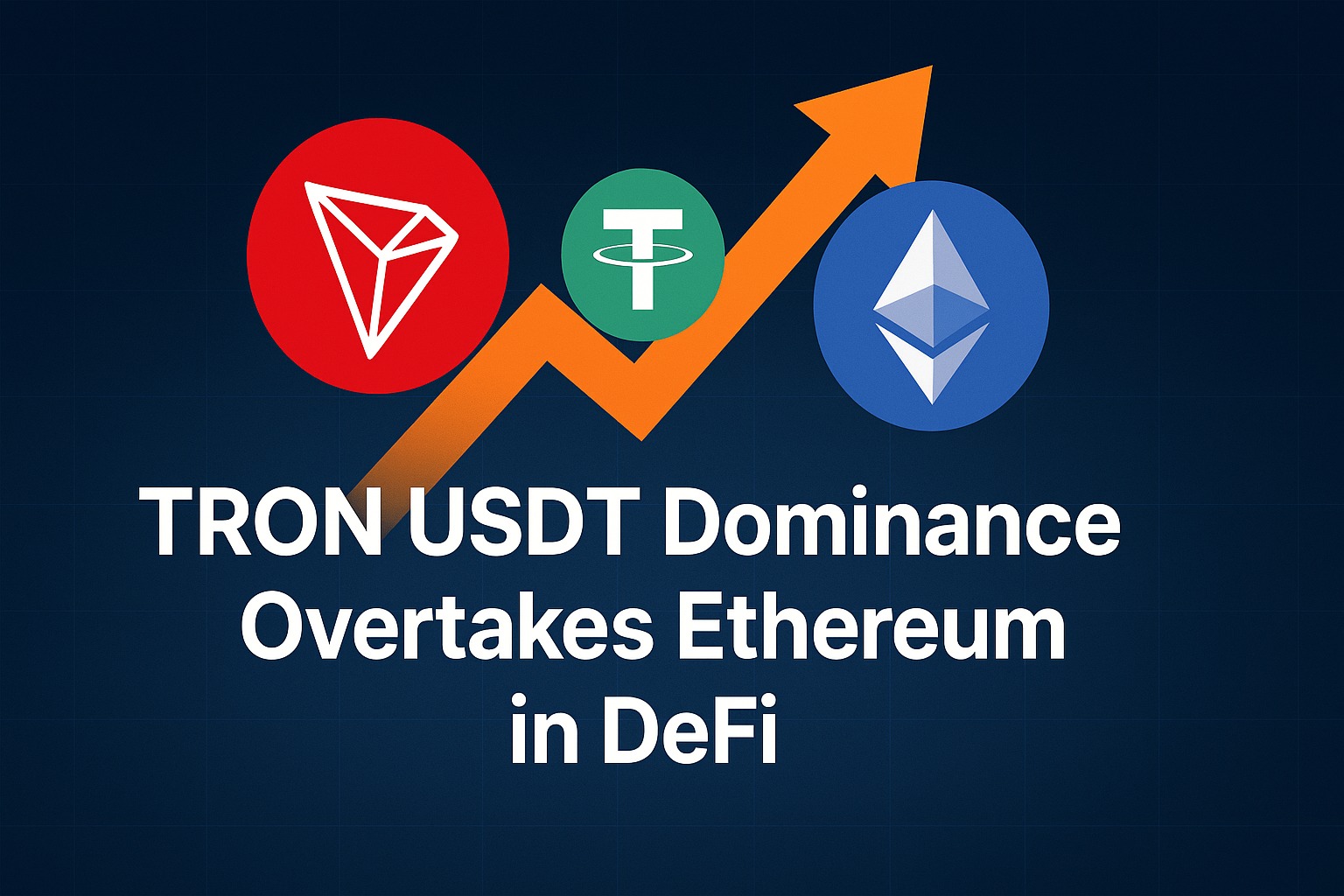
TRON USDT Dominance Overtakes Ethereum in DeFi
TRON USDT Dominance has become a major talking point in decentralized finance as the TRON blockchain has officially overtaken Ethereum in its share of USDT liquidity. This change reflects a deeper shift in how stablecoins are being used across blockchain networks and what users now prioritize when choosing where to transact, trade, and hold value within DeFi ecosystems.
Stablecoins are the backbone of decentralized finance, and among them, USDT plays the most dominant role. Accounting for roughly 60 percent of the total stablecoin market, USDT is widely used for trading, lending, borrowing, and transferring value across blockchains. Because of this, whichever network holds the largest share of USDT gains a significant advantage in liquidity and user activity.
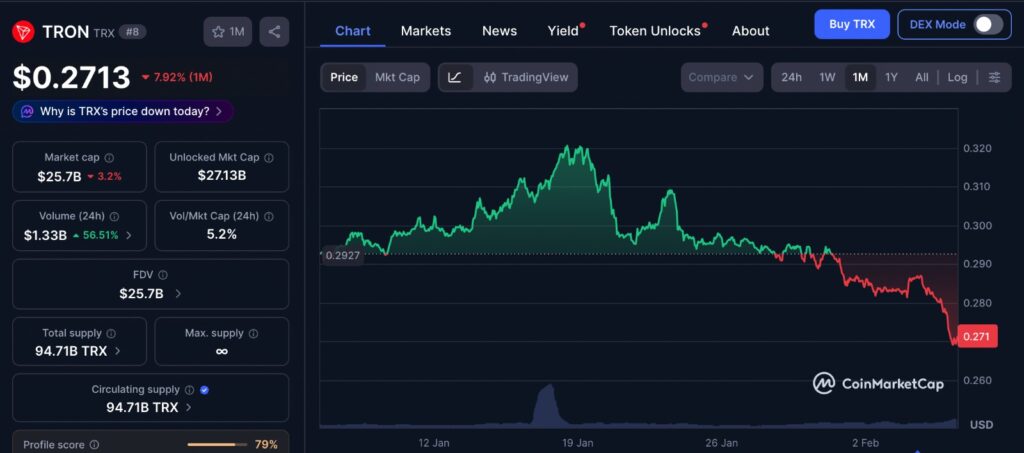
The one-month TRON price chart adds context to the network’s growing role in stablecoin activity. Despite broader market uncertainty, TRX price action over this period appears relatively contained, suggesting that much of the recent attention on the network is not being driven by speculative momentum. This kind of price behavior often aligns with utility-led usage rather than short-term trading interest. In this case, stablecoin flows may be responding more to network function than to token performance itself.
TRON USDT Dominance and Its Rise in DeFi
TRON USDT Dominance recently surpassed Ethereum, with TRON holding just under 45 percent of all USDT in circulation while Ethereum slipped slightly below that level. Although the difference between the two networks is narrow, the shift itself is significant because Ethereum has historically been the leading destination for stablecoin liquidity.
Over the past month, the amount of USDT on TRON increased steadily, while Ethereum experienced a noticeable decline. This change occurred during a period of broader market weakness, when many major cryptocurrencies, including Ethereum’s native token, faced selling pressure. In contrast, TRON’s stablecoin growth remained resilient, highlighting a divergence in network usage trends.
Why Stablecoin Dominance Matters
TRON USDT Dominance matters because stablecoins act as fuel for DeFi applications. High stablecoin liquidity allows decentralized exchanges to function smoothly, lending platforms to remain solvent, and users to move capital efficiently without worrying about price volatility.
When USDT shifts from one network to another, it often reflects user behavior rather than speculation. Traders, institutions, and everyday users tend to move stablecoins to networks that offer faster transactions, lower fees, and reliable infrastructure. In this context, TRON’s growing share suggests that it is increasingly seen as a practical and cost-effective network for stablecoin activity.
TRON’s Advantages Behind USDT Growth
One of the key drivers behind TRON USDT Dominance is transaction efficiency. TRON consistently offers lower fees and faster settlement times compared to Ethereum, especially during periods of network congestion. For users who frequently transfer USDT or rely on stablecoins for payments and arbitrage, these cost savings can be substantial.
TRON has also positioned itself as a stablecoin-friendly network, optimizing its infrastructure to support high-volume USDT transfers. This has made it particularly attractive in regions where users rely on stablecoins as an alternative to traditional banking systems.
Staking and Network Stability
Another factor supporting TRON’s position is its high staking participation. Nearly half of TRON’s circulating TRX supply is staked, which reduces sell pressure and improves network stability. This creates a more predictable environment for stablecoin holders and DeFi participants, reinforcing confidence in the ecosystem.
Ethereum’s Position Despite Losing USDT Share
While TRON USDT Dominance has overtaken Ethereum, Ethereum remains the largest DeFi ecosystem in terms of total value locked. Ethereum still holds tens of billions of dollars across decentralized exchanges, lending protocols, and derivatives platforms. Its deep liquidity, mature infrastructure, and large developer community continue to give it a strong competitive edge.
However, Ethereum’s decline in USDT supply highlights ongoing challenges related to transaction costs and scalability. Even with Layer 2 solutions gaining adoption, many users still prefer moving stablecoins on networks that offer immediate cost advantages without additional complexity.
Broader Impact on DeFi Competition
The rise of TRON USDT Dominance signals a broader change in how blockchain competition is evolving. Instead of focusing solely on token prices or innovation narratives, networks are increasingly competing to become the primary settlement layer for stablecoins.
Stablecoin dominance often leads to increased user activity, stronger liquidity pools, and more real-world use cases such as payments and remittances. As TRON captures more USDT, it may see further growth in DeFi protocols built around stablecoin utility rather than speculative trading.
User Behavior and Emerging Markets
TRON’s growing stablecoin presence has been particularly strong among users in emerging markets. In regions where access to banking is limited or local currencies are unstable, USDT is often used as a digital dollar. TRON’s low fees make it well suited for small, frequent transactions, which are common in these markets.
This practical use case strengthens TRON’s role as a functional financial network rather than purely a speculative platform.
What TRON USDT Dominance Means Going Forward
TRON USDT Dominance does not mean Ethereum is losing relevance, but it does indicate that DeFi is becoming more segmented. Different networks are beginning to specialize based on user needs. TRON is emerging as a preferred network for stablecoin transfers and cost-sensitive activity, while Ethereum continues to dominate complex DeFi applications and innovation.
As competition intensifies, both networks may adapt further. Ethereum could accelerate efficiency improvements, while TRON may continue expanding its stablecoin-focused ecosystem. The balance between the two will likely continue to shift as users prioritize usability, cost, and reliability.
Editor’s View: Why Users Quietly Move Stablecoins
TRON USDT Dominance is not just a metric shift, but a reflection of quiet user behavior that rarely shows up in charts. Stablecoin users tend to migrate gradually, not because of headlines, but because repeated small frictions add up over time. When fees feel slightly too high or transactions feel unnecessarily complex, users do not complain loudly, they simply move capital elsewhere. This kind of slow redistribution usually signals practical decision-making rather than short-term speculation, which makes it more durable than sudden spikes in activity.
Conclusion
TRON USDT Dominance represents a meaningful shift in the decentralized finance landscape. By overtaking Ethereum in USDT share, TRON has demonstrated that efficiency and accessibility can significantly influence where stablecoin liquidity flows. While Ethereum remains a powerhouse in DeFi, TRON’s rise highlights how user behavior is reshaping blockchain competition.
As stablecoins continue to drive real-world adoption of DeFi, the battle for USDT dominance will remain a critical indicator of which networks are best positioned to support the future of decentralized finance.
Disclaimer: This content is for informational purposes only and does not constitute financial advice.
Keep yourself updated with the latest crypto news with FYI Gazette
Read more about Memecoins with FYI Gazette
Keep yourself updated with the latest Altcoin News with FYI Gazette
 Bitcoin
  Ethereum
  Tether
  BNB
BNB  XRP
XRP  Solana
  TRON
TRON  Dogecoin
  Litecoin
  Pepe
Pepe