
Bitcoin Oil Surge: Can BTC Reach $79K by March?
Bitcoin Oil Surge discussions are gaining attention as traders analyze whether the cryptocurrency could climb toward $79,000 before the end of March. Oil prices recently jumped to $101 per barrel, representing a dramatic 55% increase within ten days. The move is considered one of the largest short-term increases ever recorded in crude markets and has shaken sentiment across global financial markets.
The sudden energy rally also affected traditional assets. The S&P 500 index dropped to its lowest level in ten weeks as investors reacted to geopolitical tensions linked to the conflict involving the United States, Israel, and Iran. Rising oil prices are often associated with inflation risks and economic uncertainty, both of which can weigh on risk assets.
Bitcoin initially reacted positively to the spike in energy prices. The cryptocurrency climbed roughly 16% between Feb. 28 and Wednesday as markets attempted to price in the new macro environment. However, the rally proved temporary. By Sunday, Bitcoin had erased the entire move as volatility returned to the crypto market.
This sharp reversal has led traders to question whether Bitcoin could face additional pressure from global uncertainty. At the same time, historical data shows that Bitcoin has sometimes delivered strong gains in the weeks following major oil price surges.
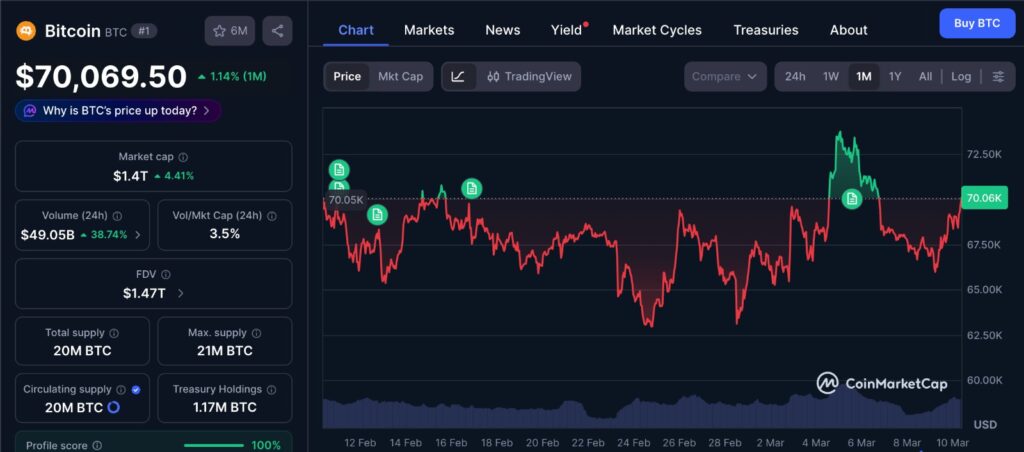
Bitcoin’s recent price movement over the past month highlights how quickly sentiment in the crypto market can shift during periods of macro uncertainty. While the chart shows several short bursts of upward momentum, those moves have often been followed by equally sharp pullbacks, reflecting cautious positioning among traders. This pattern suggests that market participants are reacting not only to technical signals but also to broader developments in global markets. As a result, short-term volatility continues to shape Bitcoin’s trajectory even when longer-term narratives remain intact.
Bitcoin Oil Surge patterns seen in previous market events
Looking at earlier commodity shocks reveals that Bitcoin has occasionally rallied after oil prices jumped rapidly. When West Texas Intermediate crude gained at least 15% within ten days, Bitcoin often experienced notable gains within the following month.
One example occurred in June 2025. Oil prices climbed sharply after international agencies warned that Iran had enriched uranium to levels associated with nuclear weapons capability. Shortly afterward, Israel launched air strikes in the region, intensifying geopolitical tension.
During the initial reaction in financial markets, Bitcoin dropped about 8%, falling from $110,300 to around $101,000. However, the decline did not last. Over the next four weeks, Bitcoin recovered and eventually posted gains of around 10%.
Another example happened in March 2023. Oil prices surged approximately 16% in just eight days after a legal dispute halted exports of roughly 450,000 barrels per day from the Kurdistan region. At the same time, the Organization of the Petroleum Exporting Countries announced a surprise production cut.
Bitcoin reacted positively during that period, rising around 12% within two weeks. However, the bullish momentum did not last long. Within less than a month, the cryptocurrency had returned to roughly $28,000.
Geopolitical shocks have influenced Bitcoin before
Earlier examples highlight how geopolitical developments can trigger large movements in both oil and cryptocurrency markets.
In February 2022, global commodity markets surged after Russia launched its full-scale invasion of Ukraine. Sanctions on Russian oil exports pushed West Texas Intermediate crude up about 29% in a single week.
Bitcoin initially responded with a sharp rally, gaining around 17% within two days. Yet those gains quickly faded as markets absorbed the broader economic implications of the conflict. Despite the early volatility, Bitcoin later climbed roughly 25% during the following three weeks and eventually reached around $48,000.
Another case occurred in November 2020 when traders anticipated the rollout of COVID-19 vaccines and a recovery in global economic activity. Oil prices jumped roughly 23% within nine days while U.S. inventory data showed unexpected supply declines.
Bitcoin followed the move closely. The asset gained around 16% during that same nine-day window and later surged about 45% within a month, climbing from roughly $13,500 as investor optimism returned to financial markets.
Bitcoin Oil Surge relationship remains uncertain
Although these historical examples show a potential pattern, analysts warn that the relationship between oil and Bitcoin should not be treated as a reliable predictive model.
Across the four events between November 2020 and June 2025, Bitcoin gained an average of about 20% within four weeks after oil prices surged at least 15% in ten days. While this statistic may appear bullish, the dataset remains extremely small.
Four historical events are not enough to establish a strong correlation. Each of those periods also involved different macroeconomic conditions, including pandemic recovery, geopolitical conflicts, and supply disruptions.
Another important factor is Bitcoin’s growing connection to traditional technology stocks. Data suggests the cryptocurrency currently has about an 81% correlation with the Nasdaq 100 index. This means broader stock market sentiment may influence Bitcoin more strongly than movements in oil prices.
Because of this relationship, a recovery in technology stocks could have a greater impact on Bitcoin than commodity market trends alone.
Editor’s View: Why oil shocks create delayed reactions in Bitcoin
Large oil price spikes often reflect sudden geopolitical stress rather than changes in long-term economic fundamentals. In those moments, traders usually prioritize liquidity and reduce exposure to volatile assets, which can explain Bitcoin’s initial instability after oil rallies. Once the immediate shock fades and markets begin processing the broader implications, capital tends to rotate back into higher-risk assets where volatility creates opportunity. This delayed adjustment may help explain why Bitcoin gains in past examples often appeared weeks after the initial oil surge rather than immediately.
Could Bitcoin Oil Surge push BTC toward $79K?
If the historical pattern repeats, Bitcoin could potentially approach $79,200 by the end of March. That estimate reflects the average 20% gain seen after previous oil price spikes and assumes a starting level near $66,000 when the latest rally in crude began around Feb. 28.
However, the outlook depends heavily on geopolitical developments. The duration and intensity of the conflict involving Iran may play a major role in determining market sentiment during the coming weeks.
If tensions escalate further, persistently high oil prices could increase inflation pressures and weaken consumer spending. Combined with signs of softness in the U.S. job market, these factors could weigh on risk assets including cryptocurrencies.
On the other hand, a faster-than-expected de-escalation could support a recovery in equity markets. Since Bitcoin now shows a strong correlation with technology stocks, a rebound in the Nasdaq 100 could help drive renewed momentum in the cryptocurrency market.
For now, the Bitcoin Oil Surge narrative offers an interesting perspective on how macroeconomic shocks can influence digital asset markets. Whether the historical pattern repeats will depend less on oil prices themselves and more on how global financial conditions evolve in response to geopolitical tensions.
Disclaimer: This content is for informational purposes only and does not constitute financial advice.
Keep yourself updated with the latest crypto news with FYI Gazette
Read more about Memecoins with FYI Gazette
Keep yourself updated with the latest Altcoin News with FYI Gazette
 Bitcoin
  Ethereum
  Tether
  BNB
BNB  XRP
XRP  Solana
  TRON
TRON  Dogecoin
  Litecoin
  Pepe
Pepe