
Bitcoin Price Action Falls Below 73K But Remains Normal
Bitcoin Price Action started the week under pressure as Bitcoin slipped below the $73,000 level, triggering concern among traders while analysts emphasized that the move remains consistent with historical market behavior. The decline came alongside a broader sell-off in US equities, reinforcing the growing connection between crypto markets and traditional financial assets.
Bitcoin’s price briefly touched the low $72,000 range after failing to hold key support levels that had previously kept bullish momentum intact. While the drop looked sharp on shorter timeframes, market analysts stressed that this type of movement is not unusual for Bitcoin, especially during periods of macroeconomic uncertainty and risk-off sentiment across global markets.
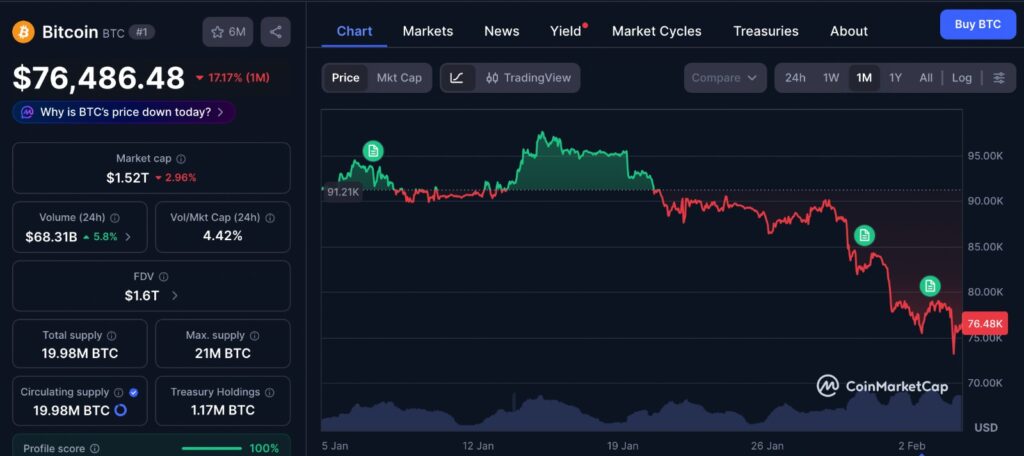
Viewed over the past month, the chart highlights how quickly sentiment can shift even without a decisive change in trend. Price movements appear compressed into short bursts, suggesting that reactions to macro headlines and market positioning have outweighed longer-term conviction during this period. Rather than a steady directional move, the structure reflects hesitation, with traders responding to levels and momentum instead of broader narratives. This kind of price behavior is common when markets are searching for clarity rather than committing to a new direction.
Recent Bitcoin Price Action Reflects Market Stress
The latest Bitcoin price action unfolded during a broader downturn in US stock markets. Major indices declined as investors reacted to concerns over corporate earnings and stretched valuations, particularly in technology and artificial intelligence-related stocks. As confidence weakened in equities, capital rotated away from risk assets, including cryptocurrencies.
Bitcoin has increasingly mirrored movements in traditional markets, especially during periods of heightened volatility. When stocks decline, leveraged positions in crypto are often reduced, leading to rapid price swings. This correlation has become more pronounced as institutional participation in Bitcoin has grown over recent years.
During the recent pullback, Bitcoin failed to reclaim the $80,000 level, which many traders viewed as an important psychological and technical resistance zone. The inability to break higher led to increased selling pressure and accelerated the move toward lower support levels.
Macro Factors Driving Bitcoin Price Action
Macroeconomic conditions played a key role in shaping Bitcoin price action. Investor caution ahead of major earnings reports contributed to declining risk appetite, while concerns about future growth projections added pressure across markets. As liquidity tightened, assets with higher volatility, such as Bitcoin, experienced sharper moves.
Another contributing factor was the unwinding of leveraged positions. As prices dropped, long positions were liquidated, intensifying the downward momentum. These liquidations often exaggerate price movements in the short term, making declines appear more dramatic than they might otherwise be.
Despite this, analysts noted that Bitcoin has experienced similar drawdowns many times in previous cycles. Sharp corrections have historically followed strong rallies, and these pullbacks often serve as reset phases rather than signals of long-term weakness.
Analysts Say Bitcoin Price Action Is Normal
Market analysts have largely dismissed fears that the recent dip signals a structural problem for Bitcoin. According to analysts, the current Bitcoin price action aligns with historical volatility patterns seen during past bull and consolidation phases.
Bitcoin has already fallen significantly from its previous peak, marking a drawdown that, while uncomfortable, is not unprecedented. In prior cycles, Bitcoin has experienced corrections of similar or even greater magnitude before stabilizing and resuming upward trends.
Analysts emphasize that volatility is a defining characteristic of Bitcoin. Large price swings are part of the asset’s nature, particularly when global markets are reacting to uncertainty. From this perspective, the move below $73,000 does not represent abnormal behavior but rather a continuation of typical market dynamics.
Liquidity Zones and Support Levels
Liquidity data suggests that Bitcoin price action may encounter increased buying interest at lower levels. Order book activity shows clusters of bids forming below current prices, indicating that some market participants are waiting for further downside before entering positions.
Support zones are expected to play a critical role in determining whether Bitcoin stabilizes or continues lower. If buyers step in near these levels, price consolidation could follow. However, if selling pressure persists, Bitcoin could test deeper support areas before finding a more sustainable base.
This behavior is common during corrective phases, where price discovery occurs through repeated tests of demand and supply levels. Traders often watch these zones closely to assess market strength.
Investor Sentiment and Market Psychology
Investor sentiment has shifted noticeably as Bitcoin price action turned bearish in the short term. While some traders interpret the drop as a warning sign, others see it as an opportunity to accumulate at lower prices.
This divide in sentiment reflects the broader uncertainty facing financial markets. Long-term holders tend to focus on Bitcoin’s historical resilience and adoption trends, while short-term traders are more sensitive to immediate price movements and macro signals.
Institutional investors have also adopted a cautious stance, balancing exposure to crypto with traditional assets. Many are closely monitoring macroeconomic data and market conditions before increasing risk again.
Impact on the Broader Crypto Market
Bitcoin’s price action continues to influence the wider crypto ecosystem. As the largest cryptocurrency by market value, Bitcoin often sets the direction for altcoins. The recent decline triggered synchronized losses across many digital assets, reinforcing Bitcoin’s role as the market’s primary driver.
When Bitcoin weakens, liquidity across the crypto market tends to decline, leading to increased volatility in smaller tokens. This interconnected behavior highlights the importance of Bitcoin’s stability for overall market confidence.
Editor’s View: What Charts Miss During Sudden Drops
Short-term declines like this often reveal more about investor behavior than about Bitcoin itself. When prices fall quickly, traders tend to react to the speed of the move rather than the magnitude, which can exaggerate fear even if the drawdown is historically modest. This creates a feedback loop where selling becomes more about avoiding regret than reassessing fundamentals. In those moments, markets are driven less by conviction and more by positioning, liquidity, and psychology. That distinction helps explain why sharp moves can feel dramatic without signaling a deeper shift.
What Comes Next for Bitcoin Price Action
Looking ahead, Bitcoin price action will likely remain sensitive to developments in traditional markets. Economic data releases, corporate earnings, and shifts in monetary policy expectations could all influence risk sentiment and capital flows.
If broader markets stabilize, Bitcoin may find support and enter a consolidation phase. Conversely, continued weakness in equities could prolong volatility in crypto markets. Analysts suggest that patience and perspective are essential during these periods.
Historically, Bitcoin has navigated similar conditions and emerged stronger over longer timeframes. While short-term price movements can be unpredictable, the broader structure of the market remains intact according to analysts.
In conclusion, although the drop below $73,000 drew attention, Bitcoin price action remains within normal historical ranges. The move reflects macroeconomic pressure, market psychology, and liquidity dynamics rather than any fundamental shift in Bitcoin’s long-term outlook.
Disclaimer: This content is for informational purposes only and does not constitute financial advice.
Keep yourself updated with the latest crypto news with FYI Gazette
Read more about Memecoins with FYI Gazette
Keep yourself updated with the latest Altcoin News with FYI Gazette
 Bitcoin
  Ethereum
  Tether
  BNB
BNB  XRP
XRP  Solana
  TRON
TRON  Dogecoin
  Litecoin
  Pepe
Pepe