Iran Crypto Outflows Spike After US Israel Strikes
Iran Crypto Outflows rose sharply within minutes after the United States and Israel launched airstrikes on Tehran, highlighting how quickly digital assets are used during moments of geopolitical shock. Iran’s largest crypto exchange, Nobitex, recorded a sudden spike in withdrawals as users rushed to move funds, though the surge was later curtailed by widespread internet blackouts across the country.
According to blockchain analytics firm Elliptic, crypto outflows from Nobitex jumped more than 700 percent within minutes of the first strikes. Withdrawals exceeded $500,000 almost immediately, and data later showed that nearly $3 million left the exchange within a single hour on the same day. The timing of these transactions closely aligned with the start of the military action, suggesting a direct reaction from users.
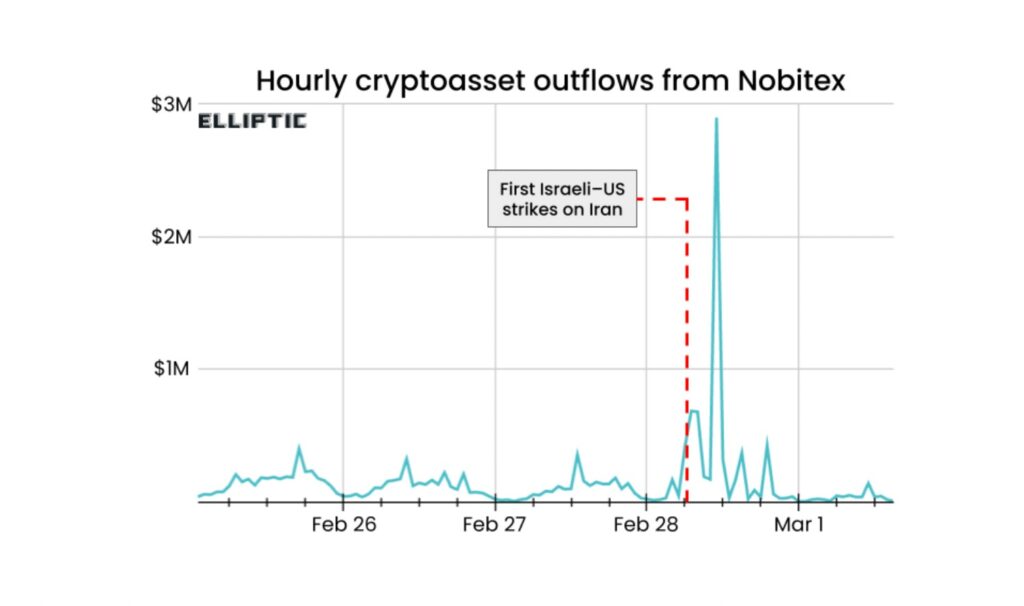
The chart illustrates how abruptly Iran crypto outflows accelerated once the first Israeli US strikes were reported. Transaction levels that had remained relatively stable for days surged within a narrow time window, underscoring how quickly market participants reacted. The sharp peak, followed by a rapid normalization, suggests an immediate response rather than a prolonged wave of withdrawals. This pattern aligns with crisis-driven behavior, where speed often outweighs strategic repositioning.
Iran Crypto Outflows Spike Following Airstrikes
Elliptic noted that the sharp rise in Iran crypto outflows potentially reflects capital flight, as uncertainty spread across the country following the attacks. Initial transaction tracing showed that a significant portion of the withdrawn funds was transferred to foreign cryptocurrency exchanges, rather than remaining within Iran’s domestic crypto ecosystem.
Elliptic explained that using crypto allows funds to move out of Iran while avoiding some of the scrutiny associated with the traditional global banking system. This feature becomes particularly relevant during periods of conflict, when access to banks, foreign currency, or international transfers may be restricted or disrupted.
Why Iran Crypto Outflows Accelerated So Quickly
The rapid spike suggests that many users were already positioned within crypto markets before the conflict escalated. When the strikes occurred, those users were able to act immediately, moving funds without relying on banks that might close, freeze accounts, or face liquidity constraints during a crisis.
Nobitex plays a central role in Iran’s crypto economy, making it a natural pressure point during moments of panic. Any sudden shift in user sentiment is likely to appear first and most visibly on the platform.
Internet Blackouts Cut Iran Crypto Outflows Short
Despite the initial surge, Iran crypto outflows dropped sharply after Saturday. Blockchain forensics firm TRM Labs attributed this decline not to reduced demand, but to severe internet restrictions imposed by Iranian authorities.
TRM reported that Iran’s internet connectivity fell by approximately 99 percent shortly after the conflict unfolded. These blackouts significantly limited users’ ability to access exchanges, wallets, and blockchain services, effectively suppressing further transaction activity.
TRM Labs Challenges Capital Flight Narrative
TRM Labs disagreed with Elliptic’s conclusion that Iran was experiencing sustained capital flight through crypto. According to TRM, the data suggests the opposite: a contraction in activity rather than an acceleration.
TRM stated that Iran’s crypto ecosystem does not show signs of expanding outflows or increasing transaction volume. Instead, the enforcement of strict internet blackouts appears to have caused a downturn in both transaction count and overall volume, making it difficult for users to move funds even if they wanted to.
Iran Crypto Outflows Amid Escalating Conflict
The spike in withdrawals occurred as the United States and Israel intensified efforts to topple Iran’s current regime and dismantle its nuclear and missile programs. Iran responded with airstrikes of its own on neighboring countries, increasing instability across the region.
This broader geopolitical backdrop helps explain why crypto activity reacted so sharply. During periods of military escalation, confidence in domestic financial systems often weakens, particularly in countries already under heavy sanctions.
Nobitex Role in Iran Crypto Outflows
Nobitex is Iran’s largest cryptocurrency exchange, accounting for roughly 87 percent of the country’s total crypto transaction volume. In 2025 alone, the exchange processed approximately $7.2 billion in trades and served more than 11 million users.
Given its scale, even a small shift in user behavior on Nobitex can produce dramatic on-chain signals. The surge in Iran crypto outflows therefore reflects not just individual panic, but the concentration of crypto activity within a single dominant platform.
Banking Instability Drives Crypto Reliance
Iranians have increasingly turned to crypto as a way to store and move funds due to the fragility of the country’s banking system and the impact of long-standing international sanctions.
In October, one of Iran’s largest private banks, Ayandeh Bank, collapsed after accumulating $5.1 billion in losses and nearly $3 billion in debt. The bankruptcy affected more than 42 million customers, further eroding trust in traditional financial institutions.
Iran’s central bank later warned that eight additional banks could face dissolution unless significant reforms were implemented. These warnings reinforced concerns about the safety of deposits and access to funds during periods of stress.
Crypto Infrastructure Faces Its Own Risks
While crypto offers an alternative, Iranian exchanges have not been immune to problems. Nobitex suffered a major security breach in June, resulting in an $81 million hack. The incident highlighted vulnerabilities within local crypto infrastructure, even as users continue to rely on it during crises.
Despite these risks, crypto remains one of the few accessible tools for moving value quickly when conventional systems falter or become inaccessible.
Editor’s View: Crisis Behavior Behind Iran Crypto Outflows
The immediate spike in Iran crypto outflows reflects something deeper than transaction data alone. In moments of sudden geopolitical shock, individuals tend to prioritize liquidity and mobility over yield or long term positioning. The reaction suggests that many users were not speculating, but simply seeking optionality in an environment where traditional systems can freeze without warning. That behavioral shift, even if brief, reveals how crypto is increasingly treated as a contingency tool rather than just an investment vehicle.
Iran Crypto Outflows Reflect Crisis Behavior
The brief but intense spike in Iran crypto outflows illustrates how digital assets are used during moments of sudden uncertainty. While the initial data suggested capital flight, subsequent internet shutdowns limited further activity and complicated interpretation.
Rather than showing a clear long-term trend, the episode highlights how geopolitical shocks, infrastructure controls, and financial fragility interact to shape crypto behavior in sanctioned economies.
In this context, Iran crypto outflows appear less like a sustained exit and more like an immediate reaction to crisis conditions, followed by enforced inactivity as connectivity vanished.
Disclaimer: This content is for informational purposes only and does not constitute financial advice.
Keep yourself updated with the latest crypto news with FYI Gazette
Read more about Memecoins with FYI Gazette
Keep yourself updated with the latest Altcoin News with FYI Gazette
 Bitcoin
  Ethereum
  Tether
  BNB
BNB  XRP
XRP  Solana
  TRON
TRON  Dogecoin
  Litecoin
  Pepe
Pepe