
Nasdaq Prediction Markets Expand to Nasdaq 100
Nasdaq Prediction Markets are moving closer to becoming a reality after one of the company’s options exchanges, Nasdaq MRX, filed to introduce cash settled, binary style contracts tied to the Nasdaq 100 Index. The proposal places Nasdaq among a growing number of Wall Street firms exploring structured event based trading, a segment that has gained serious momentum over the past year.
According to a filing submitted to the US Securities and Exchange Commission, Nasdaq is seeking approval to list what it calls Outcome Related Options. These contracts would allow traders to place yes or no positions on defined market outcomes. Each contract would be priced between 1 cent and 1 dollar and would settle in cash depending on whether the specified condition is met at expiration.
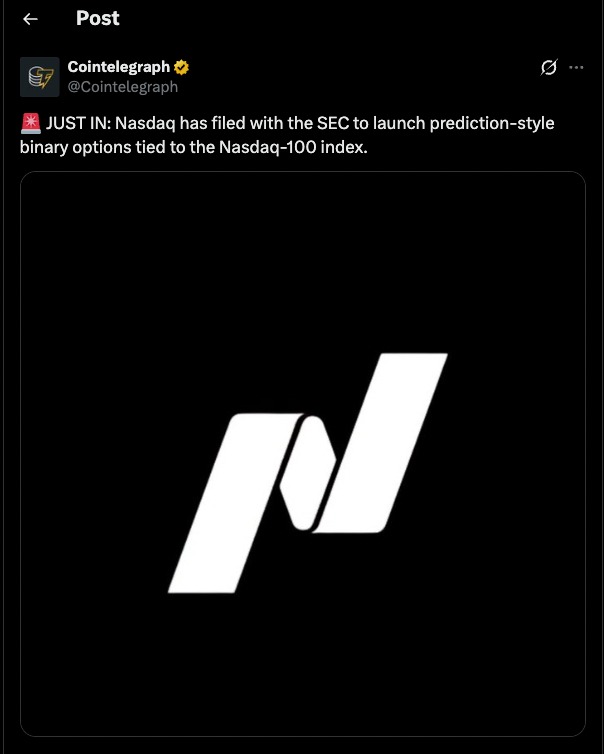
The filing quickly drew attention across financial and crypto circles, as it signals deeper institutional interest in structured event based products. While prediction markets have largely been associated with crypto native platforms in recent years, Nasdaq’s move suggests traditional exchanges are now formalizing similar instruments within regulated frameworks. The reaction underscores how probability driven contracts are becoming part of mainstream financial conversation rather than remaining on the periphery.
Nasdaq Prediction Markets Focus on the Nasdaq 100
The proposed contracts would be directly linked to the Nasdaq 100 and the Nasdaq 100 Micro indexes. Importantly, the offering would not extend to non financial events such as sports, politics or cultural outcomes. Instead, the contracts would remain strictly tied to financial benchmarks.
The Nasdaq 100 tracks 100 of the largest non financial companies listed on the Nasdaq exchange. It includes major technology and growth names such as Nvidia, Apple, Microsoft, Amazon, Google, Meta and Tesla. By focusing on this index, Nasdaq keeps the contracts within the traditional capital markets framework.
Through these binary contracts, traders would be able to take positions on whether specific conditions related to the index are met. Unlike traditional options that involve complex pricing models, time decay and volatility considerations, these contracts would resolve to a simple outcome. If the event occurs, the contract settles at one dollar. If it does not, it settles at zero. This straightforward payoff structure is designed to make participation more accessible while maintaining exchange level oversight.
SEC Approval Critical for Nasdaq Prediction Markets
Nasdaq Prediction Markets cannot launch without regulatory approval. The SEC will need to review and approve the filing before the contracts can be listed. If approved, Nasdaq would enter a competitive and rapidly growing space.
Existing players such as Polymarket and Kalshi have already built strong user bases around event driven contracts. At the same time, crypto platforms like Coinbase and Crypto.com have begun integrating similar prediction style offerings into their ecosystems. The lines between traditional finance and digital asset trading continue to blur as demand for probability based products increases.
Other Wall Street institutions are also exploring similar opportunities. Intercontinental Exchange, CME Group and Cboe Global Markets have either invested in the space or signaled intentions to develop their own versions of event linked contracts. CME Group has partnered with FanDuel to offer contracts that extend beyond financial markets, while Cboe’s strategy centers on finance and economic indicators.
This growing institutional interest suggests that event based derivatives are evolving from a niche concept into a recognized segment of modern financial markets.
Nasdaq Prediction Markets Across Multiple Exchanges
Nasdaq is not limiting its ambitions to a single trading venue. In addition to Nasdaq MRX, the company intends to make Outcome Related Options available on other Nasdaq options exchanges, including Nasdaq NOM and Nasdaq PHLX.
Exchange Structure Differences
Each exchange operates under slightly different structural rules. Nasdaq MRX uses a first come, first served system and does not provide trading incentives. In contrast, Nasdaq NOM and Nasdaq PHLX incorporate pricing models that can reward participants for adding liquidity to the market.
These structural differences may influence how trading activity develops if the product receives approval. Exchanges that reward liquidity providers could attract more active participation from market makers and professional traders. That, in turn, could help ensure tighter spreads and more efficient pricing.
By distributing the product across multiple platforms within its own network, Nasdaq appears to be positioning Nasdaq Prediction Markets for broader adoption from the outset.
Prediction Markets Growth and Broader Context
Prediction markets became one of the most active segments within crypto markets last year, with monthly trading volumes surpassing 10 billion dollars. Retail interest has been strong, and marketing efforts from major platforms have intensified. However, regulatory scrutiny has also increased, particularly for contracts tied to political or sensitive events.
Nasdaq’s decision to focus strictly on financial index related outcomes may reflect a strategic attempt to avoid regulatory friction. By keeping contracts anchored to established market benchmarks, the company can frame them as financial derivatives rather than broad event wagers.
In parallel, other asset managers have filed with regulators to launch exchange traded products tied to event contracts, including funds related to the 2028 US presidential election. These filings show that institutional experimentation in the event contract space is accelerating, even as oversight remains tight.
Editor’s View: Why Exchanges Are Embracing Event Contracts
What stands out is not just the structure of these contracts, but the timing. Traditional exchanges tend to move cautiously, especially when new products blur the line between derivatives and event speculation. Nasdaq’s decision to formalize binary style contracts suggests that demand for probability based positioning is no longer confined to niche platforms. Traders increasingly want defined risk instruments that express a clear view without navigating complex options mechanics, and exchanges appear to be responding to that shift rather than leading it.
What Nasdaq Prediction Markets Could Mean for Investors
If approved, Nasdaq Prediction Markets would introduce a new tool for expressing market views. Traders could use binary contracts to hedge risk or speculate on specific index outcomes without engaging in more complex derivatives strategies.
The simplified yes or no structure may appeal to participants who want clear risk parameters. At the same time, the contracts would remain speculative instruments, and their value could fluctuate rapidly based on changing market conditions.
Nasdaq’s involvement also adds a layer of institutional credibility. As one of the largest exchange operators in the world, its entry into the space signals that event based financial contracts are moving further into the mainstream.
Ultimately, the SEC’s decision will determine how quickly these contracts become available. But the filing itself highlights a broader shift in market structure, where traditional exchanges are adapting to evolving trader demand and integrating probability driven products into established financial systems.
Disclaimer: This content is for informational purposes only and does not constitute financial advice.
Keep yourself updated with the latest crypto news with FYI Gazette
Read more about Memecoins with FYI Gazette
Keep yourself updated with the latest Altcoin News with FYI Gazette
 Bitcoin
  Ethereum
  Tether
  BNB
BNB  XRP
XRP  Solana
  TRON
TRON  Dogecoin
  Litecoin
  Pepe
Pepe