
Ether Price Path to $2.5K Faces Market Headwinds
Ether Price Path toward the $2,500 level is becoming increasingly complicated as Ethereum faces pressure from global macroeconomic uncertainty, cautious derivatives markets, and slowing network activity. Although the asset recently recovered from its February lows, multiple indicators suggest that a sustained rally may not be easy in the current market environment.
Ether recently declined about 6 percent after briefly rallying toward the $2,200 level. The drop happened alongside weakness in US equities as geopolitical tensions intensified after the conflict involving Iran entered its sixth day. Disruptions to global oil production and natural gas shipping routes in the Middle East pushed WTI crude oil prices to levels not seen since mid 2024, increasing uncertainty across financial markets.
As tensions escalated, investors began lowering their expectations for economic growth and moved toward a risk off positioning. When investors become more cautious, they typically reduce exposure to volatile assets, including cryptocurrencies. This shift in sentiment has limited demand for Ethereum and other digital assets in the short term.
Another event adding to the uncertainty was a legal ruling involving US trade policy. A federal judge ordered the US government to begin paying more than $130 billion in tariff refunds to American businesses. The ruling followed a Supreme Court decision stating that certain tariffs implemented under the International Emergency Economic Powers Act were applied illegally. Such developments contribute to broader market instability that can influence investor behavior.
Ether remains caught within this complex macroeconomic environment. Even though the asset has recovered roughly 22 percent since retesting the $1,800 level on February 24, the rally has struggled to gain strong momentum. Onchain data and derivatives market indicators currently suggest that bullish conviction remains limited.
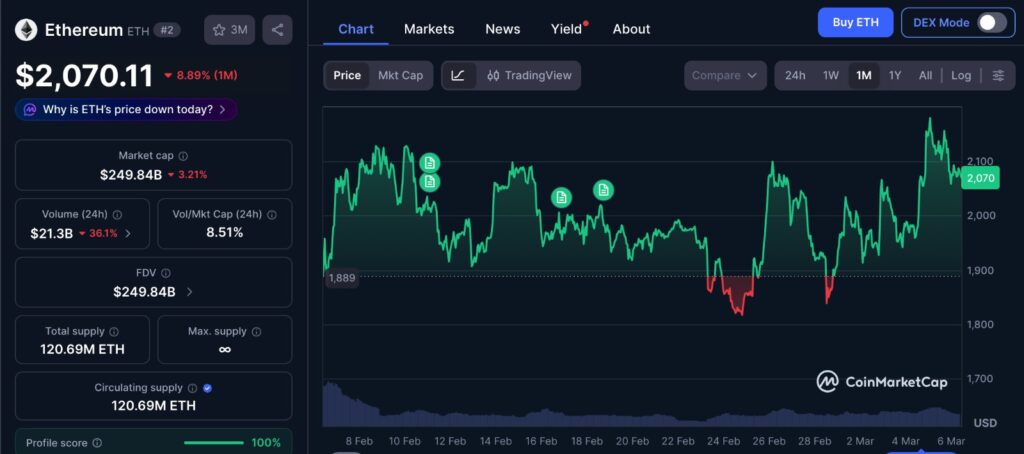
The one-month chart shows how Ethereum has moved through a period of uneven recovery following its retest of the $1,800 level in late February. While the rebound toward the $2,200 region briefly suggested improving sentiment, recent price action highlights how quickly momentum can stall when broader market conditions turn cautious. The fluctuations during the past month reflect a balance between buyers willing to accumulate after the dip and traders hesitant to push prices higher amid macro uncertainty. This pattern helps explain why ETH has remained range bound despite recovering from its earlier lows.
Ether Price Path and macroeconomic pressure
Ethereum’s recent price behavior highlights how closely digital assets are now tied to global financial conditions. When geopolitical tensions escalate or energy markets become unstable, investors often shift capital away from risk assets.
Higher oil prices and economic uncertainty can influence inflation expectations and broader market sentiment. As a result, investors may temporarily reduce exposure to assets such as cryptocurrencies while waiting for greater stability in traditional markets.
This macro environment has contributed to Ethereum’s inability to maintain strong upward momentum despite recovering from recent lows.
Ether Price Path signals from futures markets
One of the most widely used indicators for understanding trader sentiment is the futures premium, sometimes called the basis rate. This metric measures the annualized difference between futures prices and the spot price of an asset.
ETH futures premium
Under normal market conditions, Ether futures typically trade with a premium above 5 percent. This premium reflects demand from traders who are willing to pay additional costs in order to hold leveraged long positions.
Currently, the ETH 30 day futures premium remains well below this neutral level. The lower premium indicates that traders are not aggressively pursuing leveraged bullish exposure.
Impact of previous price highs
This hesitation may also be influenced by Ethereum’s distance from its previous cycle peak. Ether currently trades about 58 percent below its August 2025 all time high of $4,956.
When an asset remains significantly below its historical peak, traders often wait for stronger confirmation of a new trend before increasing leveraged exposure. This dynamic can slow the pace of recovery even after short term rallies.
Options market shows defensive positioning
Another important indicator of professional market sentiment comes from the options market. Large traders often use options contracts to hedge their positions when they expect higher volatility or potential downside risk.
ETH options skew indicator
A commonly tracked metric in this market is the options skew, which compares demand for protective put options with bullish call options. When the skew rises above the 6 percent neutral level, it usually signals increasing demand for downside protection.
Recently, the ETH options skew moved to around 7 percent after briefly returning to neutral levels the previous day. This shift indicates that professional trading desks remain somewhat skeptical about short term price strength.
Hedging activity among traders
Defensive positioning like this does not necessarily predict an immediate decline. However, it does show that experienced traders are prioritizing risk management while the broader market remains uncertain.
When professional desks hedge their exposure, it often reflects concerns about volatility rather than strong conviction in either direction.
Ethereum network activity slows
Ethereum’s onchain activity has also shown signs of cooling after a modest surge earlier in February. Strong and consistent network usage is important for maintaining healthy price momentum because it reflects real demand for blockchain services.
DEX volume decline
Recent data shows that weekly decentralized exchange volumes on Ethereum dropped to approximately $12.6 billion. Just one month earlier, weekly volumes were closer to $20.2 billion, indicating a notable slowdown in activity.
Lower trading activity within decentralized exchanges can reduce transaction demand across the network.
DApp revenue contraction
At the same time, revenue generated by decentralized applications on Ethereum also declined. Over a seven day period, DApp revenues fell to about $14.1 million, representing a 47 percent drop compared with the previous month.
This decline highlights a temporary cooling of activity across several sectors of the Ethereum ecosystem.
Activity slowdown across blockchains
Importantly, this trend is not unique to Ethereum. Other blockchains have experienced similar declines in activity.
For example, decentralized exchange volumes on Solana also fell by about 50 percent over the same thirty day period. This suggests that the slowdown reflects broader market conditions rather than issues specific to Ethereum.
Ethereum retains ecosystem dominance
Despite weaker short term network metrics, Ethereum still holds a dominant position within the broader blockchain ecosystem.
Total value locked leadership
When layer two scaling networks are included, the Ethereum ecosystem represents nearly 65 percent of the total value locked across all blockchain networks.
The Ethereum base layer alone currently holds about $55.4 billion in total value locked.
Institutional preference for decentralization
In comparison, one of Ethereum’s closest competitors, Solana, accounts for roughly $6.8 billion in total value locked.
This large difference highlights a continued preference among many institutional investors for networks that emphasize decentralization and security. While other blockchains may offer lower transaction fees or faster speeds, Ethereum continues to benefit from its established infrastructure and liquidity.
Editor’s View: Market patience around Ethereum
Ethereum’s recent behavior reflects a market that is not fully convinced yet rather than one that has lost interest. When macro uncertainty rises, traders often step back even if the long term narrative remains intact. The muted derivatives demand and increased hedging suggest that many participants are waiting for clearer signals before committing new capital. In that sense, the current slowdown may say more about caution in global markets than about weakening belief in Ethereum itself.
Ether Price Path and market sentiment
For now, the Ether Price Path toward $2,500 remains heavily influenced by broader financial market sentiment. Global macroeconomic uncertainty, cautious derivatives positioning, and softer network activity have combined to slow Ethereum’s momentum.
If macro conditions stabilize and blockchain activity strengthens again, sentiment could improve quickly. Until then, Ethereum’s recovery is likely to remain closely tied to the broader risk environment shaping financial markets.
Disclaimer: This content is for informational purposes only and does not constitute financial advice.
Keep yourself updated with the latest crypto news with FYI Gazette
Read more about Memecoins with FYI Gazette
Keep yourself updated with the latest Altcoin News with FYI Gazette
 Bitcoin
  Ethereum
  Tether
  BNB
BNB  XRP
XRP  Solana
  TRON
TRON  Dogecoin
  Litecoin
  Pepe
Pepe