Aave Shield Launch After $50M DeFi Swap Loss
Aave Shield is being introduced after a DeFi user lost more than $50 million during a large token swap executed through the Aave interface. The decentralized finance protocol announced the protection tool following an incident where a trader attempted to convert a massive amount of stablecoins into AAVE tokens but received only a fraction of the expected value due to liquidity problems and infrastructure failures.
The event quickly attracted attention across the DeFi community because the user attempted to swap $50.4 million worth of USDT for AAVE tokens but ended up receiving only about $36,500 worth of AAVE. The outcome highlighted the risks that can occur when extremely large trades interact with limited liquidity on decentralized exchanges.
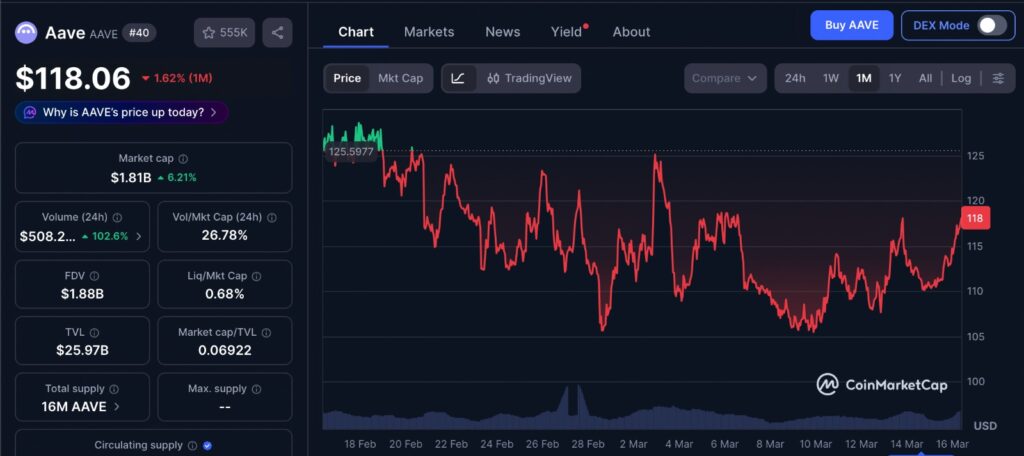
The one-month price chart of AAVE reflects how sentiment around the protocol has evolved during the period surrounding the $50 million swap incident and the announcement of Aave Shield. While price movements over short timeframes can often appear purely technical, events like this tend to influence how traders perceive risk when interacting with DeFi platforms. Sharp moves or periods of consolidation in the chart can sometimes reflect shifts in confidence rather than just market momentum. In situations like this, price action often becomes a visual reflection of how the market processes operational setbacks and new safeguards introduced by the protocol.
Aave Shield introduced to protect DeFi traders
Aave Shield is designed to prevent users from executing swaps that could result in extremely high price impact. The feature will automatically block trades that exceed a price impact threshold of around 25 percent when executed through the Aave interface.
According to the protocol team, the feature is intended to act as an additional safety layer for users interacting with the swap function on Aave’s website. Instead of allowing risky transactions to proceed unnoticed, the protection system will stop the swap before execution if the potential price impact exceeds the threshold.
Users who still wish to proceed with high risk transactions will be required to manually disable the Aave Shield protection before completing the trade. This requirement ensures that traders are fully aware of the risks involved before executing a transaction that could result in significant losses.
The announcement came shortly after Aave published a post mortem review explaining the circumstances behind the failed trade.
How the $50M trade loss happened
The incident occurred when a trader attempted to convert $50.4 million worth of USDT into AAVE tokens through the Aave interface. The swap was routed through the decentralized exchange aggregator CoW Swap, which is integrated into Aave’s interface to help users execute trades.
However, the trade encountered severe liquidity issues that caused an extreme price impact during execution. Because the available liquidity for the trade route was insufficient, the swap executed at a drastically unfavorable price.
As a result, the trader received only about $36,500 worth of AAVE tokens despite initiating a transaction worth more than $50 million. The difference between the intended trade value and the executed output resulted in a loss exceeding $50 million.
MEV bot exploited the transaction
Part of the loss was also attributed to a Maximal Extractable Value bot that carried out a sandwich attack during the transaction. The bot was able to detect the large pending trade and execute transactions before and after it to manipulate the price.
By exploiting the large order and surrounding market conditions, the MEV bot reportedly generated nearly $10 million in profit. Sandwich attacks are a known issue in decentralized trading environments where automated bots monitor pending transactions and attempt to extract profit by adjusting the market price around large orders.
This type of activity can significantly worsen the final execution price for the original trader.
User ignored multiple warnings on Aave interface
Despite the scale of the loss, the Aave team stated that several warning messages were displayed to the user before the transaction was finalized. These warnings were designed to alert the trader about the risks associated with the swap.
One alert indicated that the trade had a high price impact, meaning the order would significantly move the market price due to limited liquidity. Another message warned that the route could return less than expected because of low liquidity conditions or order size.
Before executing the transaction, the user also checked a confirmation box acknowledging that the swap carried a potential 100 percent value loss. Even with these warnings visible on the interface, the user still signed and submitted the transaction.
Infrastructure issues also contributed to the loss
While Aave and CoW DAO both pointed to poor liquidity as the main factor behind the extreme price impact, the investigation revealed that several infrastructure issues also contributed to the outcome.
CoW DAO explained that one of the solver services responsible for identifying optimal trade routes was affected by an outdated gas limit configuration. This prevented the solver from submitting a much better price quote that could have significantly reduced the losses.
Because the solver failed to submit the improved transaction when it had the opportunity, the system relied on a much worse quote that was still available. This created the conditions for the extremely unfavorable trade execution.
CoW DAO also noted that a possible mempool leak may have exposed the transaction details earlier than expected. If the transaction information became visible to bots before execution, it could have enabled MEV actors to prepare strategies that exploited the large trade.
The organization said it does not yet have final answers for all the technical issues identified in the investigation. However, it emphasized that it will continue working with Aave and the broader community to analyze the event and improve the infrastructure.
Editor’s View: Human Risk Often Overrides Interface Warnings
Large trades in decentralized markets often rely on the user’s judgment as much as the underlying technology. Even when interfaces display multiple warnings, traders sometimes proceed because they assume liquidity will behave as expected or believe the system will route the trade efficiently. In fast moving markets, confidence in automated tools can overshadow caution, especially when the transaction size is unusually large. Incidents like this illustrate that in DeFi, the final safeguard is often the user’s own decision making rather than the protocol itself.
Aave Shield aims to prevent similar incidents
The introduction of Aave Shield represents an effort to reduce the risk of similar incidents happening again through the Aave interface. By automatically blocking swaps that exceed the 25 percent price impact threshold, the feature adds an extra layer of protection for users.
Instead of relying only on warning messages, the system will now actively prevent extremely risky transactions unless users manually override the safeguard.
The new feature reflects a broader push within decentralized finance to improve user safety while maintaining the permissionless nature of blockchain systems. For protocols like Aave, improving interface protections may help reduce costly mistakes and strengthen trust in DeFi trading platforms.
Disclaimer: This content is for informational purposes only and does not constitute financial advice.
Keep yourself updated with the latest crypto news with FYI Gazette
Read more about Memecoins with FYI Gazette
Keep yourself updated with the latest Altcoin News with FYI Gazette
 Bitcoin
  Ethereum
  Tether
  BNB
BNB  XRP
XRP  Solana
  TRON
TRON  Dogecoin
  Litecoin
  Pepe
Pepe